































Printable 4-Letter Animals Word Search | Grades 2–3 ELA

Paste this activity's link or code into your existing LMS (Google Classroom, Canvas, Teams, Schoology, Moodle, etc.).
Students can open and work on the activity right away, with no student login required.
You'll still be able to track student progress and results from your teacher account.
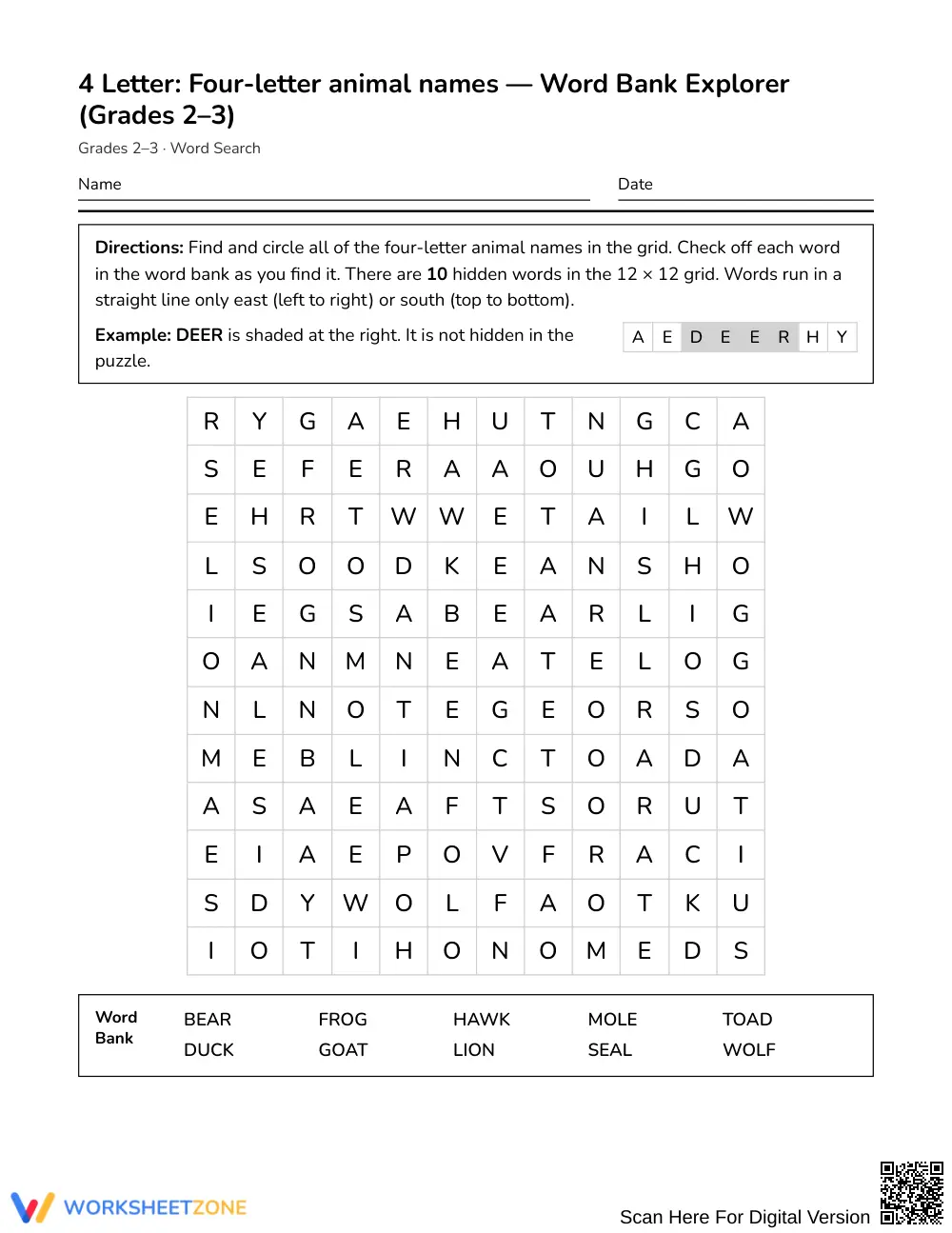
This printable Grades 2–3 word search introduces learners to ten common four-letter animal names through visual scanning and spelling reinforcement. Students locate vocabulary targets in an accessible grid, connecting letter sequences with animal identities. The format strengthens orthographic awareness, pattern recognition, and foundational reading confidence during independent classroom practice.
At a Glance
- Grade: Grades 2–3 · Subject: English Language Arts (ELA)
- Standard: Not standards-assessed — vocabulary enrichment
- Skill Focus: Four-letter animal names orthographic spelling practice
- Format: 1 printable page · 10 hidden words · 2-page answer key included · PDF
- Best For: Independent literacy centers, morning warm-ups, and early finisher activities
- Time: 10–15 minutes of focused practice
This single-page vocabulary printable features a clean 12 by 12 grid containing 10 hidden animal names. An alphabetical word bank lists every target animal alongside concise clues that highlight key physical traits and behaviors. The resource includes a two-page answer key showing full grid solutions with coordinate references for quick grading.
Puzzle Mechanics and Structure
The puzzle layout is structured specifically for early elementary learners:
- Grid Dimensions: A 12 by 12 grid allows comfortable scanning without visual clutter.
- Word Directions: Hidden terms run only East (horizontal) and South (vertical), avoiding backward or diagonal arrangements.
- Word Bank and Clues: An alphabetical bank lists all 10 words—BEAR, DUCK, FROG, GOAT, HAWK, LION, MOLE, SEAL, TOAD, and WOLF—paired with informative animal clues.
Standards Alignment
This worksheet serves as an untimed vocabulary enrichment and spelling exercise rather than a formal standards-based assessment. Because it focuses on orthographic pattern recognition and animal vocabulary, it is not aligned to a specific standard code.
How to Use It
Use this puzzle as an independent literacy station following direct phonics instruction. Learners read clues, identify animal names, and complete the puzzle within 10 to 15 minutes. Alternatively, assign it as a calm morning warm-up before reading groups. While students work, observe whether they scan systematically row by row or search haphazardly, offering prompts to guide methodical scanning habits.
Who It's For
This word search fits Grades 2–3 students strengthening spelling accuracy and print concepts. For emerging readers, read clues aloud or highlight initial letters as targeted scaffolds. For students seeking a challenge, have them write descriptive sentences using each discovered creature. Pair this puzzle with an informational text on animal habitats or a direct phonics lesson on consonant blends.
Word searches focusing on four-letter animal names provide structured orthographic practice that directly supports foundational literacy development for elementary students. According to Fisher & Frey (2014), engaging learners in targeted word-study tasks consolidates letter-sound correspondences and strengthens mental orthographic mapping, which is essential for reading automaticity and fluent decoding. While this activity is designated as an untimed vocabulary enrichment tool rather than a standard-assessed measure, locating words placed horizontally and vertically reinforces systematic visual tracking habits across connected print. Working through structured alphabetical word banks alongside descriptive clues encourages active lexical retrieval and deepens domain-specific science vocabulary in early elementary learners. Teachers utilizing these engaging, low-stakes printables establish meaningful opportunities for purposeful spelling reinforcement and phonics transfer, helping young readers connect written letter sequences to real-world animal concepts efficiently during independent classroom routines.


