


























Views
Downloads

Princess Coloring Page | Essential Kindergarten Art
Paste this activity's link or code into your existing LMS (Google Classroom, Canvas, Teams, Schoology, Moodle, etc.).
Students can open and work on the activity right away, with no student login required.
You'll still be able to track student progress and results from your teacher account.
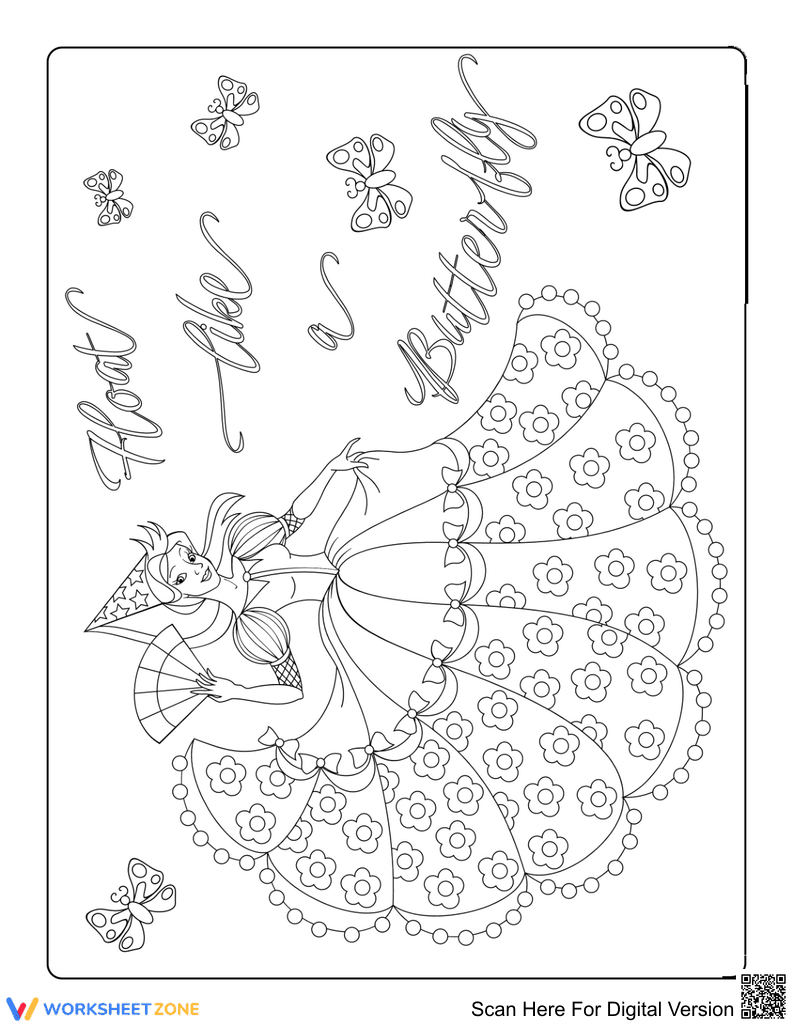
This Kindergarten coloring worksheet provides a high-interest activity that strengthens the essential fine motor skills required for early writing. By focusing on the intricate details of the princess and her butterfly companions, students practice the precision and hand-eye coordination necessary for letter formation. This resource ensures that creative time remains purposeful and aligned with developmental milestones.
At a Glance
- Grade: Kindergarten · Subject: English
- Standard:
CCSS.ELA-LITERACY.L.K.1— Demonstrate command of the conventions of standard English grammar and usage when writing- Skill Focus: Fine motor control and pre-writing readiness
- Format: 1 page · 1 task · Answer key included · PDF
- Best For: Early finishers and morning work routines
- Time: 15–20 minutes
Inside this resource, you will find a single, high-resolution coloring page featuring a princess in a floral gown surrounded by five detailed butterflies. The line art is specifically designed with varying thicknesses to help students practice staying within boundaries. This 1-page PDF is formatted for standard letter paper, ensuring a clean print every time without the need for teacher adjustments.
The zero-prep design of this worksheet ensures it fits into any busy classroom schedule. First, print the single-page PDF in seconds, requiring no complex collation or stapling. Second, distribute the sheets to students during transition periods or as a quiet-time activity; the clear line art requires no verbal instructions, making it an ideal choice for independent work. Finally, review the completed work to observe pencil grip and color boundary awareness, providing immediate feedback on motor precision.
This worksheet is aligned with `CCSS.ELA-LITERACY.L.K.1`, which focuses on the command of English conventions, including the physical act of writing. While primarily an art activity, the development of the pincer grasp and hand strength is a direct prerequisite for the writing component of this standard. This code fits directly into lesson plans or IEP goals.
Use this worksheet during the soft start of the school day to help students settle into a focused mindset. It also serves as an excellent formative assessment tool; observe students as they work to identify those who may need additional support with pencil pressure or grip. Expect students to spend approximately 15 to 20 minutes completing the scene with full color.
This resource is designed for Kindergarten students but is also appropriate for Pre-K learners developing basic motor skills. It is particularly effective for students who benefit from calming, repetitive tasks to regulate their focus. Pair this worksheet with a princess-themed read-aloud or a science lesson on butterfly life cycles for a cross-curricular experience.
The Princess with Butterflies coloring worksheet serves as a foundational tool for developing the fine motor control necessary for early literacy success. According to Fisher & Frey (2014), the development of distal muscle control through coloring and drawing is a critical precursor to formal handwriting instruction. This activity aligns with CCSS.ELA-LITERACY.L.K.1 by encouraging the grip strength and spatial awareness required for letter formation. Research indicates that engaging in creative arts within the English Language Arts block supports cognitive focus and provides a low-stakes environment for students to practice precision. By integrating these visual tasks, educators can bridge the gap between creative expression and the mechanical demands of writing. This resource provides a structured yet open-ended opportunity for Kindergarten students to refine their pincer grasp while interacting with thematic content. It remains a staple for early childhood classrooms seeking to balance academic rigor with motor skill practice.


