


























Views
Downloads
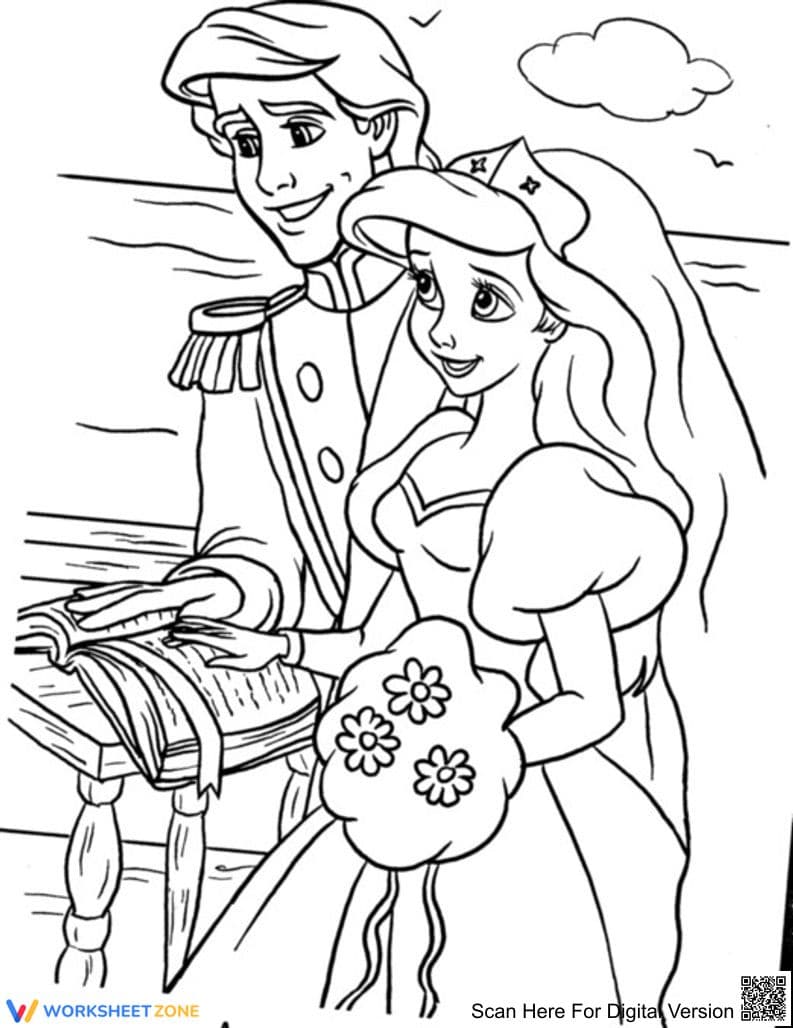

Ariel and Prince Eric Coloring Page | Essential Printable
Paste this activity's link or code into your existing LMS (Google Classroom, Canvas, Teams, Schoology, Moodle, etc.).
Students can open and work on the activity right away, with no student login required.
You'll still be able to track student progress and results from your teacher account.
This Ariel and Prince Eric coloring page provides Kindergarten students with a high-interest activity to strengthen fine motor control and hand-eye coordination. By engaging with familiar characters, learners practice precision and color selection, which are foundational for early writing development. This printable resource ensures immediate student engagement while supporting creative expression in the classroom.
At a Glance
- Grade: Kindergarten · Subject: Arts & Crafts
- Standard:
CCSS.ELA-LITERACY.SL.K.5— Add drawings or visual displays to descriptions to provide additional detail- Skill Focus: Fine motor development
- Format: 1 page · 1 task · Answer key not applicable · PDF
- Best For: Early finisher activity or morning work
- Time: 15–20 minutes
The worksheet features a high-quality line-art illustration of Princess Ariel and Prince Eric in a classic romantic scene. The 1-page PDF includes detailed outlines of the characters, a floral bouquet, and a coastal background. This structure encourages students to focus on staying within lines while allowing for creative color choices across various textures like fabric, hair, and nature.
Zero-Prep Workflow
- Print: Send the single-page PDF to your printer for immediate use (30 seconds).
- Distribute: Provide the sheets to students along with crayons, markers, or colored pencils (1 minute).
- Review: Observe completed work to provide positive reinforcement on grip and boundary awareness (30 seconds).
Total teacher preparation time is under 2 minutes, making this an ideal solution for unexpected schedule changes or sub plans.
Standards Alignment
This activity aligns with `CCSS.ELA-LITERACY.SL.K.5`, which encourages students to use visual displays to enhance their communication and descriptions. While primarily an artistic task, it serves as a bridge to narrative storytelling by allowing students to describe the scene they are coloring. Both standard codes can be copied directly into lesson plans, IEP goals, or district curriculum mapping tools.
How to Use It
Use this worksheet as a calming transition activity after recess or as a rewarding early finisher task for students who complete their primary ELA assignments. During the activity, observe student pencil grip and pressure control to formatively assess fine motor readiness. Most Kindergarten students will complete the detailed coloring within a 15 to 20-minute window.
Who It's For
This resource is ideal for early childhood learners, particularly those in Kindergarten and Grade 1 who are developing the muscular endurance required for sustained writing. It is especially effective for students who benefit from visual-spatial tasks. Pair this coloring page with a read-aloud of The Little Mermaid to integrate literacy and art instruction.
According to research from Fisher & Frey (2014), integrating visual arts into the early childhood curriculum supports the development of representational competence, which is a precursor to formal literacy. Coloring activities specifically target the small muscle groups in the hand, which the RAND AIRS 2024 report identifies as a critical factor in handwriting legibility and speed. By utilizing high-interest characters like Ariel and Eric, educators can increase student time-on-task, a metric strongly correlated with academic growth in early grades. This printable worksheet provides a structured environment for this development, ensuring that students meet the CCSS.ELA-LITERACY.SL.K.5 standard through active, creative participation. The simplicity of the single-page format allows for easy integration into diverse classroom settings without the need for complex instructional scaffolding or extensive teacher intervention.


