




























Views
Downloads
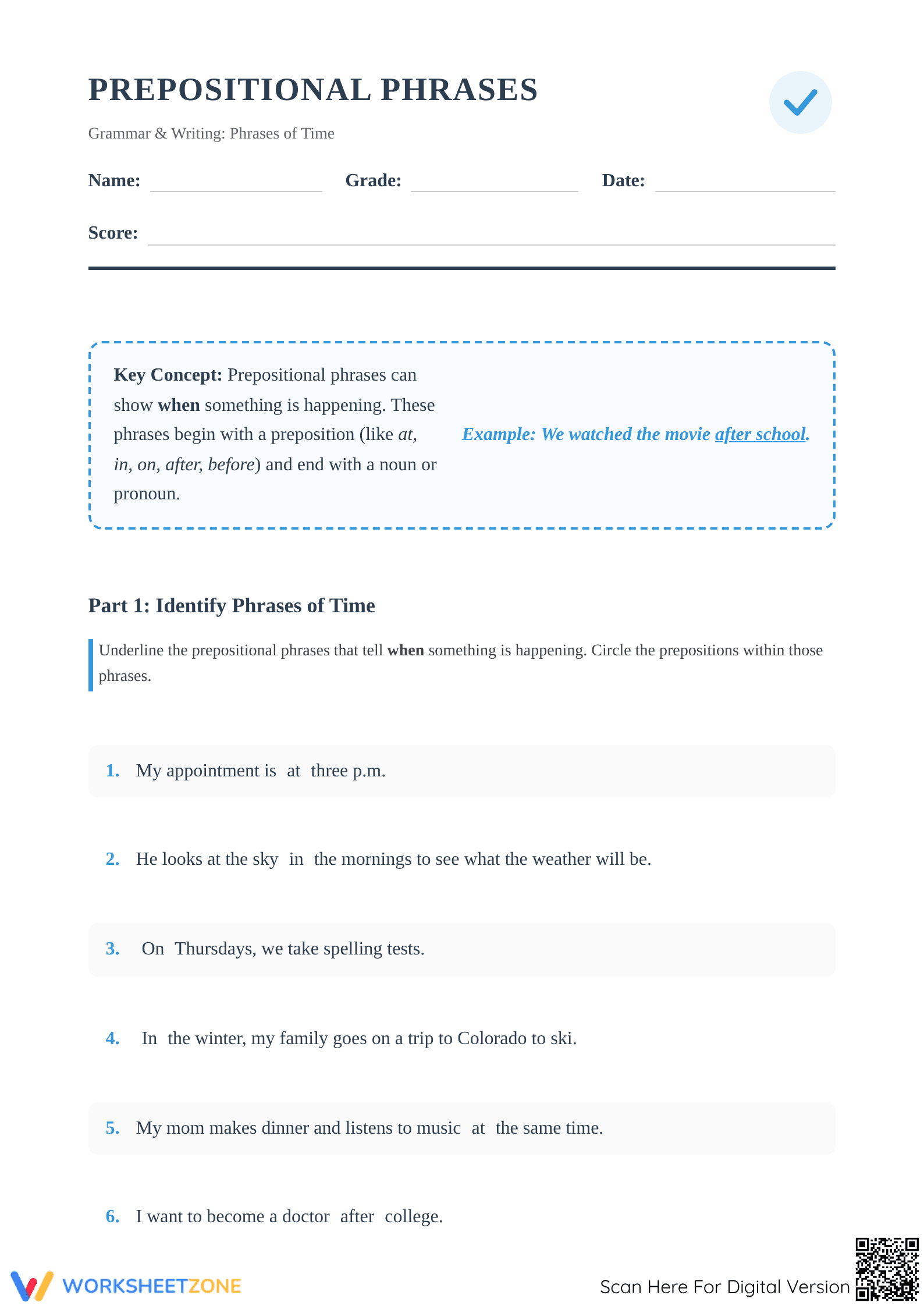


Prepositional Phrases of Time Worksheet | Essential

Paste this activity's link or code into your existing LMS (Google Classroom, Canvas, Teams, Schoology, Moodle, etc.).
Students can open and work on the activity right away, with no student login required.
You'll still be able to track student progress and results from your teacher account.
Strengthen student understanding of temporal relationships with this comprehensive prepositional phrases of time worksheet. Students will learn to identify how specific phrases establish when an action occurs, improving both their reading comprehension and their ability to craft detailed, descriptive sentences. This resource provides a clear path from basic recognition to creative application.
At a Glance
- Grade: 5-7 · Subject: ELA
- Standard:
CCSS.ELA-LITERACY.L.5.1.A— Explain the function of prepositions and their phrases in specific sentences- Skill Focus: Prepositional Phrases of Time
- Format: 3 pages · 15 problems · Answer key included · PDF
- Best For: Grammar reinforcement and sentence structure practice
- Time: 20–30 minutes
What's Inside: This three-page PDF includes a clear instructional header defining the key concept with concrete examples. The worksheet is divided into three distinct sections: a 12-item identification exercise, a contextual reading passage, and a sentence construction segment. A full three-page answer key is provided, mirroring the worksheet layout for rapid grading and immediate student feedback.
Skill Progression
- Guided Practice: The first 12 items focus on discrete identification, requiring students to underline the phrase and circle the preposition in isolated sentences to build foundational recognition.
- Supported Practice: Students transition to a short reading passage where they must locate three temporal phrases in context, bridging the gap between grammar drills and real-world text.
- Independent Practice: The final three tasks require students to synthesize their knowledge by writing original sentences using specific provided phrases like "since last year" and "before breakfast."
This structure follows the I Do, We Do, You Do model to ensure students reach mastery through scaffolded complexity.
Standards Alignment
This resource aligns primarily with `CCSS.ELA-LITERACY.L.5.1.A`, which requires students to explain the function of prepositions and their phrases in general and in particular sentences. It also supports `CCSS.ELA-LITERACY.L.7.1.A` by helping students recognize the function of phrases within more complex sentence structures. Both standard codes can be copied directly into lesson plans, IEP goals, or district curriculum mapping tools.
How to Use It
Use this worksheet as a formative assessment following a direct instruction lesson on prepositional phrases. It works effectively as a quiet independent practice activity or a structured homework assignment. Teachers should observe Part 2 closely; if students struggle to find phrases within the paragraph, it indicates a need for more work on identifying phrase boundaries. Expect completion within 20 to 30 minutes.
Who It's For
This practice set is designed for Grade 5, 6, and 7 students who are refining their grammar and mechanics. It is particularly useful for ESL/ELL students who need explicit practice with temporal prepositions. This resource pairs naturally with a mentor text analysis or a lesson on adding sensory and chronological details to narrative writing.
This instructional resource targets CCSS.ELA-LITERACY.L.5.1.A by focusing on the identification and application of prepositional phrases of time. By isolating temporal prepositions such as 'after,' 'before,' and 'during,' students develop a more sophisticated understanding of how sentence modifiers establish chronological context. According to Fisher & Frey (2014), the gradual release of responsibility model—moving from discrete identification to contextual reading and finally to independent sentence construction—is vital for linguistic mastery. This worksheet follows that exact pedagogical trajectory, ensuring students do not just memorize parts of speech but apply them to improve their own writing clarity. The inclusion of a reading passage allows for the observation of grammar in a naturalistic setting, while the final writing prompts require higher-order synthesis. Educators can utilize this tool to bridge the gap between basic grammar drills and complex composition, providing a measurable pathway toward meeting middle school language standards and improving overall literacy outcomes.


