


























Views
Downloads


Essential Prefixes Practice Worksheet | Grade 4 ELA
Paste this activity's link or code into your existing LMS (Google Classroom, Canvas, Teams, Schoology, Moodle, etc.).
Students can open and work on the activity right away, with no student login required.
You'll still be able to track student progress and results from your teacher account.
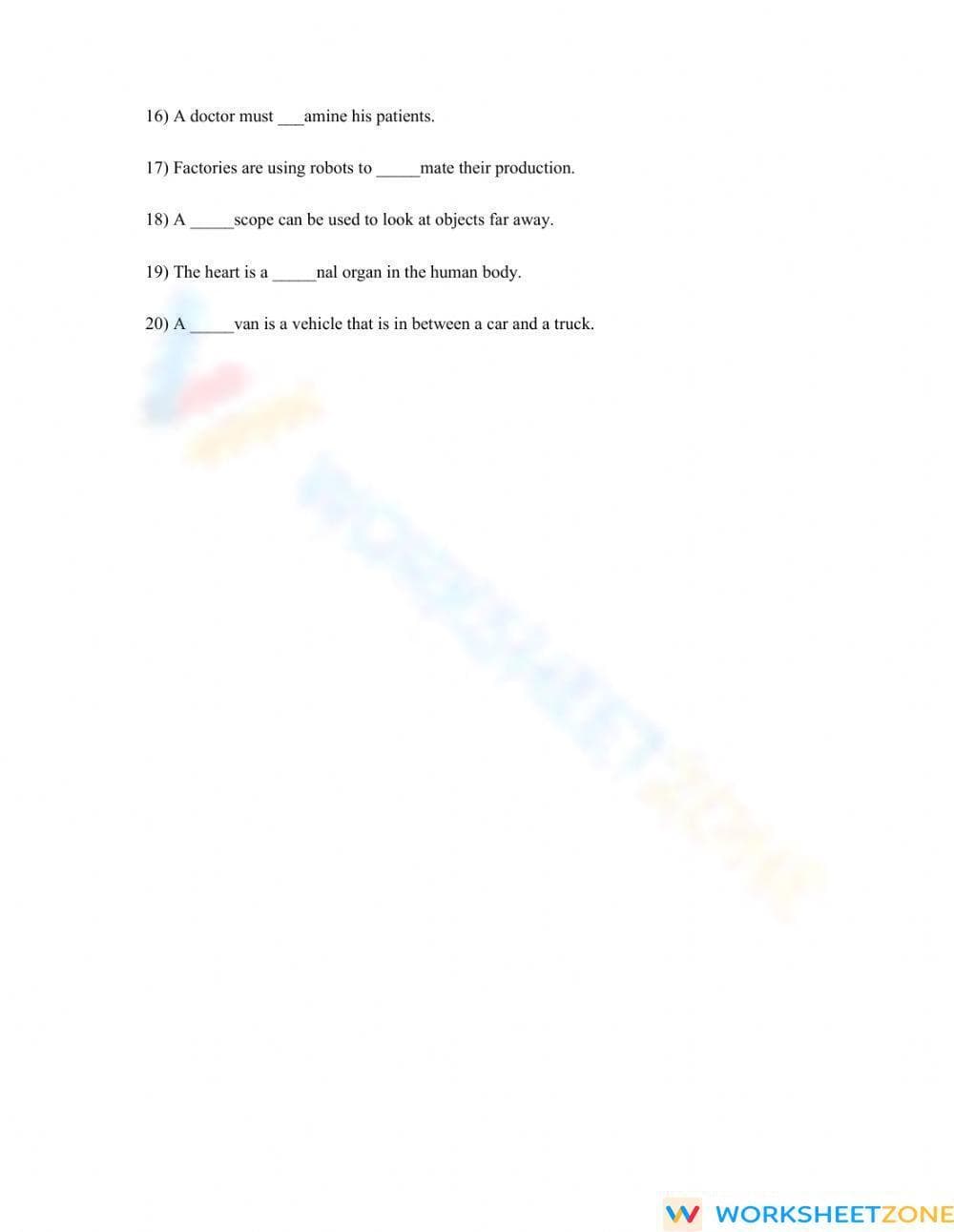
This Grade 4 ELA worksheet provides targeted practice for students to master common prefixes through sentence-level application. By selecting the correct prefix from a curated bank—including auto-, tele-, and trans-—students develop a deep understanding of how affixes modify root meanings, improving vocabulary acquisition and reading comprehension skills across all subjects.
At a Glance
- Grade: 4 · Subject: English Language Arts (ELA)
- Standard:
CCSS.ELA-LITERACY.L.4.4.B— Use common grade-appropriate Greek and Latin affixes and roots as clues to word meaning- Skill Focus: Prefix Identification and Sentence Application
- Format: 2 pages · 20 problems · Answer key included · PDF
- Best For: Vocabulary centers and independent grammar practice
- Time: 15–25 minutes
What's Inside
This two-page PDF resource features 20 carefully crafted sentences requiring students to apply ten essential prefixes: en-, uni-, trans-, micro-, super-, ex-, tele-, auto-, inter-, and mini-. The layout includes a clear word bank for student reference, ensuring they focus on semantic selection rather than spelling recall. A full answer key is provided for rapid grading.
Skill Progression
- Guided Practice: Sentences use high-frequency prefixes like "uni-" and "auto-", accompanied by clear contextual clues to build confidence.
- Supported Practice: Middle-tier tasks introduce "trans-" and "inter-", requiring students to synthesize sentence meaning before selecting the appropriate affix.
- Independent Practice: Final tasks challenge students to distinguish between technical prefixes (e.g., "micro-" vs "mini-") in complex contexts.
This gradual-release approach moves students from recognition to application using the I Do, We Do, You Do instructional framework.
Standards Alignment
This resource is explicitly aligned to `CCSS.ELA-LITERACY.L.4.4.B`, which requires students to use common, grade-appropriate Greek and Latin affixes and roots as clues to the meaning of a word. By focusing on prefixes like "tele-", "auto-", and "micro-", students practice specific linguistic skills prioritized for intermediate learners. Both standard codes can be copied directly into lesson plans or IEP goals.
How to Use It
Use this worksheet as a summative assessment after a direct instruction lesson on Greek and Latin affixes. It serves as an excellent independent practice activity to verify that students can apply prefix rules in varied contexts. While students work, observe if they are referring to the word bank or solving from memory; those who struggle may need more modeling of word-part analysis.
Who It's For
This worksheet is designed for general education Grade 4 students, but is also effective for Grade 3 enrichment or Grade 5 intervention. It pairs perfectly with an anchor chart displaying prefix definitions (e.g., "tele" = far) to provide visual support for English Language Learners and students with IEP goals.
The mastery of affixes is a critical component of morphological awareness, which research by Fisher & Frey (2014) identifies as a primary driver of academic vocabulary growth in upper elementary grades. By practicing the CCSS.ELA-LITERACY.L.4.4.B standard through 20 structured sentence tasks, students build the cognitive pathways necessary to decode unfamiliar multisyllabic words they will encounter in complex informational texts. Morphological instruction that moves beyond rote memorization to contextual application—as seen in this prefix-focused resource—has been shown to significantly improve reading comprehension scores in NAEP longitudinal studies. This worksheet provides the supported practice phase of the gradual release of responsibility model, ensuring that learners bridge the gap between modeling and independent proficiency. It is an essential tool for any literacy block aiming to meet rigorous standards for ELA vocabulary development.


