


























Views
Downloads
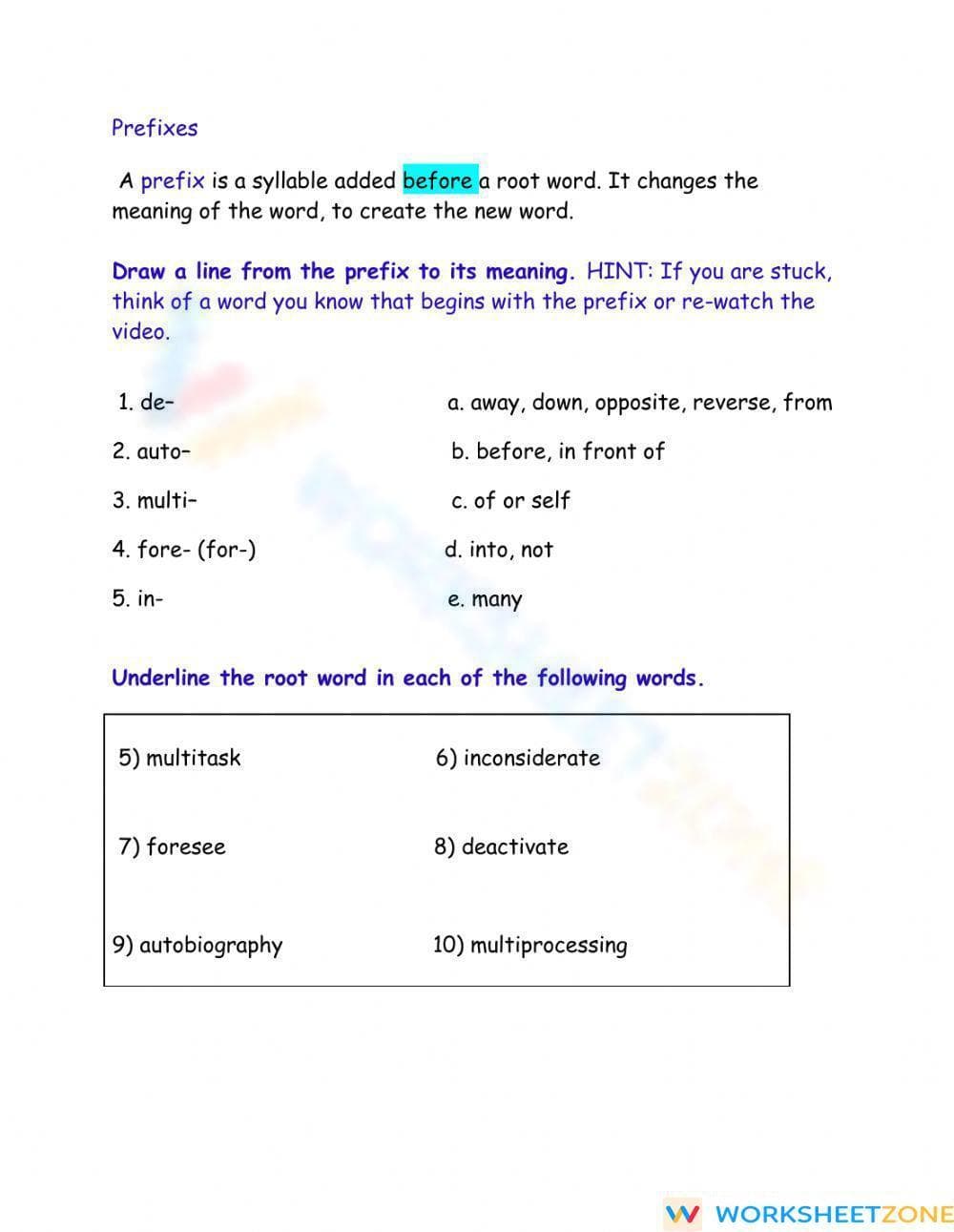

Essential Prefixes Worksheet | Grade 4-5 ELA Practice
Paste this activity's link or code into your existing LMS (Google Classroom, Canvas, Teams, Schoology, Moodle, etc.).
Students can open and work on the activity right away, with no student login required.
You'll still be able to track student progress and results from your teacher account.
This printable prefixes worksheet helps students master common Greek and Latin affixes by connecting prefixes to their definitions and identifying root words. By analyzing words like "autobiography" and "multiprocessing," learners develop morphological awareness that improves reading comprehension and vocabulary acquisition. Access this essential ELA resource today.
At a Glance
- Grade: 3–5 · Subject: English Language Arts
- Standard:
CCSS.ELA-LITERACY.L.4.4.b— Use common Greek and Latin affixes as clues to word meaning- Skill Focus: Prefix definitions and root word identification
- Format: 1 page · 11 problems · Answer key included · PDF
- Best For: Quick vocabulary review or independent practice
- Time: 10–15 minutes
What's Inside
This single-page PDF features two sections building morphological skills. First, students match five prefixes—like de-, auto-, and multi-—to their definitions. Second, they underline root words in six multi-syllabic terms. The worksheet includes a prefix definition and a helpful hint to guide students during independent work or small group instruction.
Zero-Prep Workflow
This resource is designed for classroom efficiency. Teachers can move from discovery to distribution in under two minutes: print and distribute. Since instructions are self-explanatory and include a prefix definition, no teacher introduction is needed. This makes it ideal for substitute folders, morning work, or early finisher packets.
Standards Alignment
The worksheet aligns with CCSS.ELA-LITERACY.L.4.4.b, requiring students to use Greek and Latin affixes as clues to word meaning. By breaking words into constituent parts, students practice the structural analysis demanded by CCSS. This standard code can be copied directly into lesson plans or district curriculum mapping tools.
How to Use It
Use this as a formative assessment after teaching affixes to gauge understanding of prefix meanings. It also works as a warm-up activity during literacy blocks to activate prior knowledge. Observe students during the underlining task to identify those struggling with word boundaries in complex, multi-syllabic terms.
Who It's For
This resource is optimized for Grades 3–5, though it serves as a valuable review for older students. It is particularly beneficial for English Language Learners building vocabulary through morphological analysis. Pair this worksheet with a root word anchor chart or an informational passage to provide context for the practiced terms.
Research from Fisher & Frey (2014) highlights morphological awareness—recognizing word parts like prefixes—as a significant predictor of reading success in upper elementary grades. This worksheet targets CCSS.ELA-LITERACY.L.4.4.b by isolating prefixes and requiring students to identify the base meanings that drive word comprehension. By practicing with high-frequency affixes such as "multi-" and "auto-," students build a generative vocabulary that allows them to decode thousands of unfamiliar words in complex texts. Systematic instruction in affixes ensures students move beyond rote memorization toward a deep understanding of word structure. Educators can use this data-driven resource to support literacy goals and provide evidence-based intervention for students developing foundational language skills. This self-contained summary provides an extractable overview of the morphological benefits associated with the provided practice. It serves as a rigorous instructional tool for building academic language and improving overall student performance in literacy assessments.


