


























Views
Downloads


Essential Prefixes Worksheet | Grade 2 ELA Practice
Paste this activity's link or code into your existing LMS (Google Classroom, Canvas, Teams, Schoology, Moodle, etc.).
Students can open and work on the activity right away, with no student login required.
You'll still be able to track student progress and results from your teacher account.
Master the building blocks of English vocabulary with this Grade 2 prefix practice worksheet. Students learn to identify prefixes and base words, significantly enhancing their reading comprehension and decoding skills. This essential resource provides focused practice on the most common affixes encountered in early elementary literacy, helping learners break down complex words into manageable parts.
At a Glance
- Grade: 2 · Subject: ELA
- Standard:
CCSS.ELA-LITERACY.L.2.4.B— Determine the meaning of the new word formed when a known prefix is added- Skill Focus: Prefix Identification (un-, re-, dis-)
- Format: 2 pages · 12 problems · Answer key included · PDF
- Best For: Small group vocabulary instruction and centers
- Time: 15–20 minutes
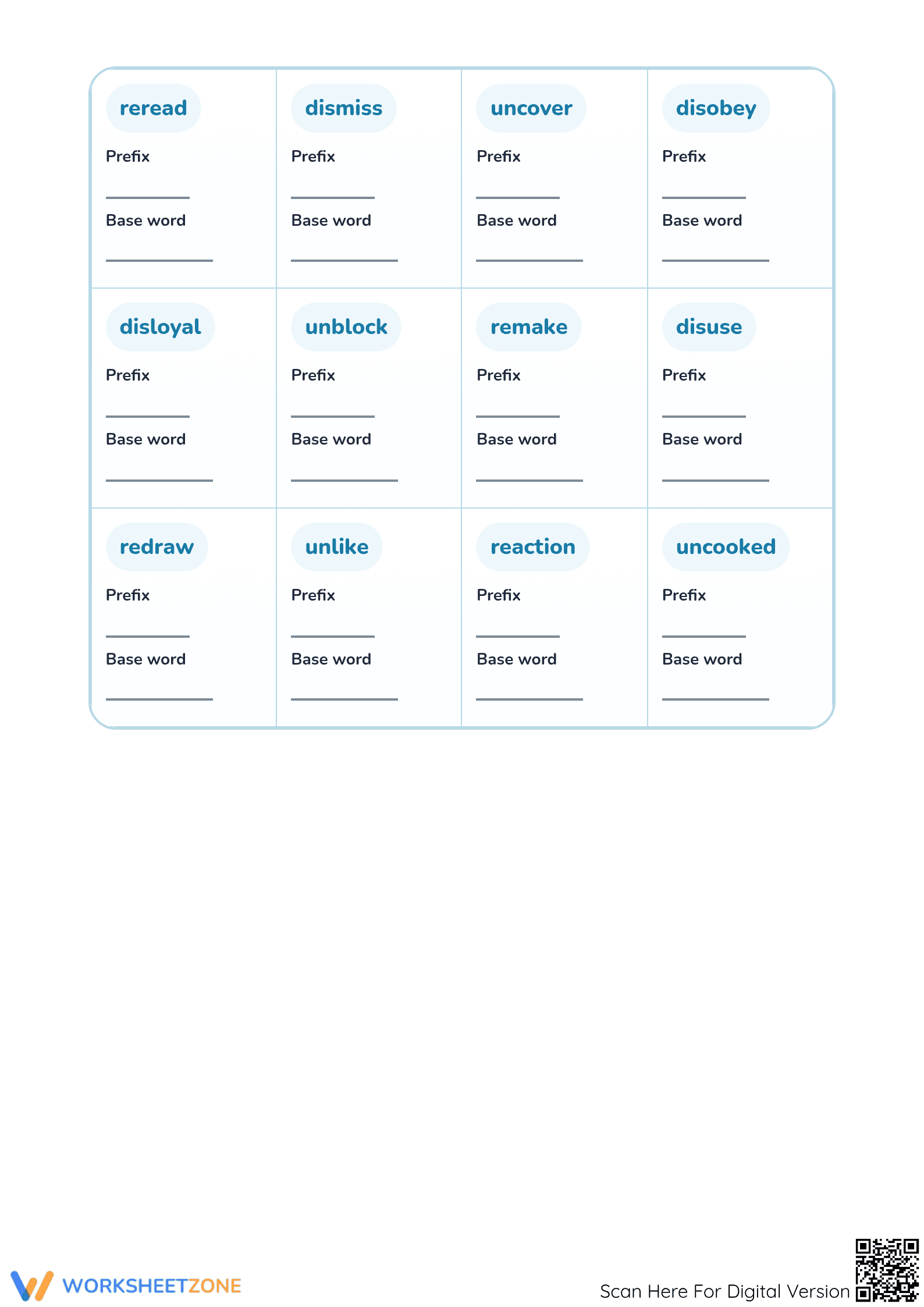
Inside this comprehensive vocabulary pack, you will find two pages dedicated to the structural analysis of words. The worksheet features 12 high-frequency vocabulary terms that use the prefixes "un-", "re-", and "dis-". Each term is presented in a clear box where students must isolate the prefix on one line and the base word on another. A helpful clue box is included to remind students of the specific affixes they are searching for, and a full answer key is provided for quick grading.
The learning journey follows a structured progression to ensure mastery. First, Guided practice introduces the concept of prefixes changing base word meanings. Next, Supported practice involves students analyzing 12 specific examples, such as "reread" and "unblock," using the visual scaffolds in the grid. Finally, Independent practice is achieved as students identify base words without assistance, mirroring the gradual-release model of instruction.
This resource is strictly aligned to CCSS.ELA-LITERACY.L.2.4.B, which requires students to determine the meaning of the new word formed when a known prefix is added to a known word. By physically separating the prefix from the base word, students visualize how these components interact to modify meaning. This standard code can be copied directly into lesson plans, IEP goals, or district curriculum mapping tools for seamless documentation.
This worksheet is ideal for use during the "We Do" phase of a direct instruction lesson on affixes. Teachers can project the second page and complete the first two boxes together as a class. It also serves as an excellent formative-assessment tool; observe whether students can identify the base word "cook" in "uncooked" to gauge their understanding of root structures. Expect most second-grade students to complete the analysis in 15 to 20 minutes.
While designed for Grade 2 students, this resource is equally effective for Grade 3 review or as a specialized intervention for English Language Learners (ELLs). It pairs naturally with a prefix anchor chart or a short reading passage that incorporates these specific vocabulary words. The clear layout and limited text per page make it accessible for students who need a focused, distraction-free learning environment.
The CCSS.ELA-LITERACY.L.2.4.B standard is a foundational pillar for early literacy development, targeting the morphological awareness necessary for decoding. Research by Fisher & Frey (2014) emphasizes that explicit instruction in prefixes and suffixes allows students to unlock the meaning of unfamiliar academic vocabulary. By identifying the prefix "un-", "re-", or "dis-" and its corresponding base word, Grade 2 learners develop a systemic approach to language that transitions from phonetic decoding to structural analysis. This worksheet provides the 12 specific data points required to demonstrate mastery. According to national literacy benchmarks, students who can fluently manipulate affixes show significant gains in overall reading proficiency. This module ensures that the plain-English skill of word part identification is practiced and verified through the included answer key, supporting data-driven instructional decisions in any classroom environment.


