


























Views
Downloads


Kindergarten Shapes Worksheet | Printable Essential Math
Paste this activity's link or code into your existing LMS (Google Classroom, Canvas, Teams, Schoology, Moodle, etc.).
Students can open and work on the activity right away, with no student login required.
You'll still be able to track student progress and results from your teacher account.
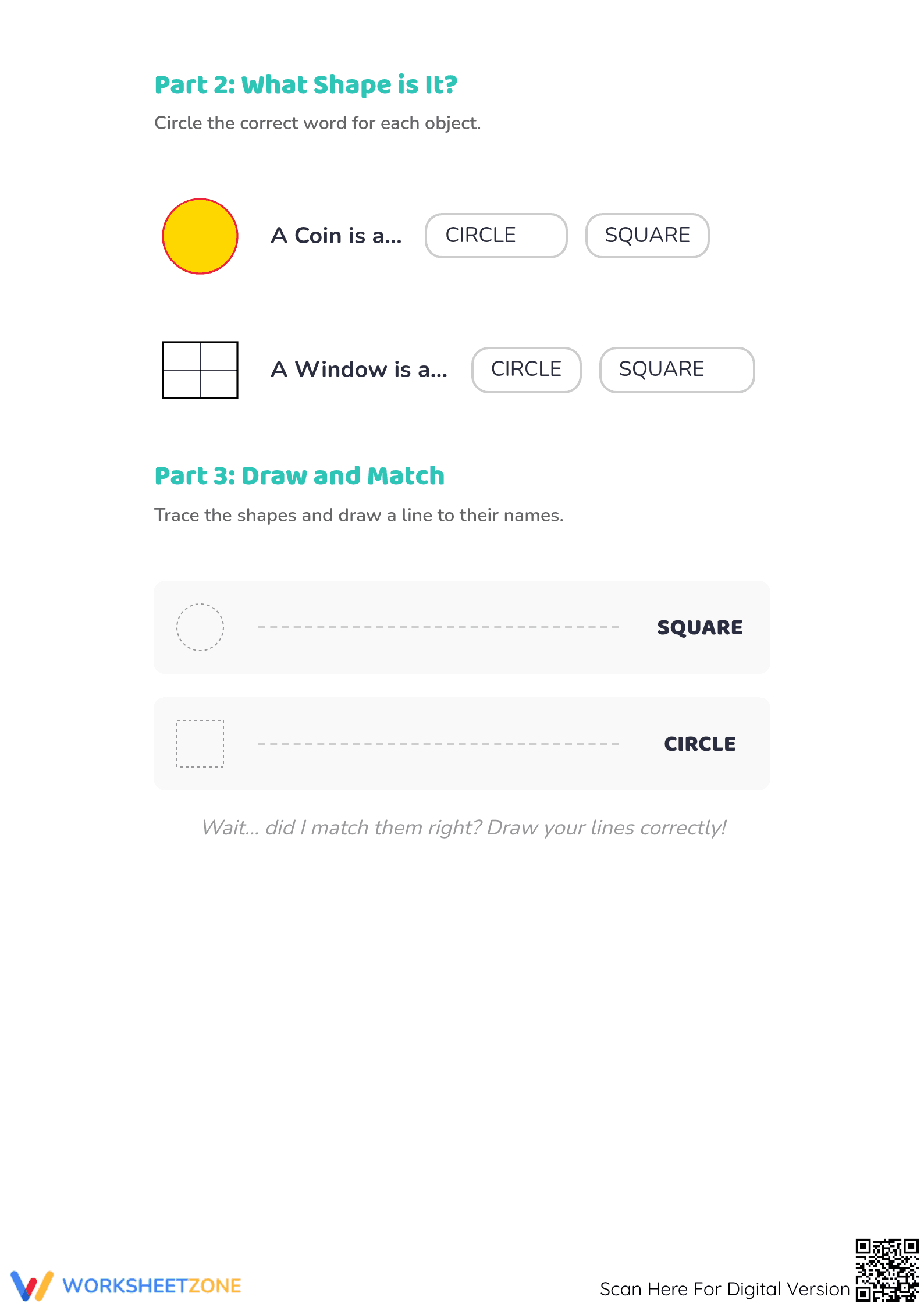
This Grade K shapes worksheet helps early learners master the foundational skill of geometry by identifying circles and squares in real-world contexts. By connecting abstract geometric concepts to familiar objects like clocks and gifts, students build strong visual discrimination skills and spatial awareness, ensuring a smooth transition into more complex mathematical reasoning and shape properties.
At a Glance
- Grade: Kindergarten · Subject: Math
- Standard:
CCSS.MATH.CONTENT.K.G.A.2— Correctly name shapes regardless of their orientations or overall size- Skill Focus: Identifying circles and squares in objects
- Format: 3 pages · 24 problems · Answer key included · PDF
- Best For: Early finishers and geometry math centers
- Time: 15–20 minutes
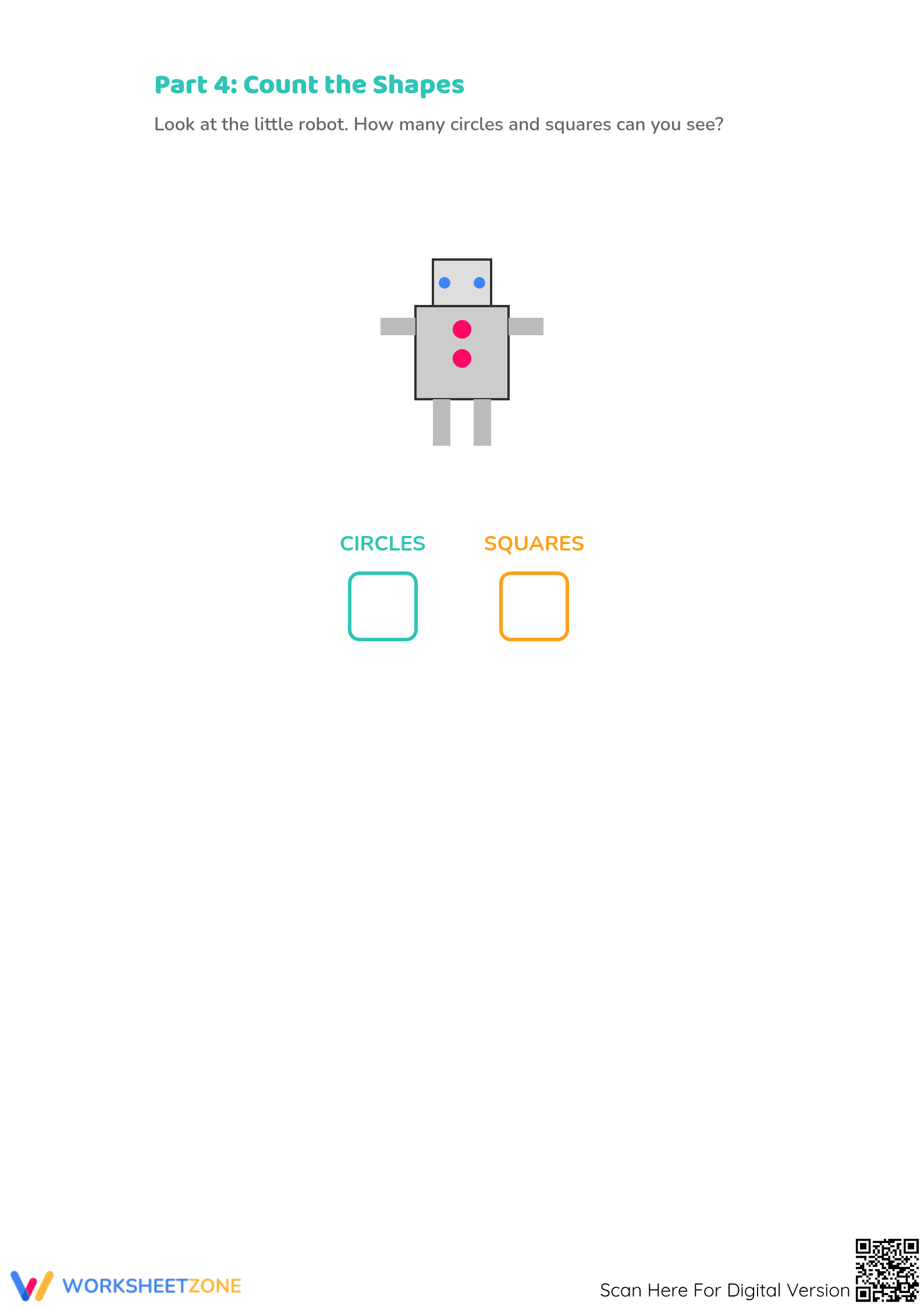
Inside this high-quality PDF resource, you will find three structured pages dedicated to shape identification. Each page features 8 distinct, recognizable illustrations of everyday items, ranging from household furniture to common foods. The layout is clean and uncluttered, providing ample space for small hands to write or mark their answers. A comprehensive answer key is provided to facilitate rapid grading and student self-correction.
The zero-prep workflow for this resource is designed to save valuable instructional time. First, print the three-page set for your class (30 seconds). Second, distribute the worksheets during your geometry block or as a morning warm-up activity (1 minute). Third, review the answers as a whole group using the provided key to reinforce vocabulary and clarify any misconceptions (5 minutes). Total teacher preparation time remains under two minutes, making it ideal for busy classrooms or unexpected sub plans.
This worksheet is directly aligned to K.G.A.2, which requires students to correctly name shapes such as circles and squares regardless of their orientation. By presenting objects like a tilted stamp or a rotated gift box, the tasks push students beyond simple rote memorization toward genuine conceptual mastery. Both standard codes can be copied directly into lesson plans, IEP goals, or district curriculum mapping tools.
For maximum impact, use this worksheet as a formative assessment after an initial lesson on two-dimensional shapes. As students work, circulate and observe if they are confusing the rounded edges of a donut with the straight lines of a chess board. Alternatively, place these pages in a laminated sleeve within a math center, allowing students to use dry-erase markers for repeated, low-stakes practice during independent work stations.
This resource is specifically crafted for Preschool and Kindergarten students who are beginning their journey into geometry. It provides necessary scaffolding through clear visual cues, making it accessible for English Language Learners and students with processing needs. This worksheet pairs naturally with a hands-on "shape hunt" around the classroom or a teacher-led read-aloud of a geometry-themed picture book to solidify learning.
The integration of real-world imagery in early geometry instruction is supported by the ScienceDirect TpT Analysis, which highlights how contextualized practice increases engagement and retention in primary students. This worksheet effectively bridges the gap between concrete observation and abstract geometric classification, a critical step in the development of spatial reasoning skills. By focusing on circles and squares, the 24 individual tasks provide the repetitive exposure needed to move shape recognition into long-term memory. Aligned to K.G.A.2, the resource ensures that students can identify these fundamental shapes in various sizes and orientations, meeting rigorous national standards. Educational research consistently shows that when students can connect math to their daily lives, their confidence and performance in STEM subjects improve significantly. This 3-page set provides a structured, evidence-based approach to early childhood math that is both practical for teachers and effective for young learners.


