


























0
Views
0
Downloads

0.0
0
Save
0 Likes
Share
Practice Writing a Strong Lead
0 Views
0 Downloads
Paste this activity's link or code into your existing LMS (Google Classroom, Canvas, Teams, Schoology, Moodle, etc.).
Students can open and work on the activity right away, with no student login required.
You'll still be able to track student progress and results from your teacher account.
Information
Description
What It Is:
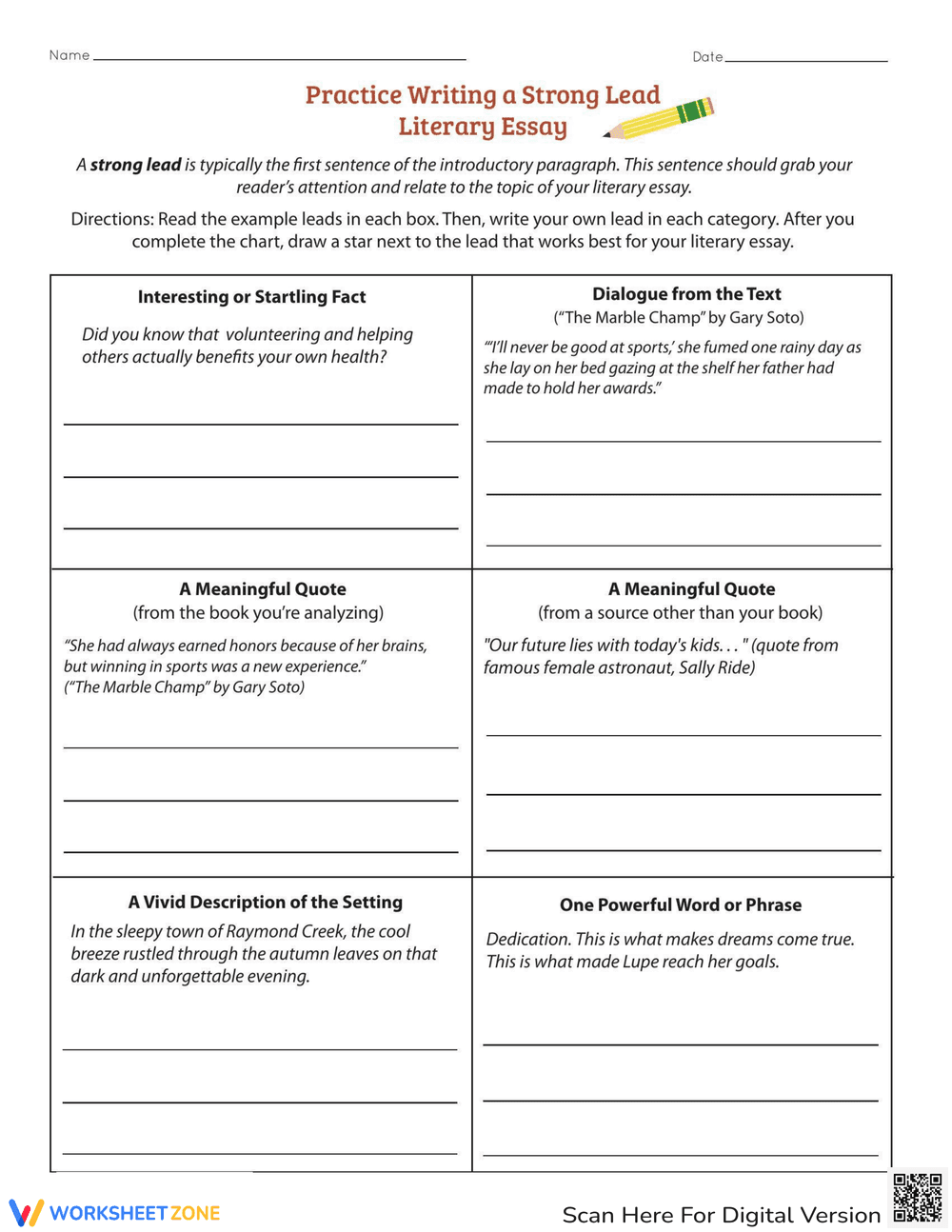
This is an educational worksheet designed to help students practice writing strong leads for literary essays. It provides examples of different types of leads, including an interesting or startling fact, dialogue from the text, meaningful quotes (from the book being analyzed and from another source), a vivid description of the setting, and one powerful word or phrase. Students are instructed to read the examples and then write their own leads in each category.
Grade Level Suitability:
This worksheet is suitable for grades 6-9. The concepts of literary essays and strong leads are typically introduced in middle school, and the examples provided are appropriate for this age range. The activities require critical thinking and writing skills that are developed during these grade levels.
Why Use It:
This worksheet helps students develop their essay writing skills by focusing on the crucial first sentence. It teaches them how to grab the reader's attention and effectively introduce the topic of their essay. By exploring different types of leads, students can learn to vary their writing style and create more engaging essays.
How to Use It:
Students should first read the introductory paragraph explaining the importance of a strong lead. Then, they should carefully read the example leads provided in each box. Next, they should write their own original lead in the blank spaces below each example. Finally, they can draw a star next to the lead they believe is the strongest for their literary essay.
Target Users:
The target users are middle school students (grades 6-9) who are learning how to write literary essays. It is also helpful for teachers looking for resources to teach students how to write effective introductory paragraphs.
This is an educational worksheet designed to help students practice writing strong leads for literary essays. It provides examples of different types of leads, including an interesting or startling fact, dialogue from the text, meaningful quotes (from the book being analyzed and from another source), a vivid description of the setting, and one powerful word or phrase. Students are instructed to read the examples and then write their own leads in each category.
Grade Level Suitability:
This worksheet is suitable for grades 6-9. The concepts of literary essays and strong leads are typically introduced in middle school, and the examples provided are appropriate for this age range. The activities require critical thinking and writing skills that are developed during these grade levels.
Why Use It:
This worksheet helps students develop their essay writing skills by focusing on the crucial first sentence. It teaches them how to grab the reader's attention and effectively introduce the topic of their essay. By exploring different types of leads, students can learn to vary their writing style and create more engaging essays.
How to Use It:
Students should first read the introductory paragraph explaining the importance of a strong lead. Then, they should carefully read the example leads provided in each box. Next, they should write their own original lead in the blank spaces below each example. Finally, they can draw a star next to the lead they believe is the strongest for their literary essay.
Target Users:
The target users are middle school students (grades 6-9) who are learning how to write literary essays. It is also helpful for teachers looking for resources to teach students how to write effective introductory paragraphs.


