


























Views
Downloads
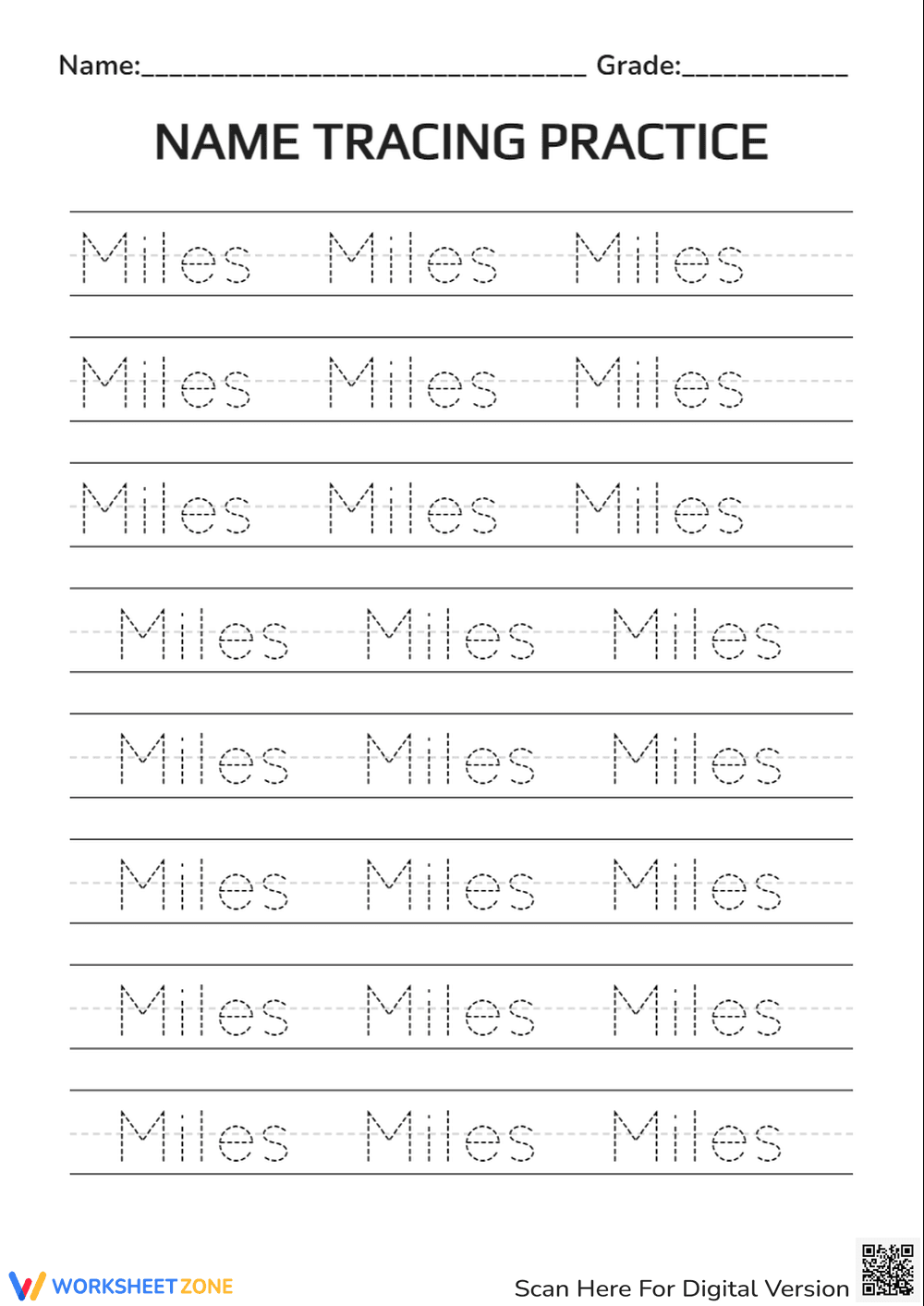

"Miles" Name Tracing Worksheet | Grade K-1 Printable
Paste this activity's link or code into your existing LMS (Google Classroom, Canvas, Teams, Schoology, Moodle, etc.).
Students can open and work on the activity right away, with no student login required.
You'll still be able to track student progress and results from your teacher account.
This Grade K-1 name tracing worksheet helps students master the specific letter formations required to write the name "Miles." By providing repetitive, guided practice, students build the muscle memory and fine motor control necessary for legible handwriting. This resource ensures young learners gain confidence in recognizing and writing their own name independently.
At a Glance
- Grade: K-1 · Subject: Handwriting
- Standard:
CCSS.ELA-LITERACY.L.K.1.A— Print many upper- and lowercase letters accurately- Skill Focus: Name recognition and letter formation
- Format: 1 page · 24 problems · Answer key N/A · PDF
- Best For: Morning work or daily handwriting practice
- Time: 5–10 minutes
This single-page PDF features 24 individual tracing opportunities for the name "Miles." The layout consists of eight horizontal rows, each containing three dashed-line versions of the name. The clear, large font is specifically designed for early childhood learners, providing ample space for small hands to follow the paths of each letter from the capital 'M' through the lowercase 's'.
The workflow for this resource is designed for maximum efficiency in busy classrooms. First, print the required number of copies in approximately 30 seconds. Next, distribute the sheets during morning arrival or transition periods, taking about 1 minute. Finally, review student progress by checking for proper pencil grip and stroke direction as they work. Total teacher preparation time is under 2 minutes, making it an ideal sub-plan filler.
This worksheet aligns with `CCSS.ELA-LITERACY.L.K.1.A`, which requires students to print many upper- and lowercase letters. By focusing on a specific name, it also supports foundational literacy and self-identification skills. This standard code can be copied directly into lesson plans, IEP goals, or district curriculum mapping tools.
Use this worksheet during the "settling in" period at the start of the school day to establish a calm routine. It also serves as an effective formative assessment tool; observe whether the student starts letters from the top or bottom to identify who needs additional direct instruction. Expected completion time for a young learner is between 5 and 10 minutes.
This resource is tailored for Kindergarten and First Grade students, particularly those named Miles or those learning specific letter combinations. It is excellent for students requiring Tier 1 fine motor support. Pair this with a tactile sand tray or a name-based anchor chart for a multi-sensory learning experience.
According to the RAND AIRS 2024 report, repetitive tracing exercises are fundamental in developing the graphomotor skills required for early literacy success. This worksheet targets CCSS.ELA-LITERACY.L.K.1.A by providing 24 structured opportunities for students to practice the specific strokes involved in the name "Miles." Research indicates that name-writing is often the first successful literacy act for a child, serving as a bridge to broader alphabet knowledge. By utilizing a dashed-line scaffold, this resource reduces cognitive load, allowing the learner to focus entirely on precision and control. Educators can use this tool to track progress in letter slant, spacing, and size consistency over time. The clear, distraction-free layout ensures that students remain focused on the task, facilitating the transition from guided tracing to independent writing. This evidence-based approach supports the development of automaticity in handwriting, which is a critical precursor to fluent written expression in later elementary grades.


