


























Views
Plays
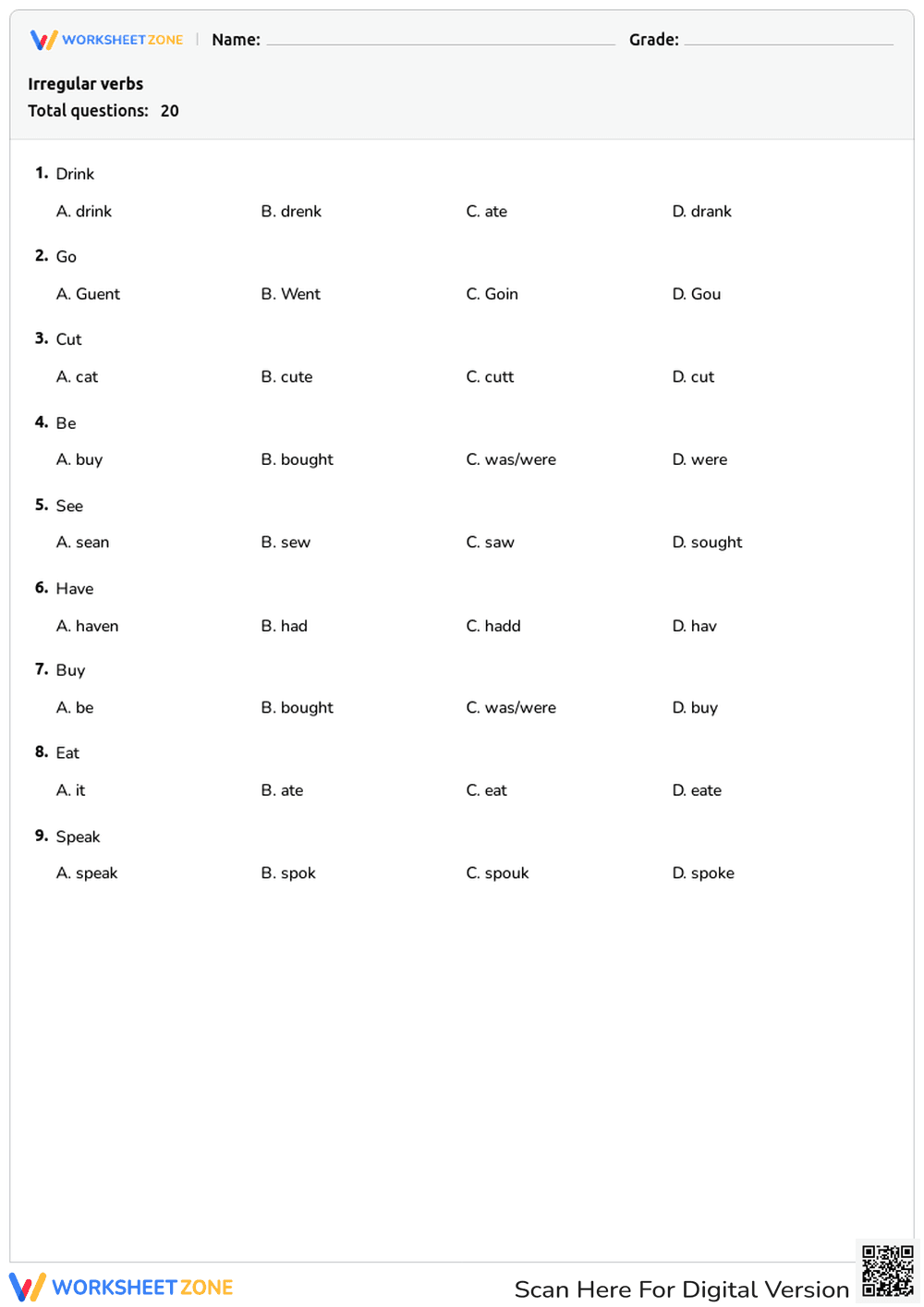
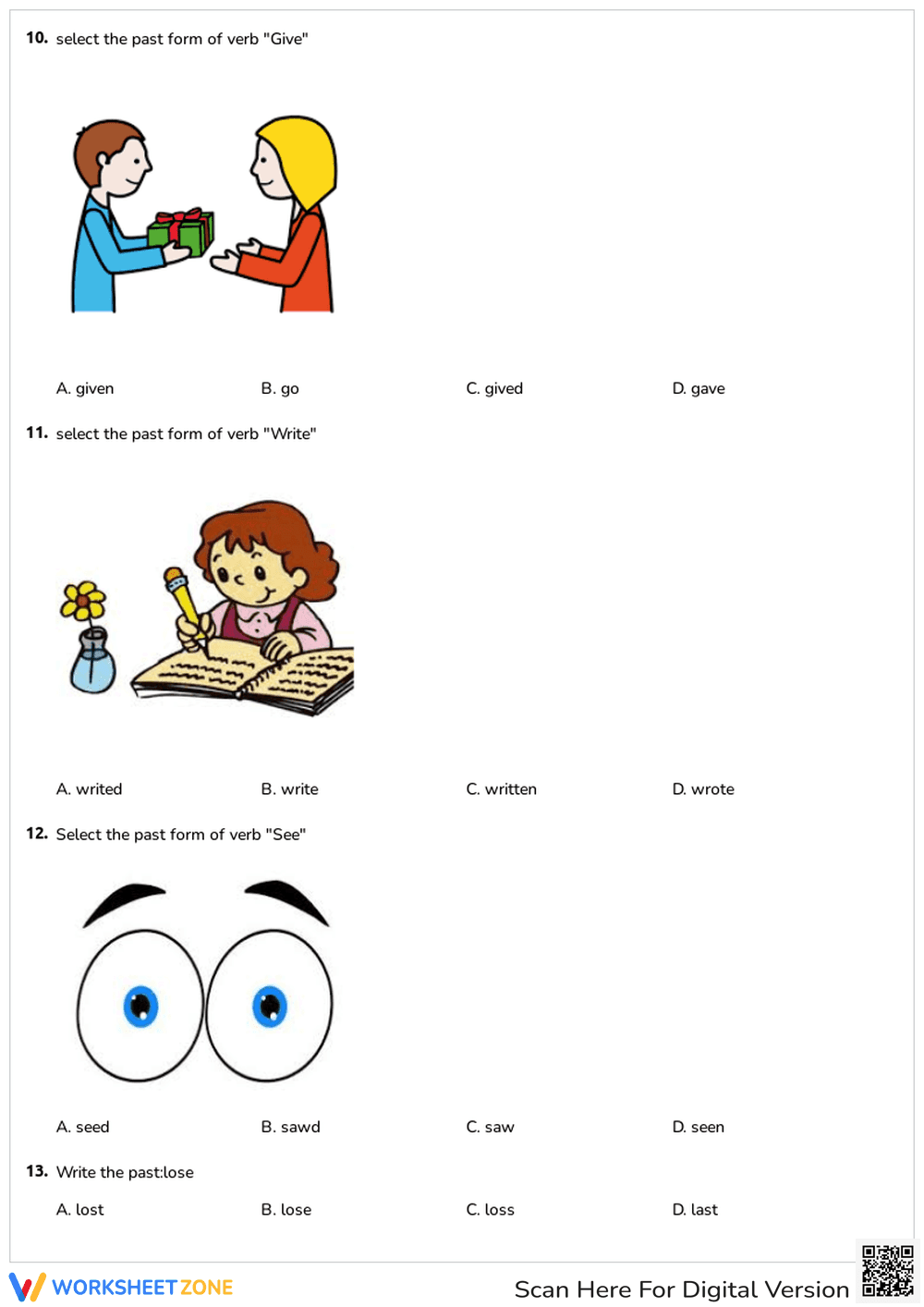


Printable Irregular Verbs Quiz | Grades 3-4 ELA
Paste this activity's link or code into your existing LMS (Google Classroom, Canvas, Teams, Schoology, Moodle, etc.).
Students can open and work on the activity right away, with no student login required.
You'll still be able to track student progress and results from your teacher account.
This ready-to-use worksheet helps students master irregular past tense verbs through targeted multiple-choice practice. By identifying the correct verb forms in various contexts, learners strengthen their foundational grammar skills and improve their overall writing fluency.
At a Glance
- Grade: 3–4 · Subject: ELA
- Standard:
CCSS.ELA-LITERACY.L.3.1.D— Form and use irregular verbs accurately- Skill Focus: Irregular Verbs
- Format: 3 pages · 20 problems · Answer key included · PDF
- Best For: Independent practice and assessment
- Time: 15–20 minutes
This comprehensive resource features a 20-question multiple-choice quiz spread across three pages. Students are tasked with selecting the correct past tense form of common irregular verbs, such as "drink," "go," "see," and "write." Several questions include helpful visual cues to support comprehension and keep young learners engaged. A complete answer key is provided to ensure quick and accurate grading.
Zero-Prep Workflow
This worksheet is designed for maximum efficiency, requiring under two minutes of teacher preparation:
- Print (1 minute): Simply download the PDF and print the three-page student packet.
- Distribute (1 minute): Hand out the quiz to students as a standalone assignment or assessment.
- Review (Ongoing): Use the included answer key to quickly evaluate student mastery or facilitate a whole-class review session.
Because the instructions are straightforward and self-explanatory, this resource is highly suitable for emergency sub plans or independent literacy centers.
Standards Alignment
This worksheet is directly aligned to CCSS.ELA-LITERACY.L.3.1.D, requiring students to form and use regular and irregular verbs. It also supports broader language conventions by reinforcing spelling patterns and vocabulary acquisition. Both standard codes can be copied directly into lesson plans, IEP goals, or district curriculum mapping tools.
How to Use It
Formative Assessment: Administer this 20-question quiz after direct instruction on irregular verbs to gauge student understanding. As students work, observe whether they are relying on phonetic spelling (e.g., choosing "writed" instead of "wrote") to identify areas needing reteaching.
Literacy Centers: Place copies of this worksheet in a grammar station for independent practice. Students can complete the assignment in 15 to 20 minutes, allowing the teacher to focus on small-group guided reading instruction.
Who It's For
This resource is primarily designed for third and fourth-grade students developing their foundational grammar skills. It is also an excellent remediation tool for older students who struggle with verb tense consistency. For optimal results, pair this worksheet with an anchor chart displaying common irregular verb transformations to provide scaffolding for English Language Learners or students needing extra support.
Mastering irregular verb forms is a critical component of early literacy and language development. According to Fisher & Frey (2014), explicit grammar instruction combined with targeted, independent practice significantly improves students' ability to apply standard English conventions in their own writing. This worksheet directly supports CCSS.ELA-LITERACY.L.3.1.D by requiring students to form and use irregular verbs accurately. By transitioning from recognizing correct forms in a multiple-choice format to applying them independently, learners build the automaticity necessary for fluent reading and writing. Providing structured opportunities to practice these specific linguistic patterns helps reduce common overgeneralization errors, such as adding "-ed" to irregular bases. This targeted approach ensures that students develop the robust vocabulary and grammatical precision required for academic success across all subject areas.


