


























Views
Downloads
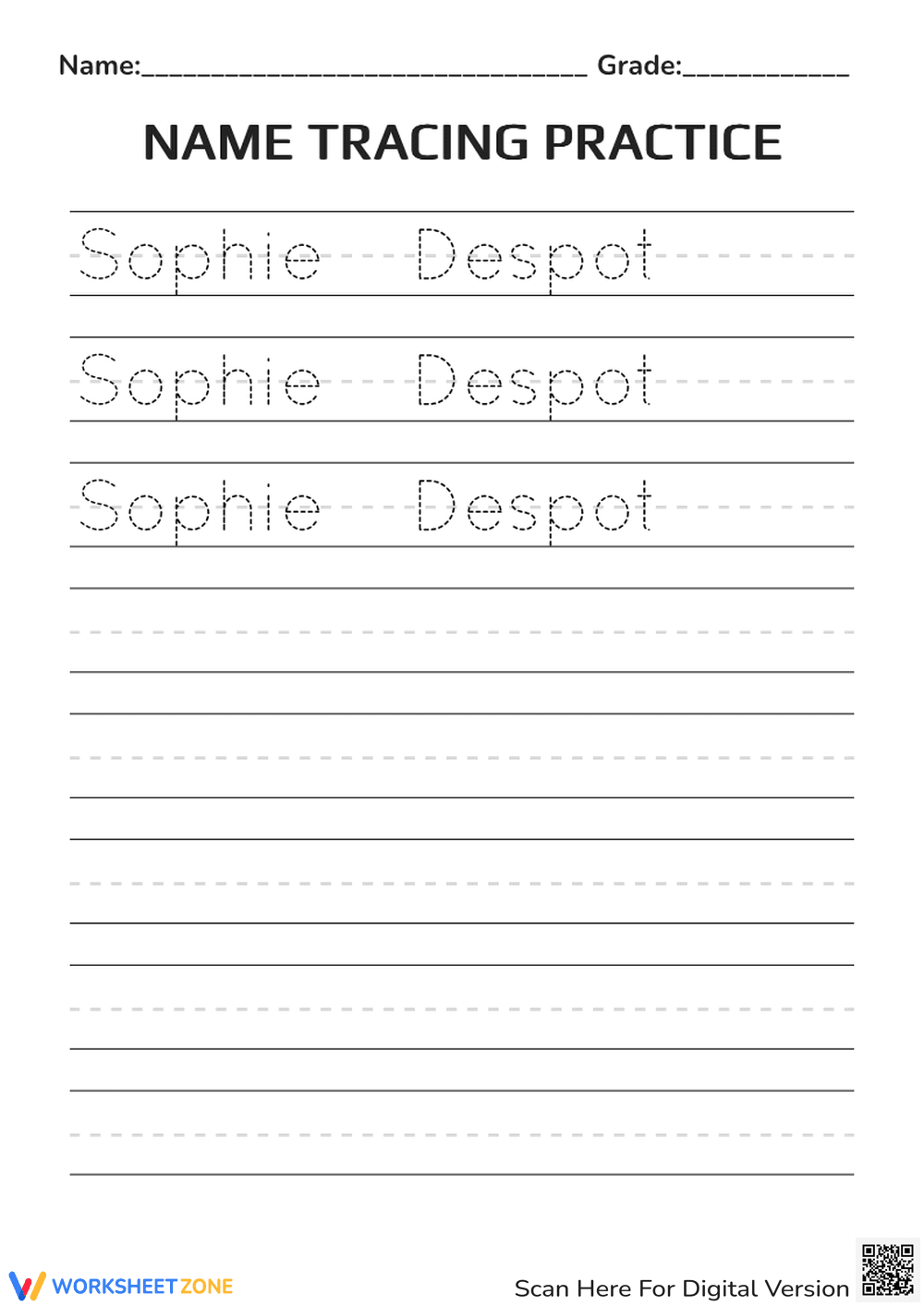

Name Tracing Practice | Essential Grade K-1 Printable
Paste this activity's link or code into your existing LMS (Google Classroom, Canvas, Teams, Schoology, Moodle, etc.).
Students can open and work on the activity right away, with no student login required.
You'll still be able to track student progress and results from your teacher account.
This Kindergarten and Grade 1 handwriting worksheet provides a structured environment for students to master the essential skill of writing their own names. By combining guided tracing with independent practice, learners develop the muscle memory and letter-stroke precision required for legible penmanship.
At a Glance
- Grade: K-1 · Subject: Handwriting
- Standard:
CCSS.ELA-LITERACY.L.K.1.A— Print many upper- and lowercase letters correctly and legibly- Skill Focus: Name writing and letter formation
- Format: 1 page · 10 lines · No-prep · PDF
- Best For: Morning work and literacy centers
- Time: 5–10 minutes
The worksheet features a clean, distraction-free layout designed for young learners. It includes 3 dedicated lines for tracing the name "Sophie Despot" using dashed-line fonts that guide stroke direction. Below the guided section, 7 additional primary-ruled lines provide ample space for independent practice, allowing students to transition from supported tracing to free-hand writing on a single page.
This resource is designed for immediate classroom implementation with a total teacher preparation time of under 2 minutes. First, print the required number of copies for your student group. Second, distribute the sheets during morning arrival or as a transition activity. Third, review student progress by observing grip and stroke order during the 10-minute session.
The primary focus is `CCSS.ELA-LITERACY.L.K.1.A`, which requires students to print many upper- and lowercase letters. By practicing a specific name, students encounter a variety of letter shapes and connections. This activity also supports `CCSS.ELA-LITERACY.RF.K.1.B`, recognizing that spoken words are represented in written language by specific sequences of letters. Both standard codes can be copied directly into lesson plans, IEP goals, or district curriculum mapping tools.
Use this worksheet during the "You Do" phase of a gradual release model after demonstrating proper pencil grip. It is particularly effective as a formative assessment tool; teachers can quickly scan the 7 independent lines to identify students struggling with specific letter descenders or spacing. Expect most Kindergarten students to complete the page in approximately 8 minutes, while Grade 1 students may finish in 5 minutes.
This resource is tailored for early childhood educators, homeschool parents, and occupational therapists working with students on fine motor delays. It pairs naturally with alphabet anchor charts or name-tag desk references. The clear primary ruling helps students who need visual boundaries to maintain consistent letter height and alignment.
According to research by Fisher & Frey (2014) regarding the gradual release of responsibility, providing students with immediate opportunities to move from guided modeling to independent application is critical for skill acquisition. This handwriting worksheet embodies that principle by offering 3 lines of scaffolded tracing followed by 7 lines of independent practice. Handwriting remains a foundational literacy skill; the NAEP indicates that fluent letter formation is a significant predictor of later writing quality and length. By focusing on name writing, educators leverage personal relevance to increase student engagement and retention. This specific resource addresses CCSS.ELA-LITERACY.L.K.1.A by isolating letter formation within a high-frequency context. Systematic practice of this nature helps automate the physical act of writing, eventually freeing up cognitive resources for higher-level composition tasks as students progress through the primary grades.


