


























Views
Downloads
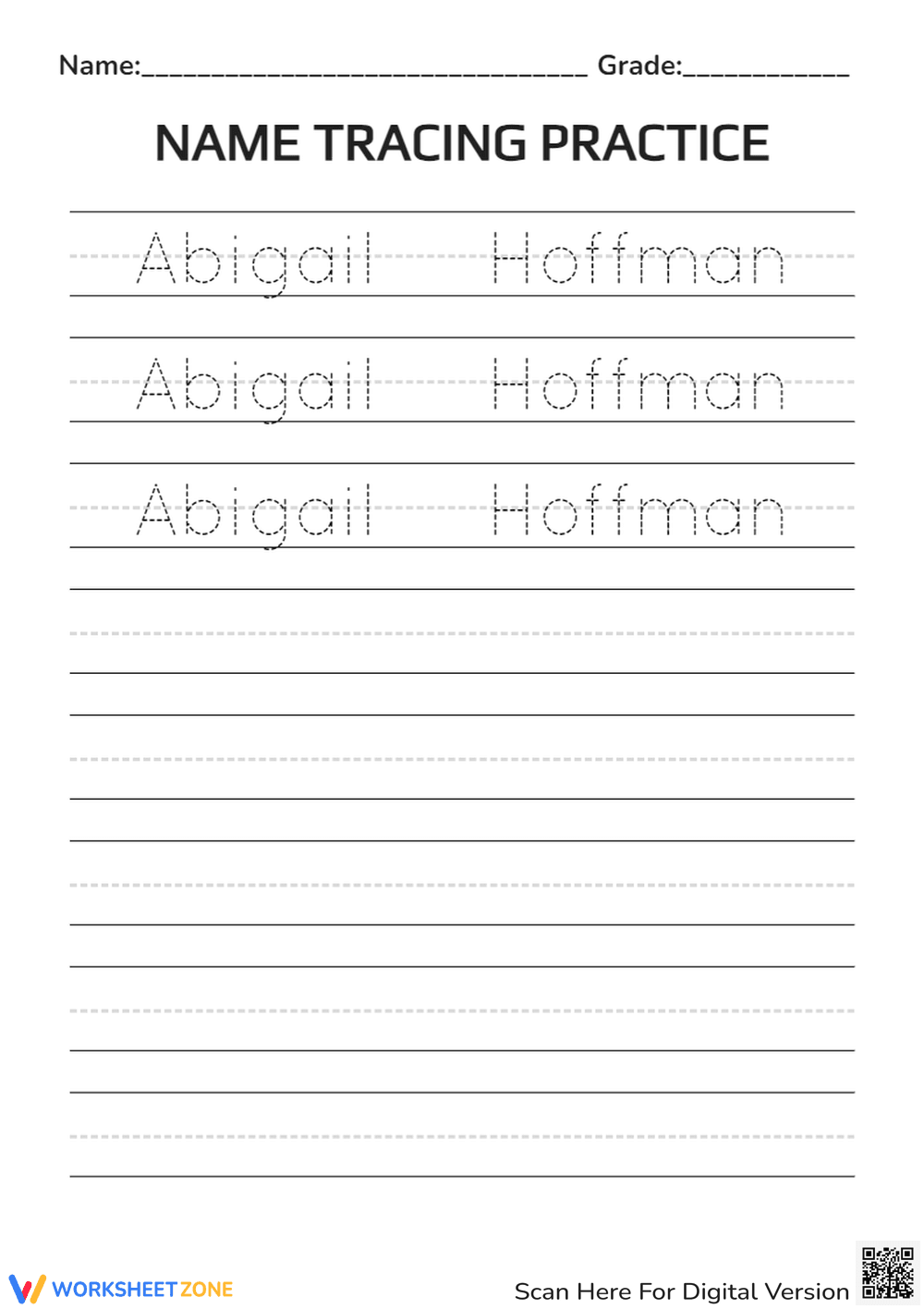

Name Tracing Practice | Grade K-1 Printable Worksheet
Paste this activity's link or code into your existing LMS (Google Classroom, Canvas, Teams, Schoology, Moodle, etc.).
Students can open and work on the activity right away, with no student login required.
You'll still be able to track student progress and results from your teacher account.
Handwriting mastery starts with a personal connection to the alphabet. This name tracing worksheet helps Kindergarten and Grade 1 students develop fine motor control and letter formation through repetitive, structured practice. By focusing on their own names, learners engage more deeply with the mechanics of writing while building the confidence necessary for early literacy success.
At a Glance
- Grade: Kindergarten · Subject: Handwriting
- Standard:
CCSS.ELA-LITERACY.L.K.1.A— Print many upper- and lowercase letters with proper form- Skill Focus: Name tracing and letter formation
- Format: 1 page · 10 problems · Practice sheet · PDF
- Best For: Morning work or literacy centers
- Time: 10–15 minutes
What's Inside
This single-page PDF features a clean, distraction-free layout designed for young learners. It includes three rows of dedicated name tracing with dotted midlines to guide height and proportion. Following the scaffolded section, students find seven blank primary-ruled lines for independent practice. The generous spacing ensures that students have ample room to refine their pencil grip and stroke order without feeling crowded on the page.
Zero-Prep Workflow
- Print: Select the document and print enough copies for your entire class or literacy block in under 30 seconds.
- Distribute: Hand out the sheets during morning arrival, as a transition activity, or within a dedicated handwriting station.
- Review: Walk the room to monitor pencil grip and stroke directionality as students complete the 10 lines of practice.
This workflow requires less than 2 minutes of teacher preparation, making it an ideal resource for busy mornings or emergency sub plans.
Standards Alignment
This resource is directly aligned to `CCSS.ELA-LITERACY.L.K.1.A`, which requires students to print many upper- and lowercase letters. By practicing a specific name, students master a variety of letter shapes and connections in a meaningful context. This standard code can be copied directly into lesson plans, IEP goals, or district curriculum mapping tools to document evidence of foundational writing practice.
How to Use It
Use this worksheet during the first 15 minutes of the school day as a calming morning work activity. It also functions effectively as a formative assessment tool; observe students as they transition from the traced lines to the blank lines to identify who requires additional intervention with letter sizing. Most students will complete the full page within a 10 to 15-minute window, depending on their fine motor development.
Who It's For
This worksheet is designed for Kindergarten and Grade 1 students who are beginning their writing journey. It is particularly helpful for students receiving Occupational Therapy (OT) services who need consistent practice with line orientation. Pair this resource with an alphabet anchor chart or a name-tag reference to provide additional visual support for students who are still memorizing their letter sequences.
According to Fisher & Frey (2014), the gradual release of responsibility is vital in early literacy, moving from highly scaffolded tracing to independent production. This worksheet implements that research-based strategy by providing three rows of dotted-line tracing followed by seven rows of independent writing space. By focusing on the student's name, the resource leverages personal relevance to increase engagement and retention of letter shapes. Mastery of CCSS.ELA-LITERACY.L.K.1.A requires consistent, repetitive motion to build the muscle memory necessary for fluid handwriting. Research from the 2024 NAEP highlights that early intervention in fine motor skills directly correlates with later writing fluency and academic success. This printable resource provides the structured environment needed for Kindergarten and Grade 1 students to practice upper- and lowercase letter formation accurately. It serves as a foundational tool for developing the grip and stroke precision required for all future written communication tasks in the primary classroom.


