


























Views
Downloads

Positive Adjectives Worksheet | Grade 4-5 Essential
Paste this activity's link or code into your existing LMS (Google Classroom, Canvas, Teams, Schoology, Moodle, etc.).
Students can open and work on the activity right away, with no student login required.
You'll still be able to track student progress and results from your teacher account.
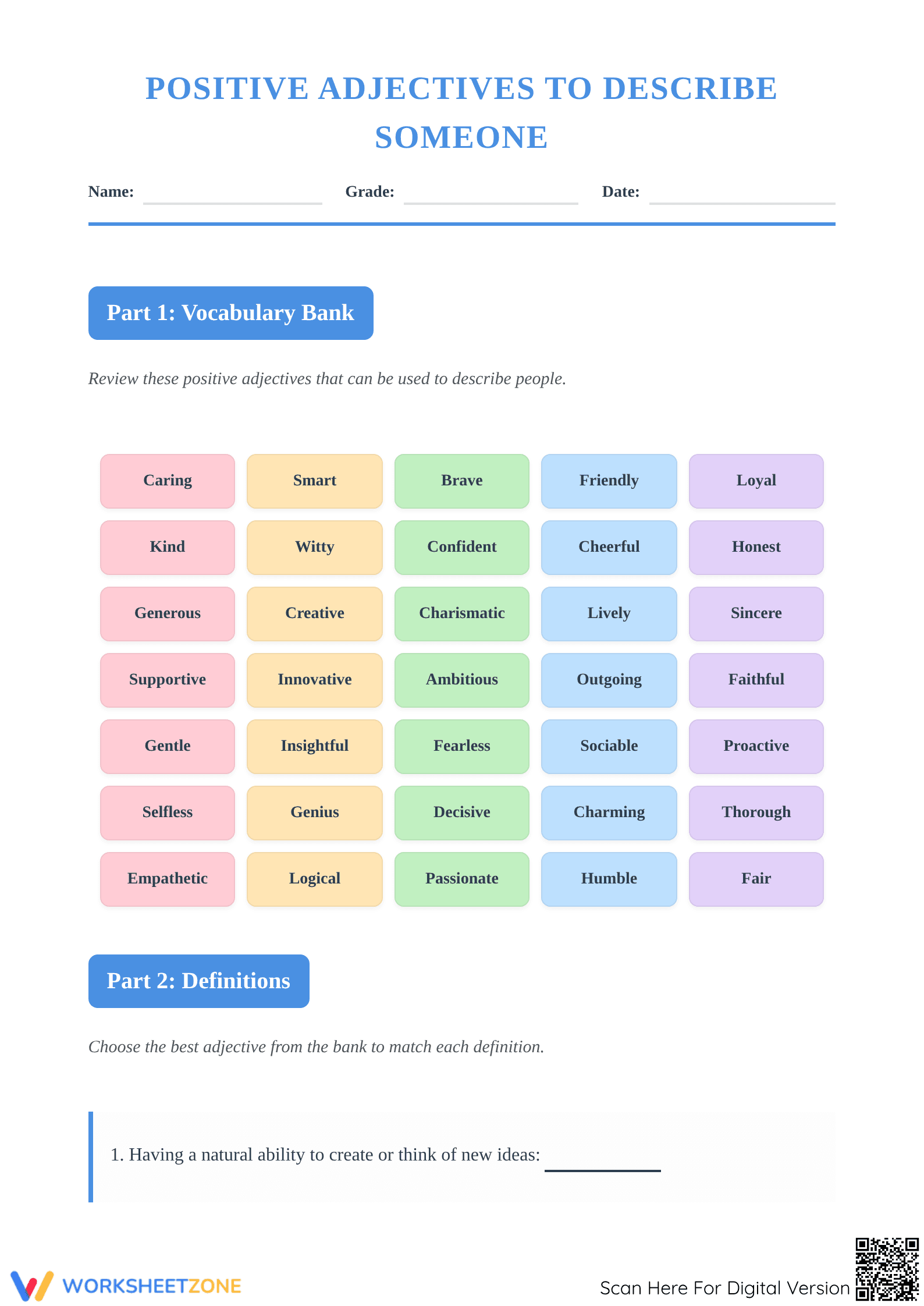
This Grade 4-5 ELA worksheet helps students master positive adjectives to describe character traits. By engaging with 35 curated vocabulary words, learners improve their descriptive writing and interpersonal communication. Students will define, apply, and reflect on positive attributes, moving from basic recognition to meaningful personal application in their daily writing.
At a Glance
- Grade: 4-5 · Subject: ELA
- Standard:
CCSS.ELA-LITERACY.L.4.6— Acquire and use accurately grade-appropriate general academic and domain-specific words and phrases- Skill Focus: Positive Adjectives & Character Traits
- Format: 3 pages · 11 problems · Answer key included · PDF
- Best For: Vocabulary expansion and social-emotional learning
- Time: 20–30 minutes
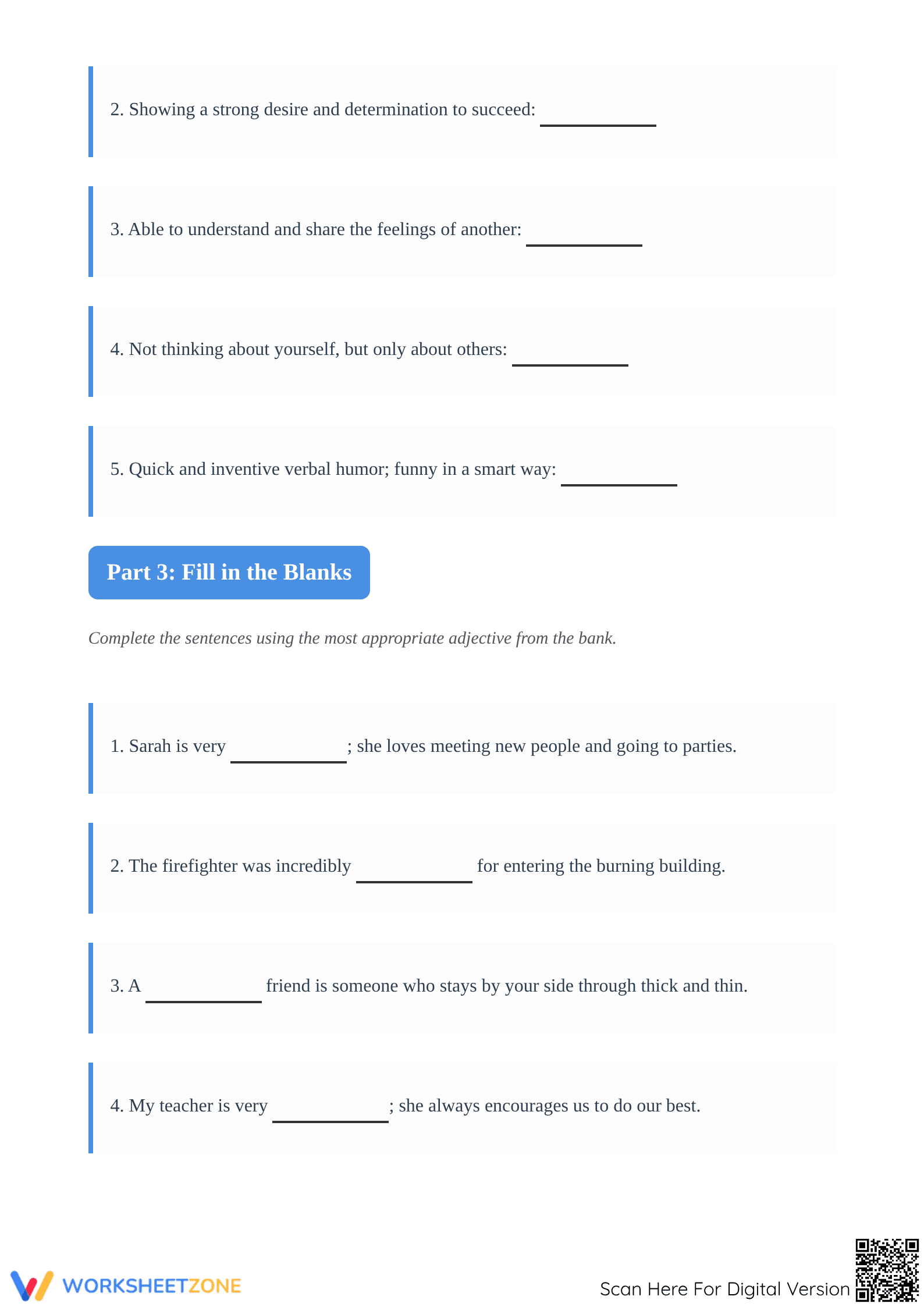
This comprehensive 3-page PDF includes a robust vocabulary bank of 35 positive adjectives, ranging from "empathetic" to "proactive." The resource features five definition-matching exercises, five context-based fill-in-the-blank sentences, and a personal reflection section. A full answer key is provided to ensure quick grading and immediate student feedback on their word choices.
Skill Progression
- Guided practice: Students begin by reviewing a 35-word vocabulary bank, providing a visual scaffold for spelling and word recognition.
- Supported practice: Learners complete 5 definition matches and 5 sentence completions to build contextual understanding of nuanced traits.
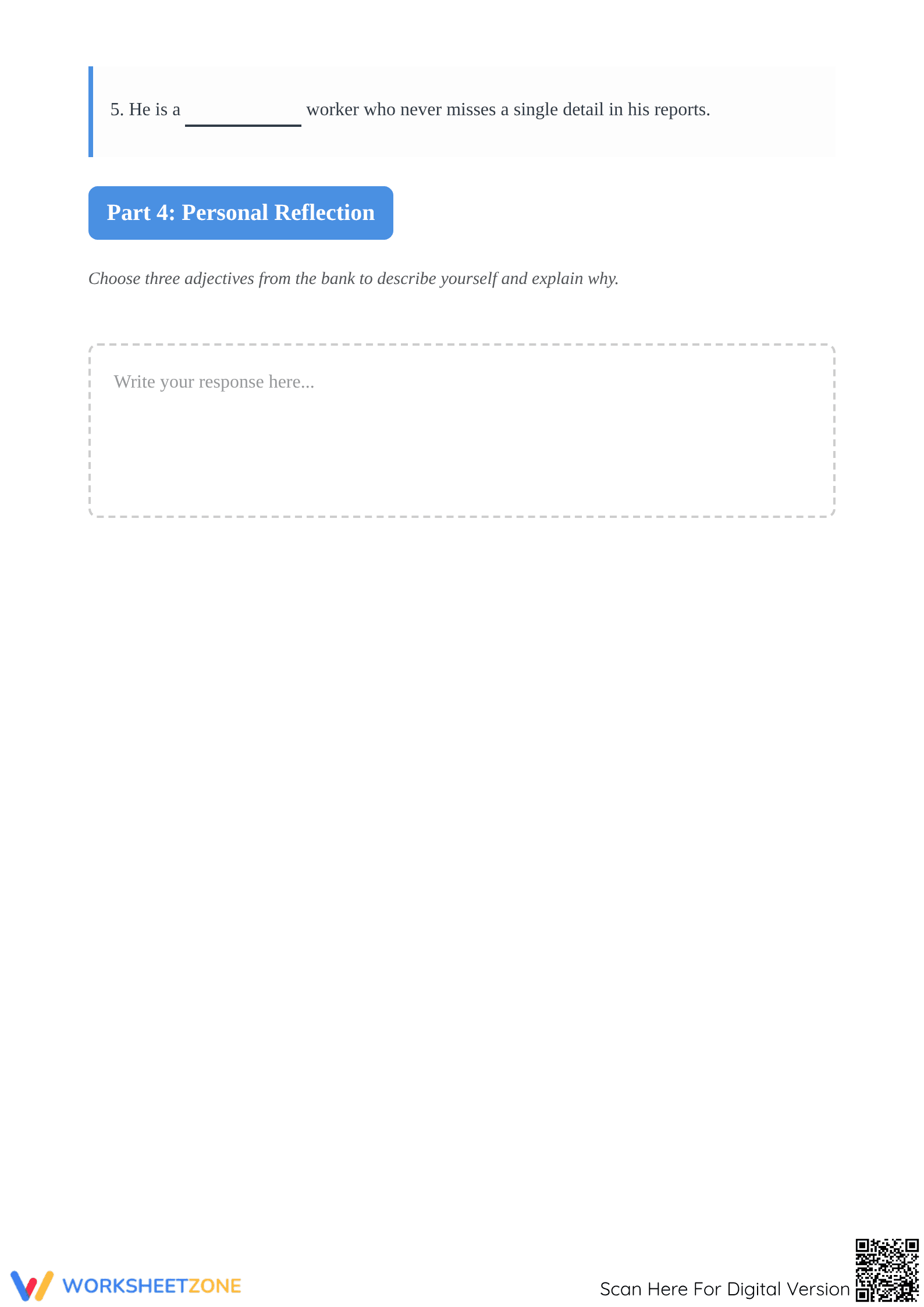
- Independent practice: The final task requires students to select three adjectives to describe themselves in a written reflection, applying the vocabulary to real-world scenarios.
This resource follows the gradual-release model of instruction, moving from I Do (word bank) to We Do (contextual practice) to You Do (personal reflection).
Standards Alignment
This resource is aligned with `CCSS.ELA-LITERACY.L.4.6`, which requires students to acquire and use accurately grade-appropriate general academic and domain-specific words and phrases. It also supports L.5.6 by expanding the nuance of descriptive language used in narrative and informational writing. Both standard codes can be copied directly into lesson plans, IEP goals, or district curriculum mapping tools.
How to Use It
Use this worksheet during a character analysis unit to help students describe protagonists with more precision than "nice" or "good." It also serves as an excellent formative assessment for social-emotional learning (SEL) lessons. Expect students to complete the technical portions in 15 minutes, with an additional 10 minutes for the reflection. Teachers should observe which words students choose for themselves to gauge their self-perception.
Who It's For
This resource is designed for 4th and 5th-grade students, including English Language Learners who need visual word banks for support. It pairs naturally with a character trait anchor chart or a narrative writing prompt where students must develop a "hero" archetype using specific, positive descriptors to enhance their storytelling.
Vocabulary acquisition is a cornerstone of literacy development, as highlighted by Fisher & Frey (2014) in their research on the gradual release of responsibility. This worksheet implements that framework by providing a 35-word bank before asking for independent application. By focusing on CCSS.ELA-LITERACY.L.4.6, the resource ensures students move beyond high-frequency words toward more sophisticated academic language. Research from the NAEP suggests that students with a broader vocabulary of descriptive adjectives perform significantly better on standardized writing assessments. This 3-page printable provides the structured repetition necessary for long-term retention of character-based vocabulary. By integrating social-emotional learning with grammar practice, teachers can maximize instructional time while fostering a positive classroom culture. The inclusion of a personal reflection task encourages metacognition, allowing students to internalize these positive traits as part of their own identity and descriptive repertoire.


