


























Views
Downloads
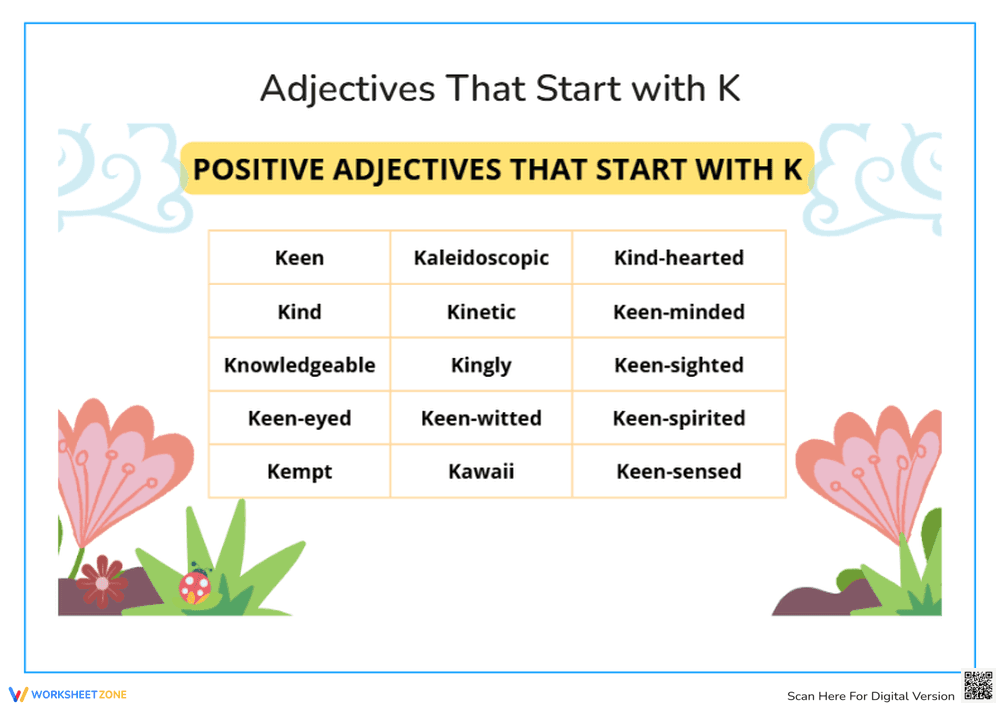

Printable Positive Adjectives K Worksheet | Grade 3-4
Paste this activity's link or code into your existing LMS (Google Classroom, Canvas, Teams, Schoology, Moodle, etc.).
Students can open and work on the activity right away, with no student login required.
You'll still be able to track student progress and results from your teacher account.
This printable vocabulary worksheet helps third and fourth-grade students expand their descriptive writing capabilities by introducing fifteen positive adjectives starting with the letter K. Students learn to identify and apply these uplifting modifiers to enhance their narrative essays, character descriptions, and daily communication.
At a Glance
- Grade: 3-4 · Subject: ELA Vocabulary
- Standard:
CCSS.ELA-LITERACY.L.3.6— Acquire and use grade-appropriate conversational, general academic, and domain-specific words- Skill Focus: Positive adjectives starting with K
- Format: 1 page · 15 vocabulary terms · Reference list · PDF
- Best For: Descriptive writing and vocabulary expansion
- Time: 10–15 minutes
This single-page resource features a clean, structured grid containing fifteen carefully selected positive adjectives, ranging from common terms like "kind" to advanced vocabulary like "kaleidoscopic" and "kinetic." The visual layout includes colorful floral illustrations to engage young learners, making it an excellent anchor chart or student reference sheet for writing folders.
Teachers can integrate this resource into their daily routine with a simple three-step workflow. First, print the single-page PDF document, which takes less than one minute. Second, distribute the sheet to students during writing workshop or morning work, requiring zero setup time. Finally, review the definitions and practice pronouncing the fifteen terms together for five minutes. This straightforward layout makes the worksheet an ideal option for emergency sub plans or independent writing center activities.
This worksheet aligns directly with the Common Core State Standard CCSS.ELA-LITERACY.L.3.6, which requires students to acquire and use grade-appropriate conversational, general academic, and domain-specific words and phrases. Additionally, it supports standard CCSS.ELA-LITERACY.L.4.6 by helping fourth graders expand their descriptive word choice. Both standard codes can be copied directly into lesson plans, IEP goals, or district curriculum mapping tools.
Use this worksheet as a quick warm-up activity before a creative writing lesson. Have students select three adjectives from the list and write sentences describing a friend or family member. Alternatively, use it as a formative assessment tool by asking students to highlight the words they already know and write definitions for the new terms. This activity typically takes ten to fifteen minutes to complete.
This resource is designed for third and fourth-grade students, including English language learners who need visual support and structured word banks to build their descriptive vocabulary. It pairs naturally with a character trait anchor chart or a narrative writing prompt, allowing students to immediately apply their new vocabulary in context.
This vocabulary reference worksheet aligns with the Common Core State Standard CCSS.ELA-LITERACY.L.3.6 to help third and fourth-grade students acquire and use grade-appropriate conversational, general academic, and domain-specific words. According to research from Fisher & Frey (2014) on vocabulary instruction, providing students with structured word lists and direct exposure to targeted modifiers significantly enhances their descriptive writing quality and reading comprehension. By focusing on fifteen positive adjectives starting with the letter K, this resource scaffolded vocabulary acquisition, allowing young writers to transition from basic descriptors to more sophisticated academic language. Educators can confidently integrate this evidence-based tool into daily language arts instruction, spelling centers, or writing workshops to support diverse learners. The structured format ensures students build lasting lexical connections, improving overall communication skills.


