


























Views
Plays
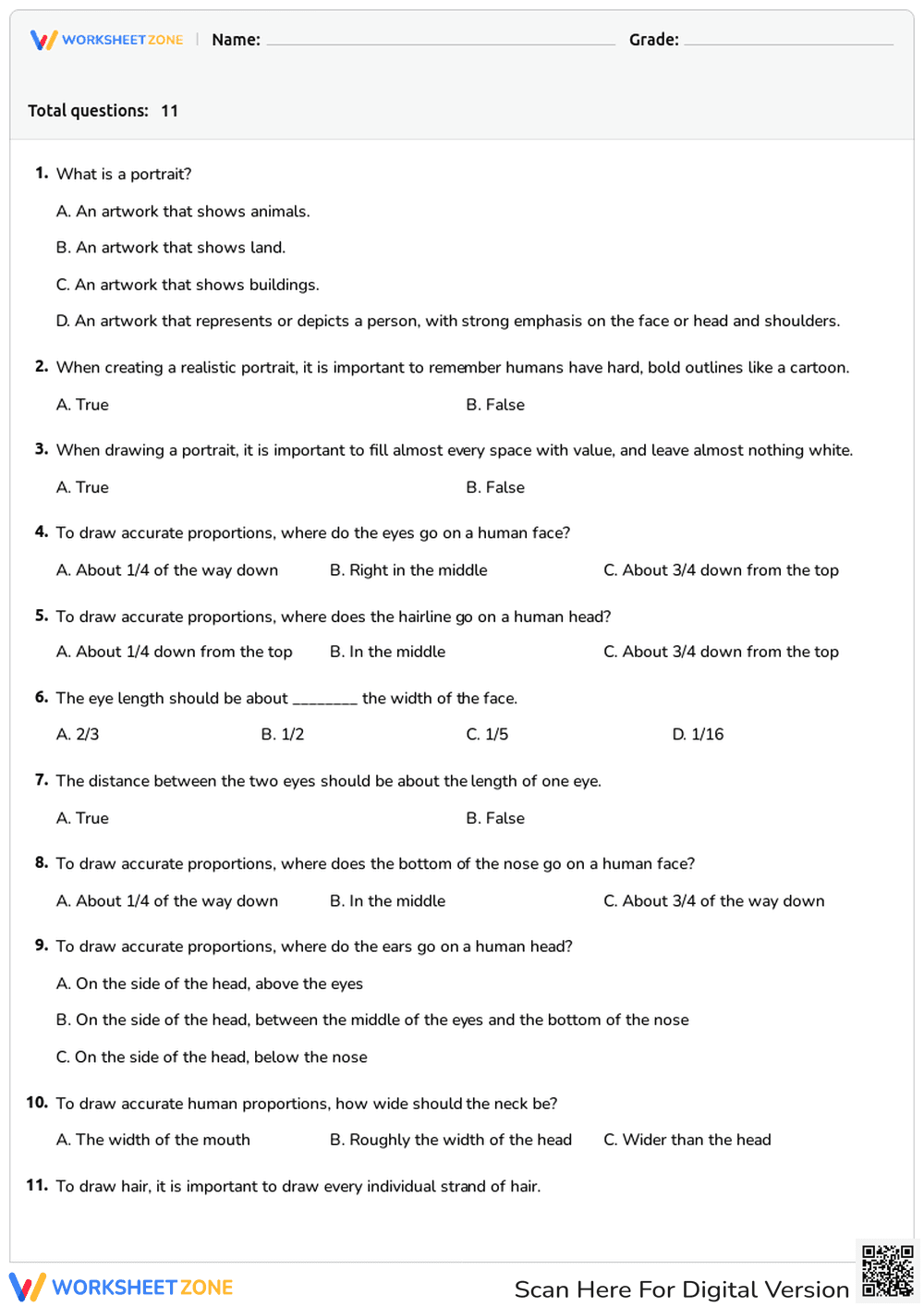


Portrait Drawing Worksheet | Grade 3 Essential Art
Paste this activity's link or code into your existing LMS (Google Classroom, Canvas, Teams, Schoology, Moodle, etc.).
Students can open and work on the activity right away, with no student login required.
You'll still be able to track student progress and results from your teacher account.
This Grade 3 portrait drawing worksheet helps students master the technical foundations of realistic facial representation. By focusing on specific anatomical measurements and shading techniques, students move beyond symbolic drawing to create more accurate depictions. This resource ensures learners understand where features sit on the head before they begin their final art projects.
At a Glance
- Grade: 3 · Subject: Visual Arts
- Standard:
VA:Cr2.1.3a— Create artwork using specific artistic processes and technical skills for realistic representation- Skill Focus: Facial Proportions & Portraiture
- Format: 2 pages · 11 problems · Answer key included · PDF
- Best For: Formative assessment of technical art concepts
- Time: 15–20 minutes
What's Inside: This comprehensive 2-page assessment features 11 targeted questions designed to evaluate a student's grasp of portraiture. The worksheet includes multiple-choice and true-false formats covering eye placement, hairline location, ear alignment, and the role of value in shading. A clear layout ensures students can focus on the conceptual content without visual distraction, and the included answer key allows for immediate feedback.
Zero-Prep Workflow
- Print (1 minute): Select the two-page PDF and print enough copies for your art studio or classroom.
- Distribute (30 seconds): Hand out the worksheets as a quiet entry task or a mid-lesson check for understanding.
- Review (30 seconds): Use the provided answer key to grade papers instantly or facilitate a peer-review session to reinforce the concepts.
This resource is designed to function as a standalone sub plan or a quick check-in during a larger portraiture unit, requiring less than two minutes of total teacher preparation.
Standards Alignment: This resource is aligned to VA:Cr2.1.3a, which requires students to create personally satisfying artwork using a variety of artistic processes and materials. By mastering the proportions outlined in these 11 questions, students build the technical proficiency needed to meet this standard. This standard code can be copied directly into lesson plans, IEP goals, or district curriculum mapping tools.
How to Use It: Assign this worksheet during the "guided practice" phase of a portraiture unit. After demonstrating how to map a face, use these questions to verify that students have internalized the rules of proportion before they apply them to paper. It also serves as an excellent formative assessment observation tool; if students struggle with question nine regarding ear placement, you can provide a quick targeted re-teach to the whole group. Expect completion in 15 to 20 minutes.
Who It's For: This is ideal for elementary art students in grades 2 through 4 who are transitioning from cartooning to realistic drawing. It is particularly helpful for students who need concrete rules to overcome the frustration of "lopsided" drawings. Pair this worksheet with a mirror-based self-portrait activity or a printed anchor chart showing facial grid lines for maximum instructional impact.
The mastery of technical proportions in portraiture is a critical milestone in visual arts education, bridging the gap between observation and execution. According to Fisher & Frey (2014), scaffolded checks for understanding are vital in technical skill acquisition to prevent incorrect habits. This worksheet addresses standard VA:Cr2.1.3a by ensuring students can identify the correct placement of eyes, nose, and ears—skills often counter-intuitive for young artists who place eyes too high. By quantifying these spatial relationships through 11 tasks, the resource provides the framework necessary for realistic results. Research indicates that when students understand facial geometry, their confidence in self-expression increases. This assessment serves as a reliable data point for art educators to track progress in technical drawing proficiency across elementary grade levels.


