


























Views
Plays
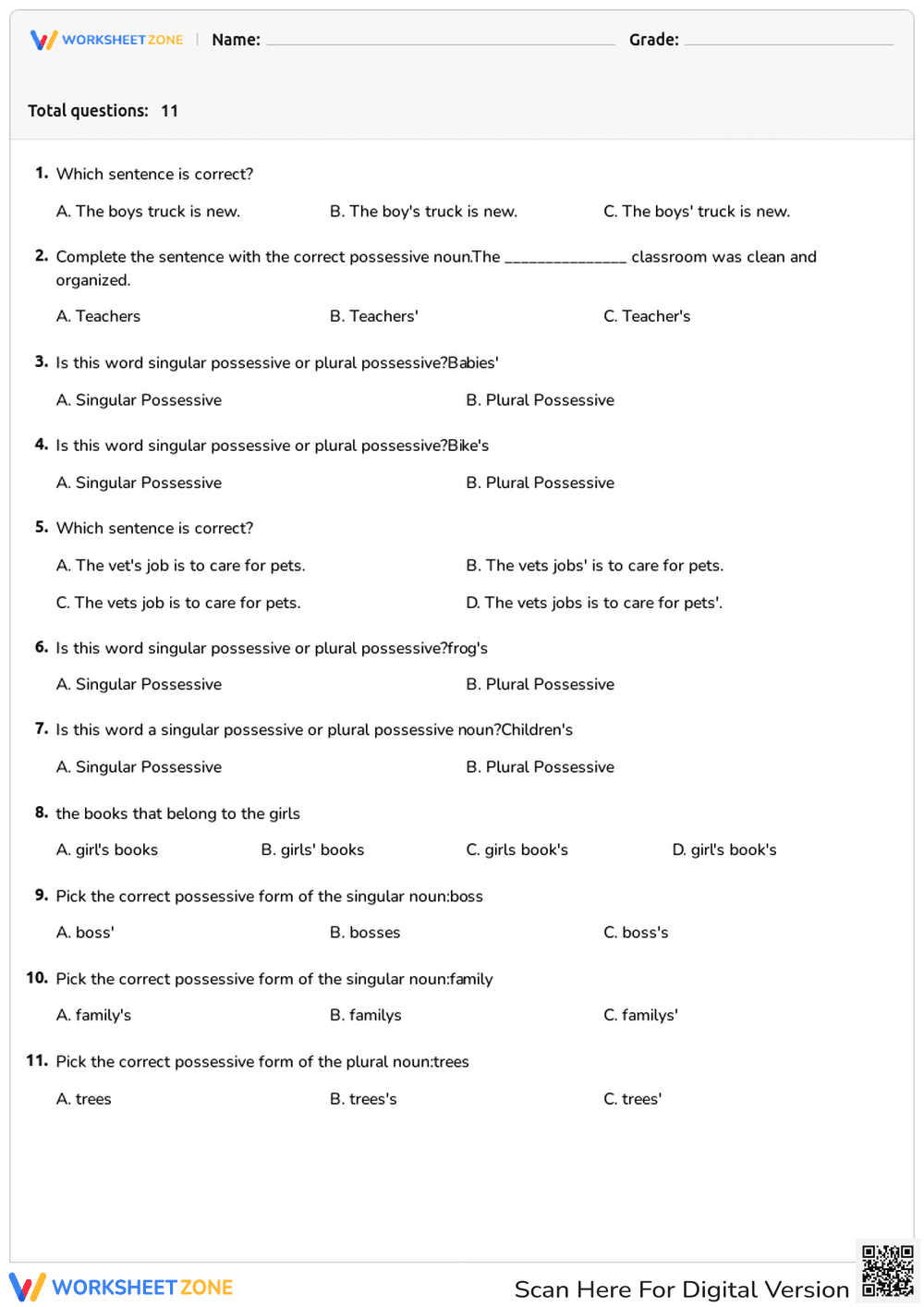

Possessive Nouns Worksheet | Grade 3 Essential Practice
Paste this activity's link or code into your existing LMS (Google Classroom, Canvas, Teams, Schoology, Moodle, etc.).
Students can open and work on the activity right away, with no student login required.
You'll still be able to track student progress and results from your teacher account.
This Grade 3 possessive nouns worksheet helps students distinguish between singular and plural possessives through 11 targeted practice problems. By identifying correct apostrophe placement and categorizing noun types, learners build the grammatical precision necessary for clear writing. This resource ensures students master the nuances of ownership in both simple and complex sentences.
At a Glance
- Grade: 3 · Subject: ELA Grammar
- Standard:
CCSS.ELA-LITERACY.L.3.2.D— Form and use possessives correctly in sentences and phrases- Skill Focus: Singular and plural possessive nouns
- Format: 1 page · 11 problems · Answer key included · PDF
- Best For: Independent practice or formative assessment
- Time: 15–20 minutes
This single-page PDF contains 11 multiple-choice and fill-in-the-blank questions. Students are tasked with selecting the correct sentence structure, identifying whether a word is singular or plural possessive (e.g., "Babies'" vs. "Bike's"), and transforming base nouns like "boss" or "trees" into their proper possessive forms. A comprehensive answer key is provided for quick grading and immediate feedback.
- Guided practice: Initial questions provide full sentence contexts to help students recognize correct apostrophe usage in common singular nouns through 5 multiple-choice options.
- Supported practice: Mid-section tasks require students to categorize specific words as either singular or plural possessive, reinforcing the visual rules of punctuation.
- Independent practice: The final set of problems challenges students to generate the correct possessive form from a provided root noun without multiple-choice scaffolding.
This gradual-release approach moves students from recognition to application, ensuring a solid grasp of grammar rules through the I Do, We Do, You Do instructional framework.
Standards Alignment
This resource is primarily aligned with `CCSS.ELA-LITERACY.L.3.2.D`, which requires students to form and use possessives. It also supports `CCSS.ELA-LITERACY.L.2.2.C` by reinforcing apostrophe placement in frequently occurring possessives. Both standard codes can be copied directly into lesson plans, IEP goals, or district curriculum mapping tools.
How to Use It
Use this worksheet as a formative assessment after a direct instruction lesson on apostrophes. It is particularly effective during the independent practice phase of a lesson. Teachers should observe students during questions 8 through 11 to see if they can independently apply the "s'" rule for plural nouns. Completion typically takes 15 to 20 minutes depending on student proficiency.
Who It's For
This worksheet is designed for Grade 3 students but serves as an excellent review for Grade 4 or an enrichment activity for advanced Grade 2 learners. It pairs naturally with an anchor chart showing the difference between "boy's" and "boys'" to provide visual support for English Language Learners and struggling readers.
Effective grammar instruction requires explicit practice in identifying and forming possessives to prevent common punctuation errors in student writing. According to Fisher & Frey (2014), the gradual release of responsibility model—moving from identifying correct sentences to independently forming possessive nouns—is essential for long-term retention of mechanical skills. This worksheet implements that research-backed strategy by providing 11 structured tasks that target CCSS.ELA-LITERACY.L.3.2.D. By focusing on both singular and plural forms, the resource addresses the specific cognitive load associated with apostrophe placement. Research from the NAEP indicates that mastery of these foundational conventions in early elementary grades correlates with higher writing proficiency scores in later years. This printable resource provides the necessary repetition for students to internalize these rules, making it a reliable tool for classroom teachers seeking to improve student literacy outcomes through evidence-based practice and clear, standards-aligned assessment.


