


























Views
Downloads

Letter P Handwriting Worksheet | Essential Grade K-1
Paste this activity's link or code into your existing LMS (Google Classroom, Canvas, Teams, Schoology, Moodle, etc.).
Students can open and work on the activity right away, with no student login required.
You'll still be able to track student progress and results from your teacher account.
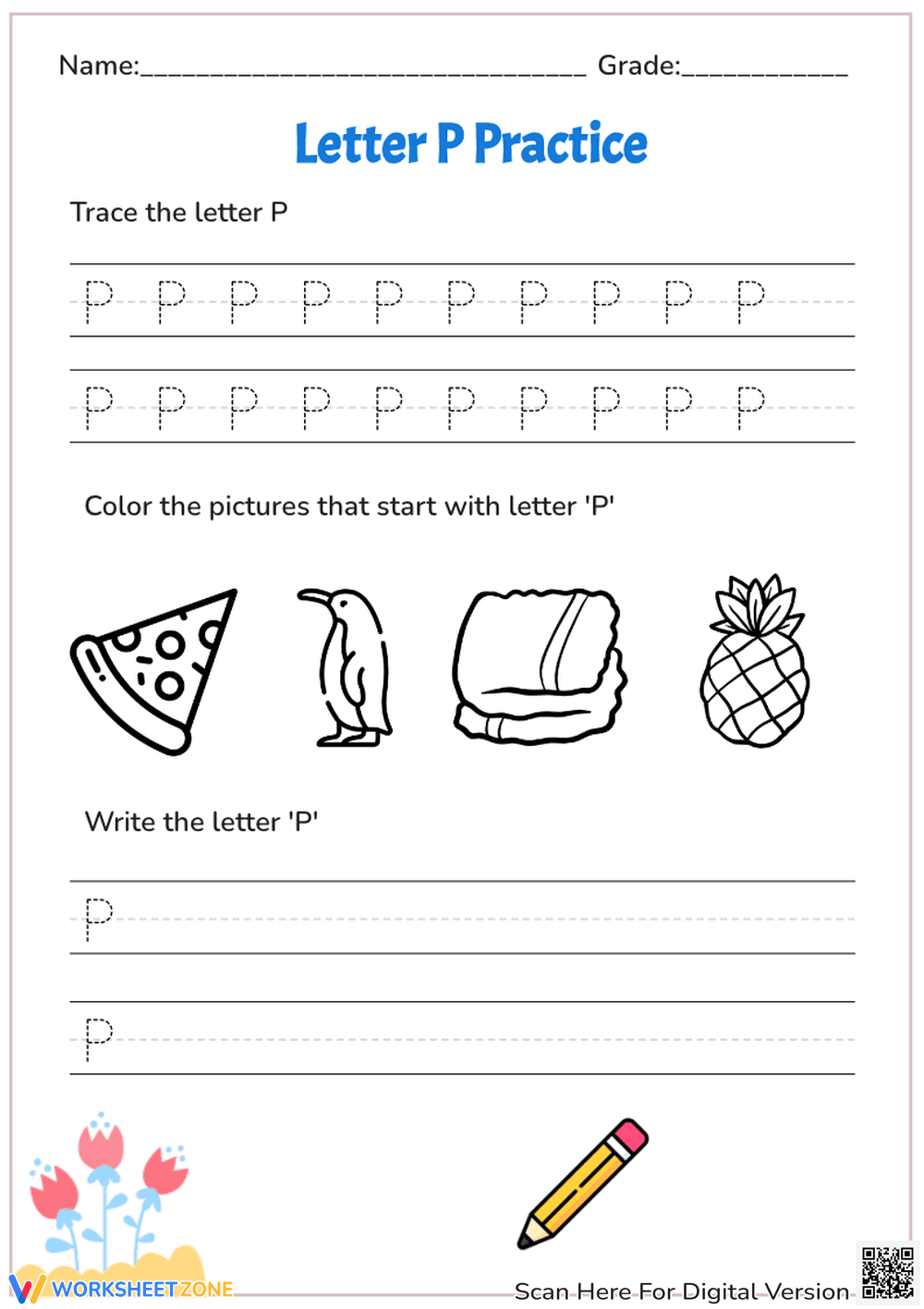
This Grade K-1 Letter P handwriting worksheet provides students with structured practice to master uppercase letter formation and phonemic awareness. By combining tactile tracing with visual identification, learners develop the fine motor control necessary for legible writing. This resource ensures students can confidently produce the letter P while connecting it to familiar vocabulary.
At a Glance
- Grade: K-1 · Subject: Handwriting
- Standard:
CCSS.ELA-LITERACY.L.K.1.A— Print many upper- and lowercase letters with proper form- Skill Focus: Letter P formation and initial sounds
- Format: 1 page · 26 tasks · Answer key included · PDF
- Best For: Morning work or literacy centers
- Time: 10–15 minutes
This single-page PDF features a clean, distraction-free layout designed for young learners. It includes two rows of guided tracing for the letter P, a middle section for identifying and coloring objects starting with the "p" sound (pizza, penguin, pineapple), and two rows for independent writing practice. The worksheet uses standard primary lines to support consistent letter height and placement.
The workflow for this resource is designed for maximum efficiency in busy classrooms. Teachers can print the single-page PDF in less than 30 seconds. Distribution takes approximately 1 minute during transition periods. Reviewing student work is instantaneous, as the visual coloring task and tracing lines provide immediate feedback on letter formation and phonemic recognition. This makes it an ideal choice for emergency sub plans.
This resource aligns with CCSS.ELA-LITERACY.L.K.1.A, which requires students to print many upper- and lowercase letters. It also supports RF.K.1.D by reinforcing letter recognition through repetitive practice. Both standard codes can be copied directly into lesson plans, IEP goals, or district curriculum mapping tools to ensure compliance with state and national literacy frameworks.
Use this worksheet during the independent practice phase of a gradual release lesson after demonstrating the stroke order for letter P. It also serves as an excellent formative assessment tool; observe students as they color the images to check for correct initial sound identification. Completion typically takes 10 to 15 minutes, making it perfect for a quick literacy station rotation.
This worksheet is ideal for Kindergarten and first-grade students developing foundational literacy skills. It is particularly helpful for students requiring extra fine motor support or those following a Handwriting Without Tears style approach. Pair this with a letter P anchor chart or a short read-aloud featuring "P" words for a complete and cohesive instructional block.
Research from Fisher & Frey (2014) emphasizes the importance of the gradual release of responsibility, moving from guided tracing to independent production. This worksheet facilitates that transition by providing 20 guided tracing opportunities before asking for independent writing. Furthermore, integrating phonemic awareness with handwriting practice aligns with the "Science of Reading" approach, which suggests that multi-sensory engagement strengthens neural pathways for letter-sound correspondence. By focusing on the specific standard CCSS.ELA-LITERACY.L.K.1.A, this tool ensures that students meet early literacy benchmarks for letter production. The inclusion of 26 distinct tasks allows for sufficient repetition to build muscle memory without overwhelming the learner. This structured approach is a proven method for improving handwriting legibility in early childhood settings, providing the necessary scaffolding for students to move from simple recognition to fluent production of the alphabet.


