


























Views
Downloads
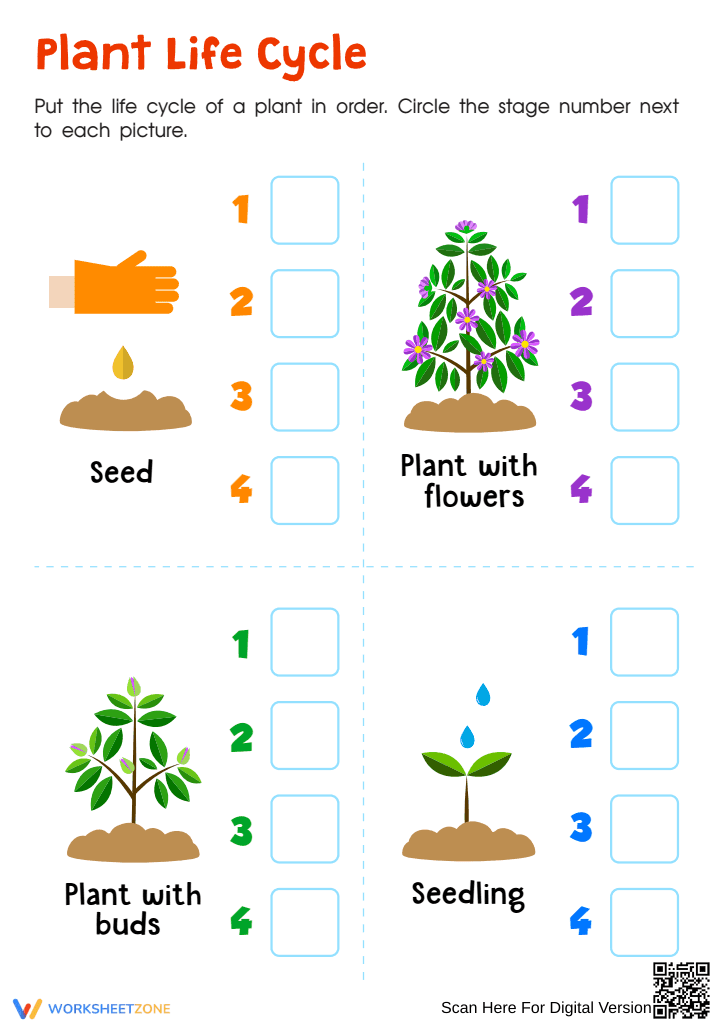

Printable Plant Life Cycle Worksheet | Grade 3 Science
Paste this activity's link or code into your existing LMS (Google Classroom, Canvas, Teams, Schoology, Moodle, etc.).
Students can open and work on the activity right away, with no student login required.
You'll still be able to track student progress and results from your teacher account.
This Grade 3 science worksheet helps students visualize and sequence the biological development of plants. By identifying and ordering four distinct growth stages—from seed to flowering plant—learners build foundational knowledge of organism life cycles. The clear, visual format ensures students can independently demonstrate their understanding of biological progression.
At a Glance
- Grade: 3 · Subject: Science
- Standard:
3-LS1-1— Describe that organisms have unique and diverse life cycles- Skill Focus: Sequencing plant growth stages
- Format: 1 page · 4 problems · Answer key included · PDF
- Best For: Independent practice or morning work
- Time: 10–15 minutes
Inside this single-page resource, educators will find a highly visual sequencing activity. The worksheet features four illustrations representing key phases of a plant's life: a planted seed, a seedling, a plant with buds, and a mature plant with flowers. Next to each illustration, students use a numbered column to circle the correct chronological stage. The uncluttered layout minimizes distractions.
Enjoy a streamlined zero-prep workflow:
- Print (1 minute): Download the PDF and print copies. The design prints beautifully in grayscale.
- Distribute (1 minute): Hand out during science blocks or as part of a sub plan.
- Review (3 minutes): Quickly assess understanding using the visual cues. Total teacher preparation time is under two minutes, making it an ideal print-and-go solution.
This activity is directly aligned to the Next Generation Science Standards, specifically focusing on 3-LS1-1: Develop models to describe that organisms have unique and diverse life cycles but all have in common birth, growth, reproduction, and death. By ordering the stages from seed to flowering plant, students create a basic conceptual model of this biological process. Both standard codes can be copied directly into lesson plans, IEP goals, or district curriculum mapping tools.
Use this worksheet as independent practice following direct instruction on plant biology, or as a formative assessment tool. While students work, circulate and observe whether learners correctly identify the seedling as the second stage—a common point of confusion. Expected completion time is 10 to 15 minutes, making it a concise addition to any science block.
This worksheet is primarily designed for third-grade science students, though its highly visual nature makes it appropriate for first and second graders exploring basic botany. The clear illustrations and minimal text provide built-in scaffolding, making it highly accessible for English Language Learners and students requiring modified assignments. For a comprehensive lesson, pair this sequencing activity with a hands-on seed planting lab or an anchor chart detailing the specific needs of plants at each developmental stage.
Understanding biological sequencing is a critical component of early elementary science education. When students engage with targeted materials aligned to 3-LS1-1, they learn to accurately describe that organisms have unique and diverse life cycles. According to a recent ScienceDirect TpT Analysis, visually structured sequencing tasks significantly reduce extraneous cognitive load, allowing young students to focus entirely on the core scientific concepts rather than deciphering complex instructions. By physically interacting with the material—specifically, circling the correct stage numbers next to clear, relatable illustrations—learners actively reinforce their chronological reasoning skills. This specific instructional design supports better long-term retention of domain-specific vocabulary and fundamental biological processes. Providing students with focused, single-page activities ensures that essential concepts like growth, development, and reproduction are mastered efficiently, ultimately setting a strong foundation for more complex ecological studies in upper elementary grades.


