


























Views
Downloads
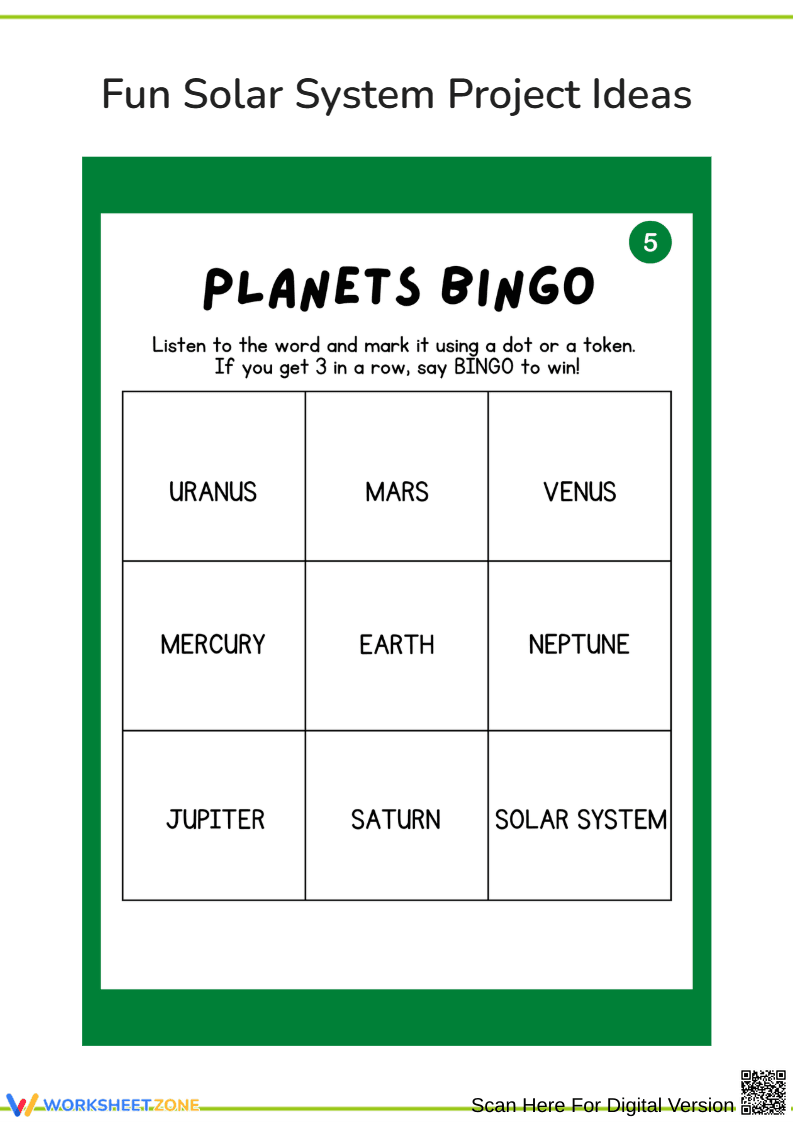

Planets Bingo Worksheet | Grade 2-3 Essential
Paste this activity's link or code into your existing LMS (Google Classroom, Canvas, Teams, Schoology, Moodle, etc.).
Students can open and work on the activity right away, with no student login required.
You'll still be able to track student progress and results from your teacher account.
This Grade 2-3 Planets Bingo worksheet transforms solar system vocabulary into an engaging group activity. By focusing on the names of the eight planets and the solar system itself, students build familiarity with celestial bodies through auditory recognition and visual matching. It is an effective tool for reinforcing science terminology in a low-stakes, high-engagement format.
At a Glance
- Grade: 2-3 · Subject: Science
- Standard:
1-ESS1-1— Use observations of the sun, moon, and stars to describe patterns- Skill Focus: Solar System Vocabulary
- Format: 1 page · 9 problems · Answer key included · PDF
- Best For: Vocabulary reinforcement and review games
- Time: 10–15 minutes
The worksheet features a clean 3x3 grid containing nine essential terms: Mercury, Venus, Earth, Mars, Jupiter, Saturn, Uranus, Neptune, and the Solar System. The layout is designed for high visibility, making it accessible for young learners. It includes clear instructions for students to listen and mark their boards, facilitating a teacher-led or peer-led listening exercise that reinforces spelling and pronunciation.
This resource is designed for a zero-prep classroom environment. First, print the required number of copies for your group (30 seconds). Second, distribute the sheets and provide students with tokens or markers (1 minute). Third, call out the planet names in random order to facilitate the game (5-10 minutes). Total teacher preparation time is under two minutes, making it an ideal choice for emergency sub plans, indoor recess, or quick transition periods between core subjects.
This activity aligns with `1-ESS1-1`, which encourages students to observe and describe objects in the sky. While focused on identification, it provides the foundational vocabulary necessary for meeting more complex Earth and Space Science standards in later grades. Both standard codes can be copied directly into lesson plans, IEP goals, or district curriculum mapping tools to ensure all activities are grounded in academic rigor.
Use this bingo card as a formative assessment after a lesson on the planets to gauge student recognition. It also works well as a "hook" at the start of a unit to activate prior knowledge. Teachers should observe which students struggle to match the spoken word to the written name, providing a quick check for reading fluency and scientific literacy. The 9-square format ensures the game moves quickly enough to maintain high energy.
This worksheet is perfect for second and third-grade students beginning their journey into astronomy. It is particularly helpful for English Language Learners (ELL) who benefit from the repetitive auditory exposure to scientific terms. Pair this with a solar system anchor chart or a short video about the planets for a comprehensive learning experience that caters to visual and auditory learners alike.
According to research by Fisher & Frey (2014) on the gradual release of responsibility, gamified vocabulary practice like this Planets Bingo worksheet provides a necessary bridge between direct instruction and independent mastery. By using the 1-ESS1-1 standard as a framework, the activity ensures that student engagement remains tethered to rigorous academic expectations. The use of a 9-square grid reduces cognitive load for younger learners while still requiring active listening and pattern recognition. Studies in the ScienceDirect TpT Analysis suggest that interactive science tools significantly increase retention rates compared to passive reading alone. This resource offers a structured way to implement these findings in a daily classroom routine, ensuring that every student can identify the major components of our solar system with confidence and accuracy.


