The unit covers place value in three-digit numbers for the students. Students are going to:
- discover how to sketch base-ten blocks straightforwardly.
- match base-ten block displays with numbers.
- What mathematical representations exist for relationships?
- How can the study of mathematics aid in clear communication?
- How can identifying regularity or repetition help with problem-solving efficiency?
- How are numbers represented, compared, quantified, and modeled using mathematics?
- What does it mean to evaluate or estimate a numerical quantity?
- What qualifies a tool or strategy as suitable for a particular task?
- Digit: A symbol used to make a number. 0, 1, 2, 3, 4, 5, 6, 7, 8, and 9 are the ten digits we use to write numbers.
- Hundreds: The place third from the right in a number. In the number 2,435 the digit 4 is in the hundreds place.
- Ones: The place all the way on the right in a number. In the number 2,435 the digit 5 is in the ones place.
- Place Value: The value of the position of a digit in a number. In the number 7,863, the 8 is in the hundreds place and its value is 800.
- Tens: The place second from the right in a number. In the number 2,435 the digit 3 is in the tens place.
- number cards (M-2-1-1_Number Cards)
- base-ten blocks
- place-value mat (M-2-1-1_Place-Value Mat)
- The Number Game (M-2-1-1_The Number Game)
- place-value practice cards (M-2-1-1_Place-Value Practice Cards)
- Place-Value Worksheet (M-2-1-1_Place-Value Worksheet and KEY)
- Watch the students work through the Place-Value Worksheet (M-2-1-1 Place-Value Worksheet and KEY).
- Watch students engage in the Number Game (M-2-1-1_The Number Game) and take notes.
- Throughout instructional procedures, watch how students react.
Explicit instruction, modeling, scaffolding, and active engagement
W: Explain to the students that because our system of writing numbers is based on grouping items by tens, it is also known as the base-ten system. Let them know that base-ten blocks are useful for learning numbers.
H: Put the place-value mat, number cards, and base-ten blocks on display. Tell them that the purpose of these materials is to aid in their understanding of numbers.
E: Students will compare and contrast number cards, base-ten blocks, written numbers, and spoken numbers.
R: Students will consider how well they understand place value as a result of the pre-, during--, and post-lesson questions.
E: To assess place-value comprehension, use the Place-Value Worksheet and the answers to the questions throughout the lesson.
T: The ideas in the Extension section can be used to modify the lesson.
O: Increasing students' comprehension of place value was the goal of the lesson plan. As they acquire understanding, students progress from using base-ten blocks to using pictures to using numbers.
Part 1
Begin the lesson by having the class practice counting by 5s, 10s, and 100s by playing the game Cherry Pie. (This is a lot like the spelling game Sparkle.)
Students will sit in a circle. Choose the number students will count by (5, 10, or 100) and the starting and ending numbers ( _____ to _____ ). One student will say the first number; then the next student will say the next number in the sequence. This counting continues until you reach the last number. For example, tell students to count by 5s from 5 to 100. The first student will say 5, the person next to him/her will say 10, and so on (15, 20, 25, 30, 35, 40, 45, 50, 55, 60, 65, 70, 75, 80, 85, 90, 95, 100). The very next student will say “Cherry Pie,” and the next student in the circle is out. This game can be used to practice counting by 5s, 10s, and 100s. Then ask students to
Count by 10s from 10 to 200.
Count by 100s from 100 to 900.
Count by 5s from 20 to 220.
Count by 10s from 40 to 240.
Part 2
Hold up a cube, a long, and a flat. “These are called base-ten blocks.” Hold up a cube. “This is a base-ten cube. It represents one.” Hold up a long. “This is a long. It represents ten. Why do you think a long represents ten?” (It is made up of ten cubes.) Hold up a flat. “This is a flat. It represents one hundred. Why do you think a flat represents one hundred?” (It is made up of 100 cubes.)
“Our system for writing numbers is called the base-ten number system because it is based on grouping things by tens. Base-ten blocks can be used to help understand numbers and solve problems.”
“Drawing pictures may be more efficient than using actual blocks. Pictures can also be used to explain and record a solution to a problem.” Show students how to draw a cube, long, and flat. To save time, encourage students to draw a large square for a flat, a line for a long, and a dot for a cube.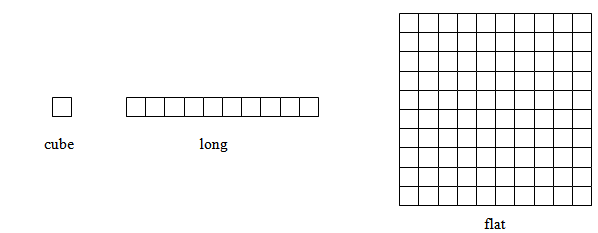
Give each child a set of number cards (M-2-1-1_Number Cards) and a Place-Value Mat (see M-2-1-1_Place-Value Mat in the Resources folder). Display 2 flats, 4 longs, and 5 cubes on a Place-Value Mat. “Show the number 245 by putting your cards on your Place-Value Mat.” (Students show 245 by putting the card for 2 in the hundreds place, the card for 4 in the tens place, and the card for 5 in the ones place.) “How many hundreds are in this number?” (2) “How many tens?” (4) “How many ones?” (5) “Read the number.” (Two hundred forty-five)
Repeat with other two- and three-digit numbers, including 72 and 27. “What do the digits 7 and 2 mean in each of these numbers?” (In 72 the digit 7 means 7 tens and the digit 2 means 2 ones. In 27 the digit 2 means 2 tens and the digit 7 means 7 ones.) After a few examples, display the base-ten blocks at random without the mat. This will allow students to sort the blocks mentally into ones, tens, and hundreds.
Reverse the above procedure. Write two- and three-digit numbers on the board and ask students to show the number by placing base-ten blocks on their Place-Value Mats.
Repeat the previous procedures using numbers with zero in the tens or ones place. For example, display 3 flats and 6 cubes. “Use your number cards to show this number.” (Some students may put no number card in the tens column; others will put a zero.) Write 36 and 306 on the board. “Which number matches the base-ten blocks?” (306) “Which digit in 306 shows that there are no longs?” (zero)
Continue with activities using base-ten blocks, number cards, written numbers, and spoken numbers. For example:
“Show the number 204 with base-ten blocks.” (2 flats, 4 cubes)
“Use your number cards to show the number with a 3 in ones place, 0 in the tens place, and 4 in the hundreds place.” (403)
“In 457, which digit is in the ones place?” (7) “The tens place?” (5) “The hundreds place?” (4)
Write 671 on the board. “Read the number on the board.” (six hundred seventy-one)
Summarize student understanding of place value by asking the following questions:
“How do you know which number is larger, 64 or 46?”
“What does place value tell you about a number?”
“How can you show a number using base-ten blocks?”
Give each student a copy of the Place-Value Worksheet (M-2-1-1_Place-Value Worksheet and KEY). As students fill out the worksheet, move around the room observing and asking clarifying questions to evaluate which students understand place value and which need additional exploration.
Extension:
Routine: Partners play the Number Game (M-2-1-1_The Number Game). Links listed under Related Resources can also be used for ongoing learning and practice.
Small Group: Students who need additional exploration can practice with Place-Value Practice Cards (M-2-1-1_Place-Value Practice Cards). Use the following clarifying questions to evaluate your understanding of place value.
“How many hundreds are in this number?”
“How many tens are in this number?”
“How many ones are in this number?”
“What place is the digit _____ in?”
“What does the digit _____ mean in this number?”
Links listed under Related Resources can also be used for additional exploration.
Expansion: Students use number cards (M-2-1-1_Number Cards), excluding 0, to create as many three-digit numbers as possible using the same three number cards. Students record their answers. “How many combinations are possible using three cards?” (6) Students do the same as above using four number cards. “How many combinations are possible using four cards?” (24)
Links listed under Related Resources can also be used for Expansion activities.

Place Value (M-2-1-1)
The unit covers place value in three-digit numbers for the students. Students are going to:
- discover how to sketch base-ten blocks straightforwardly.
- match base-ten block displays with numbers.