




























Views
Downloads
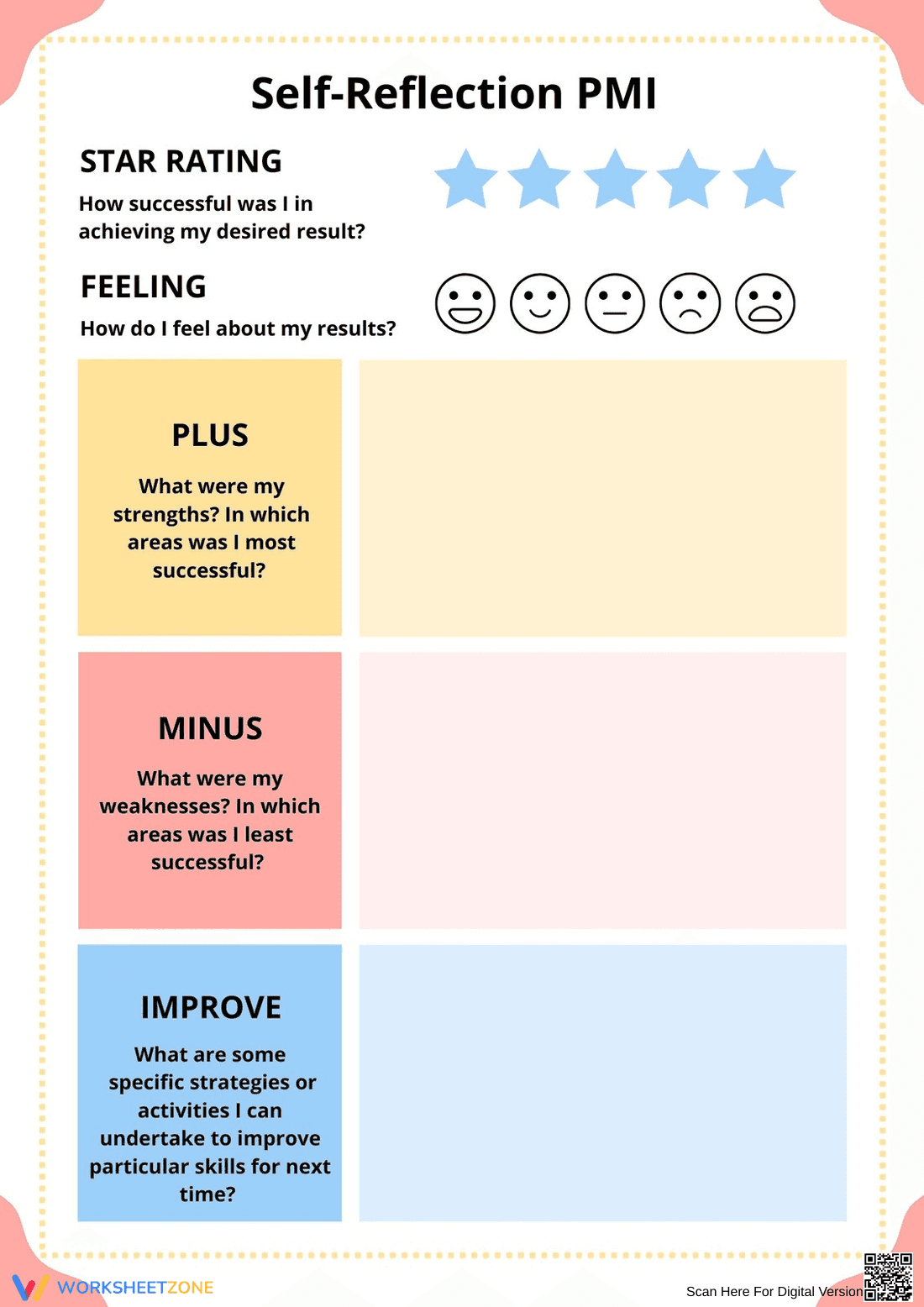

Grade 5 Self-Reflection PMI — Printable No-Prep Worksheet

Paste this activity's link or code into your existing LMS (Google Classroom, Canvas, Teams, Schoology, Moodle, etc.).
Students can open and work on the activity right away, with no student login required.
You'll still be able to track student progress and results from your teacher account.
This Grade 5 self-reflection worksheet gives students a structured framework to evaluate their own work and set actionable goals. By using the Plus, Minus, Improve (PMI) method, learners identify their strengths, acknowledge areas of weakness, and develop specific strategies for future success.
At a Glance
- Grade: 5 · Subject: ELA
- Standard:
CCSS.ELA-LITERACY.W.5.5— Develop and strengthen work through reflection and revision- Skill Focus: Self-Reflection and Goal Setting
- Format: 1 page · 5 tasks · No answer key needed · PDF
- Best For: Post-assignment reflection
- Time: 10–15 minutes
This single-page resource features five reflection tasks for comprehensive self-evaluation. It begins with a five-star rating scale and an emoji feeling check-in to capture immediate emotional responses. Three text boxes then prompt students to articulate their "Plus" (strengths), "Minus" (weaknesses), and "Improve" (future strategies). The clean layout ensures easy navigation.
Zero-Prep Workflow
This resource requires absolutely no teacher setup.
- Print (1 minute): Simply print the single-page PDF. The color-coded design also prints beautifully in grayscale.
- Distribute (1 minute): Hand out the worksheet immediately after a major project, writing assignment, or assessment.
- Review (3 minutes): Briefly explain the PMI acronym (Plus, Minus, Improve) and let students work independently.
With a total teacher prep time of under two minutes, this is an ideal tool for sub plans or quick end-of-lesson wrap-ups.
Standards Alignment
This worksheet aligns with CCSS.ELA-LITERACY.W.5.5, which requires students to develop and strengthen writing as needed by planning, revising, editing, rewriting, or trying a new approach. By prompting learners to identify specific strategies they can undertake to improve particular skills next time, the PMI framework directly supports the metacognitive processes required for meaningful revision. Both standard codes can be copied directly into lesson plans, IEP goals, or district curriculum mapping tools.
How to Use It
Use this versatile tool across multiple subjects. First, assign it as a post-assessment activity after returning a graded test to help students process results constructively. Second, integrate it into the writing process as a self-editing checkpoint. As a formative-assessment observation tip, collect these sheets to identify common "Minus" areas across the class, informing future reteaching strategies. Expected completion time is 10 to 15 minutes.
Who It's For
Designed for Grade 5, this worksheet's accessible language suits upper elementary learners. For differentiation, provide sentence frames for students struggling with expressive writing. It pairs perfectly with any project rubric or a direct instruction lesson on growth mindset, helping students become active participants in their learning journey.
Integrating structured self-evaluation tools like the PMI framework is essential for fostering independent learners. Aligned with CCSS.ELA-LITERACY.W.5.5, this resource helps students develop and strengthen work through reflection and revision. According to Fisher & Frey (2014), providing students with explicit opportunities to assess their own learning significantly increases their metacognitive awareness and overall academic achievement. When students regularly articulate their strengths and pinpoint specific areas for growth, they shift from a fixed mindset to a growth-oriented perspective. This simple, five-task worksheet operationalizes that research by breaking the reflection process into manageable, concrete steps. By consistently using this tool after major assignments, educators can build a classroom culture that values continuous improvement and self-directed goal setting, ultimately equipping students with the evaluative skills necessary for long-term academic and personal success.


