


























Views
Downloads

Fruit Vocabulary Matching Worksheet | Grade 1 Printable
Paste this activity's link or code into your existing LMS (Google Classroom, Canvas, Teams, Schoology, Moodle, etc.).
Students can open and work on the activity right away, with no student login required.
You'll still be able to track student progress and results from your teacher account.
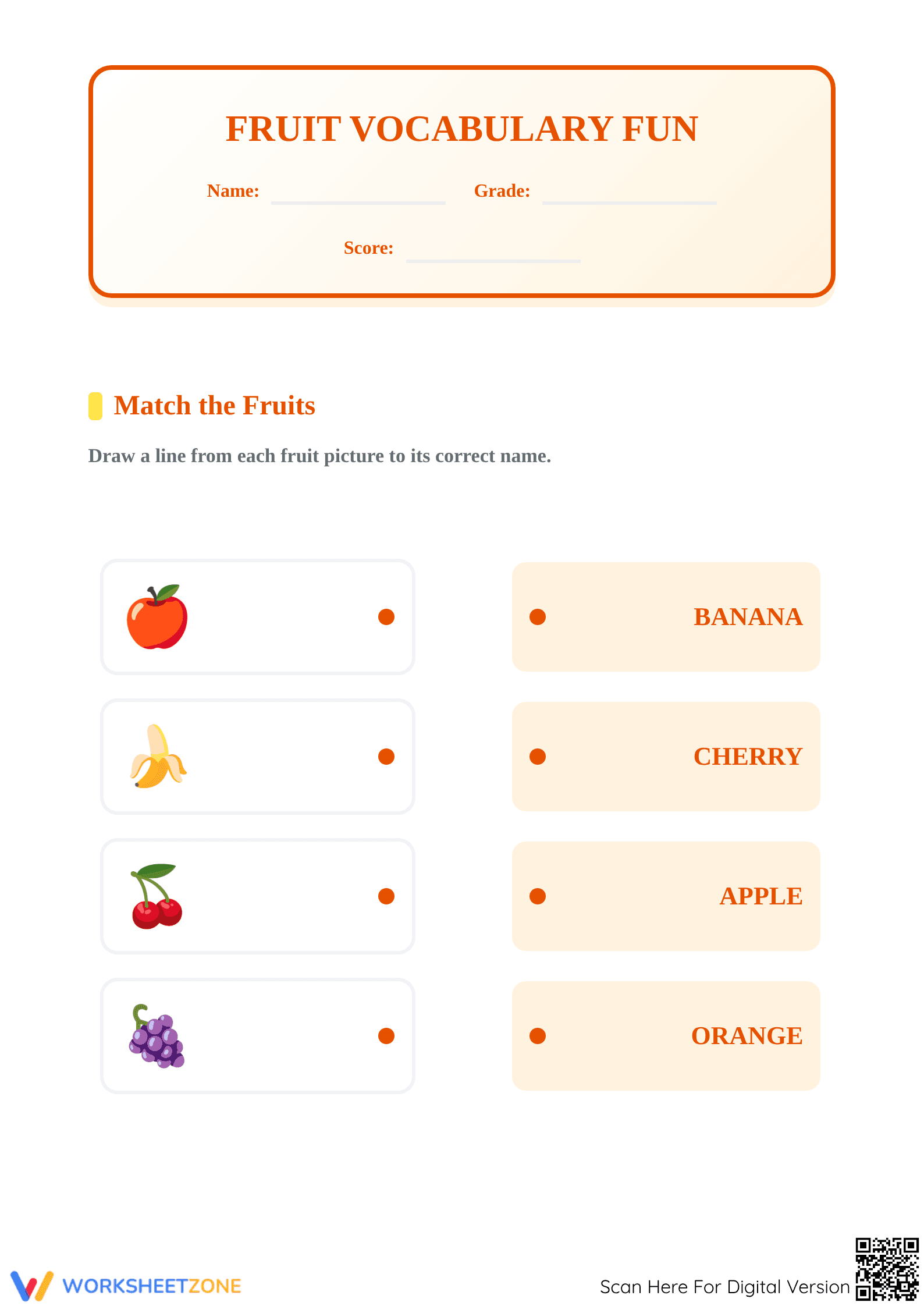
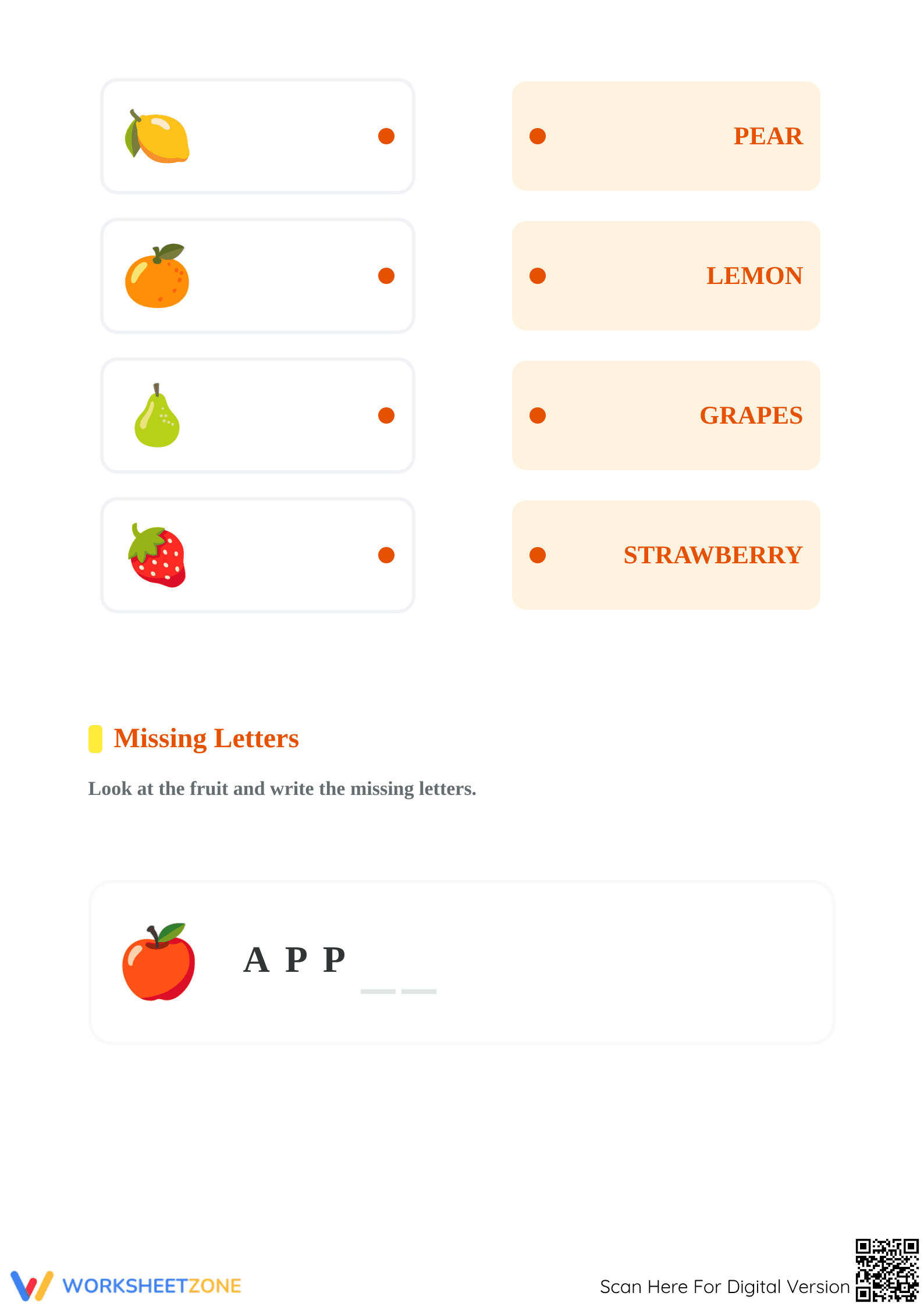
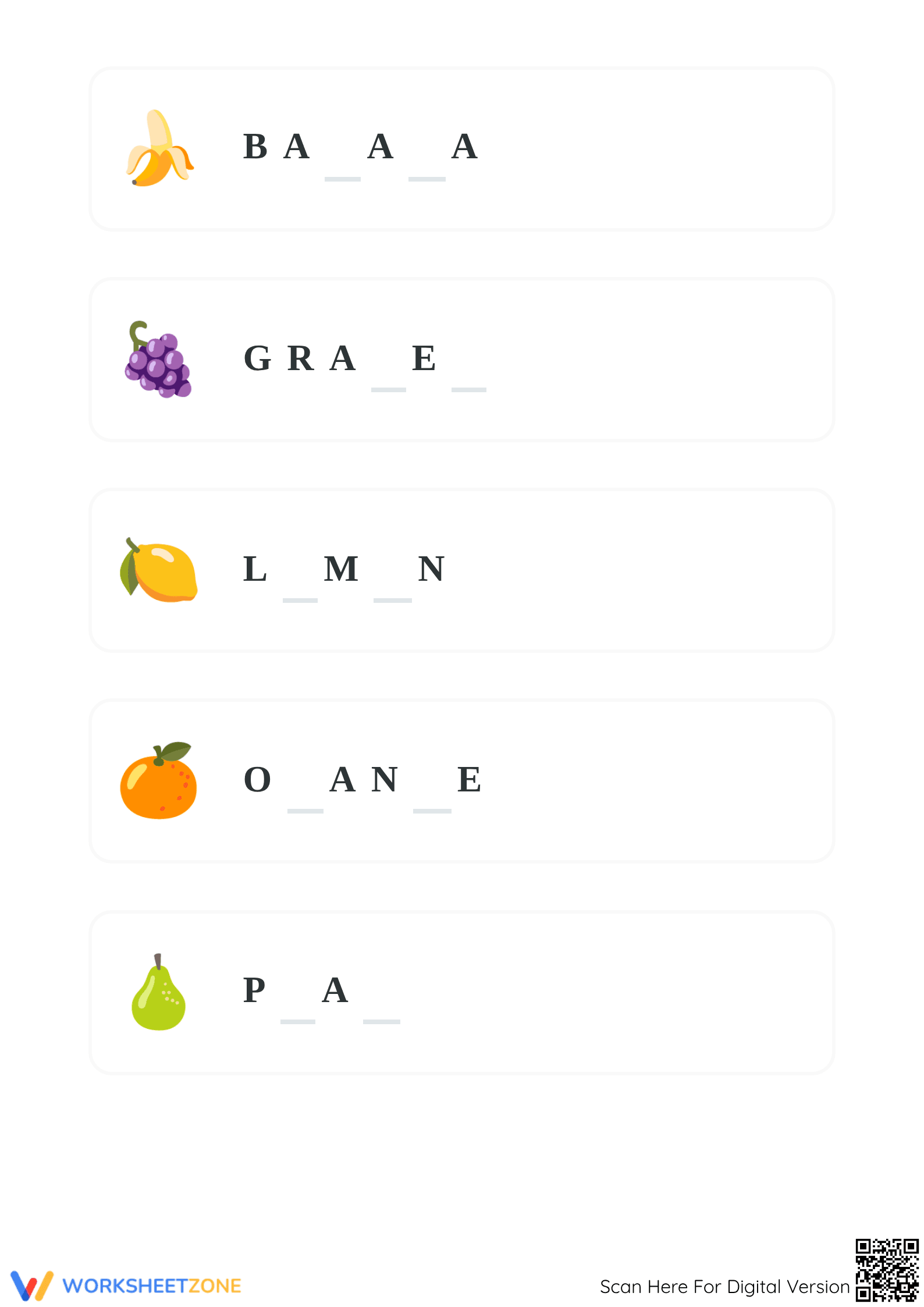
This Grade 1 fruit vocabulary worksheet helps early readers connect familiar images with written words and practice essential spelling skills. By combining visual matching with missing-letter exercises, students actively reinforce their phonics knowledge and build a stronger foundation for everyday reading and writing confidence.
At a Glance
- Grade: 1 · Subject: ELA
- Standard:
CCSS.ELA-LITERACY.L.1.2.D— Spell untaught words phonetically- Skill Focus: Vocabulary and Spelling
- Format: 4 pages · 17 problems · Answer key included · PDF
- Best For: Independent practice
- Time: 15–20 minutes
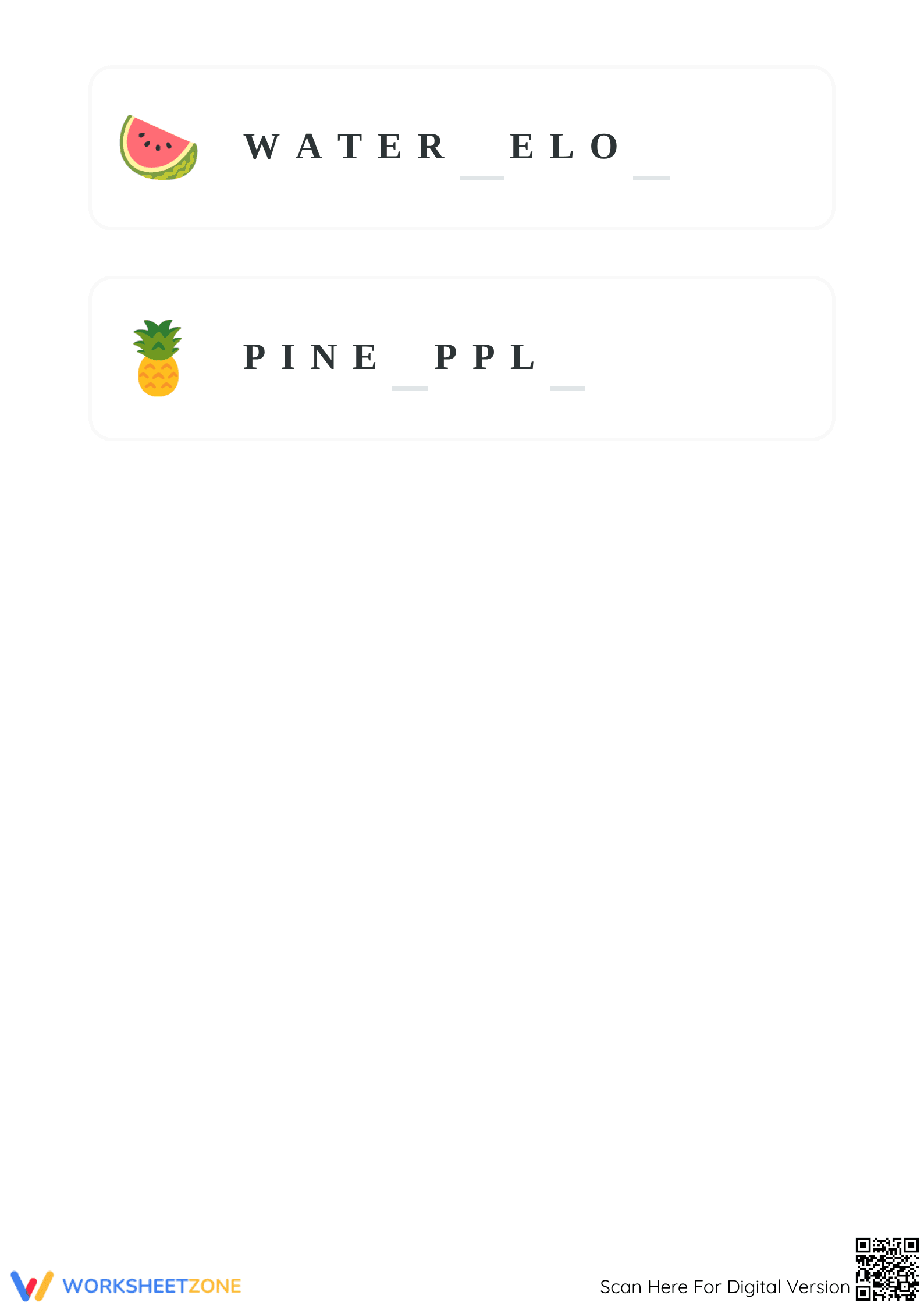
This four-page resource features two distinct activity types to keep young learners engaged. The first section includes nine picture-to-word matching tasks where students draw lines connecting colorful fruit illustrations to their corresponding names. The second section provides eight missing-letter spelling challenges, requiring students to fill in the blanks to complete fruit words. A complete answer key is provided for quick grading.
Designed for maximum efficiency, this activity requires absolutely zero teacher setup.
- Print (1 minute): Generate the four-page PDF and the accompanying answer key.
- Distribute (1 minute): Hand out the double-sided sheets to students during literacy centers or morning work.
- Review (3 minutes): Use the provided key to quickly check spelling accuracy and matching comprehension.
With a total prep time of under two minutes, this packet is an excellent addition to any emergency sub plan or last-minute schedule change.
This activity is aligned to CCSS.ELA-LITERACY.L.1.2.D, requiring students to use conventional spelling for words with common spelling patterns and for frequently occurring irregular words. It also supports basic decoding and word recognition skills as students sound out fruit names to find the correct match. Both standard codes can be copied directly into lesson plans, IEP goals, or district curriculum mapping tools.
Deploy this worksheet during morning work to activate prior knowledge before a broader literacy or health lesson. It also functions perfectly as an independent literacy center activity while the teacher conducts small group guided reading. As a formative assessment tip, observe how students tackle the missing-letter section; notice whether they rely on phonetic sounding-out or visual memory to fill in the blanks. Most students will complete the full four pages in 15 to 20 minutes.
This resource is primarily designed for first-grade students developing their foundational reading and spelling skills. It also serves as an effective intervention tool for second graders needing extra phonics reinforcement, or as an extension for advanced kindergarteners. Pair this worksheet with a read-aloud book about healthy eating or a classroom anchor chart featuring common food vocabulary to maximize engagement.
Aligning instructional materials with CCSS.ELA-LITERACY.L.1.2.D ensures that students can spell untaught words phonetically, drawing on phonemic awareness and spelling conventions. Research highlights the critical role of multimodal vocabulary instruction in early childhood education. According to Fisher & Frey (2014), integrating visual cues with explicit spelling practice significantly improves word retention and decoding automaticity in primary grade learners. When students connect a concrete image, such as a piece of fruit, to its written representation, they build stronger neural pathways for literacy. This dual-coding approach reduces cognitive load, allowing young readers to focus on phonetic patterns rather than struggling with abstract word meanings. By practicing these foundational spelling and matching skills, educators provide the necessary scaffolding for independent reading success, ensuring students meet critical early literacy benchmarks.


