


























Views
Downloads


Animal Picture Word Matching | Grade 1 Printable
Paste this activity's link or code into your existing LMS (Google Classroom, Canvas, Teams, Schoology, Moodle, etc.).
Students can open and work on the activity right away, with no student login required.
You'll still be able to track student progress and results from your teacher account.
This early reading and vocabulary worksheet helps young learners connect written text to visual representations. Students practice decoding and word recognition by drawing lines between animal names and their corresponding illustrations, building foundational literacy skills and expanding their working vocabulary in a highly visual format.
At a Glance
- Grade: 1 · Subject: ELA
- Standard:
CCSS.ELA-LITERACY.L.1.6— Use acquired words and phrases- Skill Focus: Picture-Word Matching
- Format: 2 pages · 10 problems · Answer key included · PDF
- Best For: Independent practice or centers
- Time: 10–15 minutes
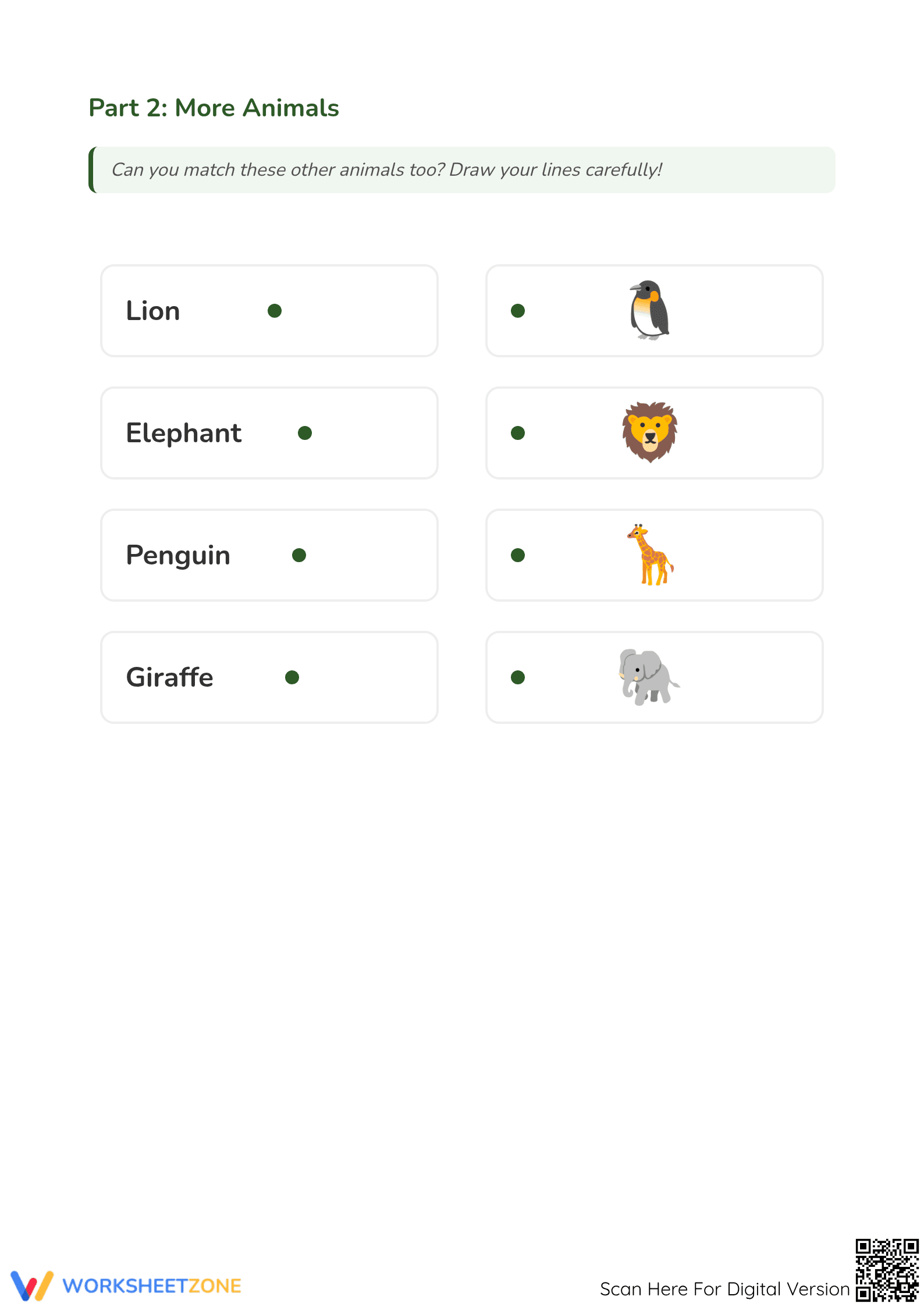
This resource features two distinct pages of matching activities centered around an animal theme. Part one includes six diverse animals, such as a buffalo, whale, and squirrel, while part two focuses on four additional zoo animals like a lion and penguin. The clean layout provides clear dots for drawing lines, ensuring students know where to connect answers. An answer key is provided for quick grading.
This resource requires no teacher setup.
- Print (1 minute): Simply download the PDF and print the two student pages. The graphics print beautifully.
- Distribute (1 minute): Hand out the sheets during your literacy block. The instructions are self-explanatory, meaning students can begin working immediately.
- Review (2 minutes): Use the included answer key to quickly check student work or project it on your smartboard for self-correction.
With a total prep time of under two minutes, this activity is an excellent addition to any emergency sub plan or morning work routine.
This activity aligns with CCSS.ELA-LITERACY.L.1.6: "Use words and phrases acquired through conversations, reading and being read to, and responding to texts." It also supports early decoding skills as students use initial consonant sounds to identify complex animal names. Both standard codes can be copied directly into lesson plans, IEP goals, or district curriculum mapping tools.
This worksheet functions perfectly as an independent literacy center activity during guided reading rotations. Place sheets in dry-erase pockets for reusable practice. Alternatively, use it as a quick formative assessment after a unit on animals to gauge vocabulary retention. While students work, observe whether they are relying on initial letter sounds to guess the word or if they are recognizing the whole word by sight. Students will complete both pages within 10 to 15 minutes.
This resource is primarily designed for first-grade students, though it serves as excellent enrichment for kindergarteners or review for second graders who need additional vocabulary support. English Language Learners (ELLs) will particularly benefit from the strong visual scaffolds that connect English vocabulary directly to clear images. Pair this worksheet with a read-aloud book about zoo or wild animals to reinforce the vocabulary in context.
Developing strong vocabulary skills in early elementary grades requires explicit connections between text and visual representations. According to Fisher & Frey (2014), providing students with multimodal learning opportunities, such as pairing written words with clear illustrations, significantly enhances vocabulary acquisition and retention. This worksheet directly supports CCSS.ELA-LITERACY.L.1.6 by requiring students to use acquired words and phrases to accurately identify animals. By engaging in picture-word matching, young learners practice essential decoding strategies, such as utilizing initial letter sounds and context clues, to make meaning of text. The straightforward format allows students to build confidence in their reading abilities while simultaneously expanding their expressive and receptive vocabulary. Regular practice with these types of visual-textual associations lays a critical foundation for future reading comprehension success across all academic subjects.


