


























Views
Downloads


Picking Adjectives Worksheet | Grade 1 Essential ELA
Paste this activity's link or code into your existing LMS (Google Classroom, Canvas, Teams, Schoology, Moodle, etc.).
Students can open and work on the activity right away, with no student login required.
You'll still be able to track student progress and results from your teacher account.
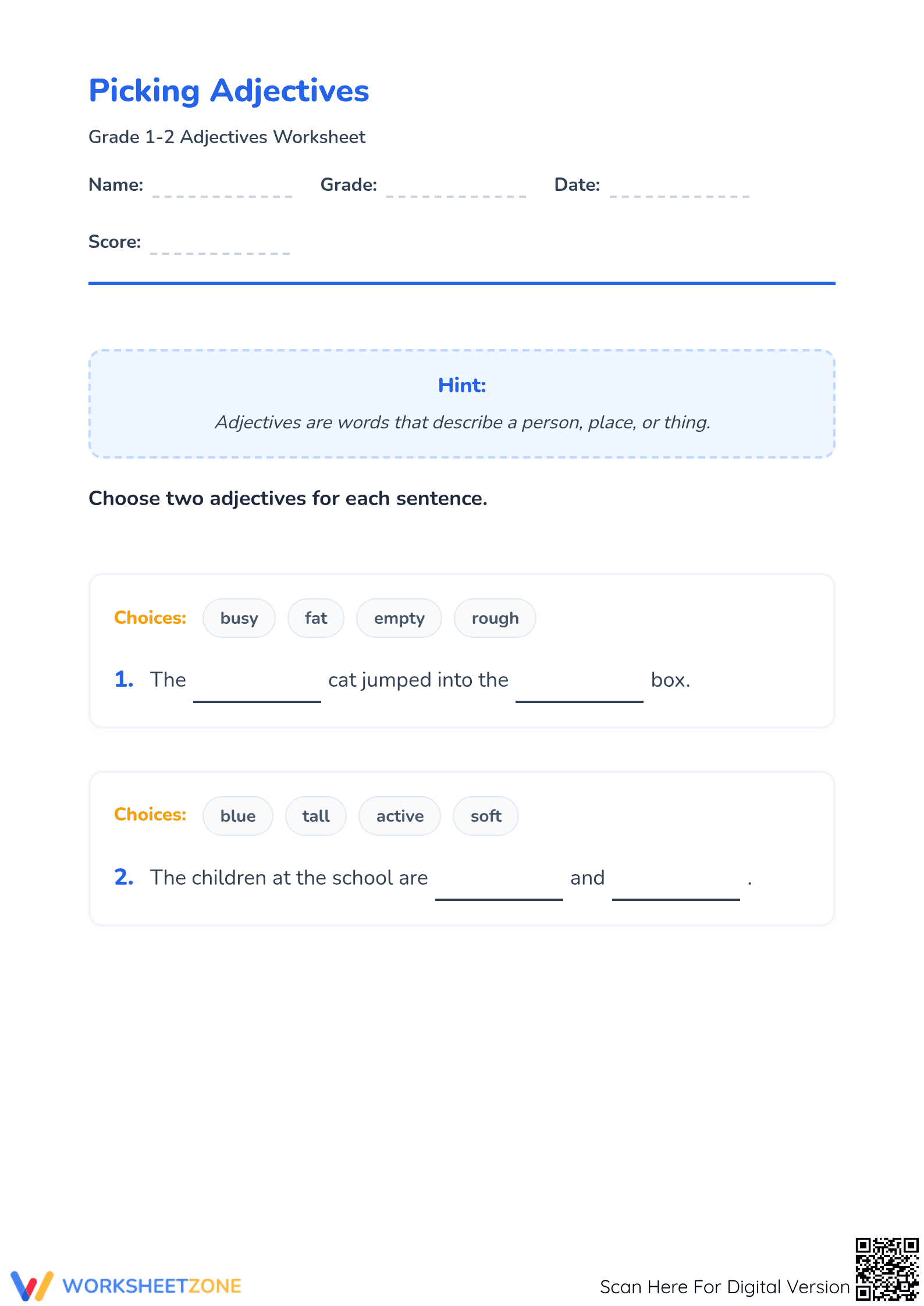
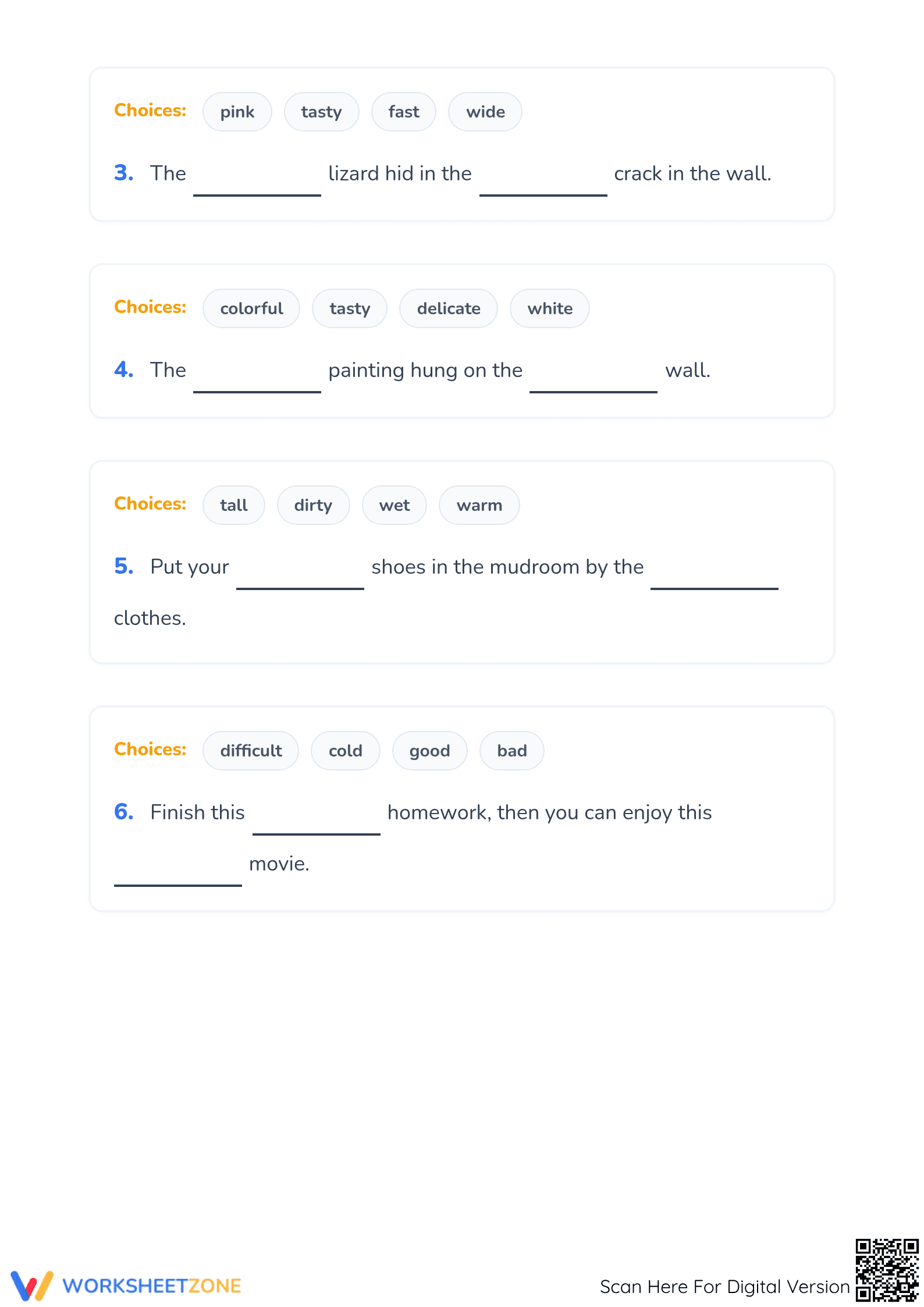
This Grade 1 adjectives worksheet helps young learners master descriptive language by selecting appropriate modifiers for specific sentence contexts. Students practice identifying how words like busy, rough, or tasty change the meaning of a sentence. By completing these exercises, children develop the foundational vocabulary necessary for more complex creative writing and reading comprehension tasks.
At a Glance
- Grade: 1 · Subject: ELA
- Standard:
CCSS.ELA-LITERACY.L.1.1.F— Use frequently occurring adjectives to describe people, places, and things- Skill Focus: Adjective selection and context
- Format: 2 pages · 6 problems · Answer key included · PDF
- Best For: Independent practice or morning work
- Time: 10–15 minutes
What's Inside
The resource consists of two primary activity pages featuring six multi-part sentence completion tasks. Each problem provides a word bank of four distinct adjectives, requiring students to select the two most logical choices to fill the blanks. A helpful Hint box at the top of the first page defines adjectives as words that describe a person, place, or thing, providing immediate support for students who may need a quick refresher. A comprehensive answer key is included for rapid grading.
Zero-Prep Workflow
- Print: Select the two-page PDF and print enough copies for your class in under 1 minute.
- Distribute: Hand out the sheets; the self-explanatory Hint box and clear Choices bubbles allow students to begin working immediately without lengthy verbal instructions.
- Review: Use the provided answer key to project for whole-class self-correction or for quick individual assessment during a 2-minute check.
Standards Alignment
The primary focus of this worksheet is `CCSS.ELA-LITERACY.L.1.1.F`, which requires students to use frequently occurring adjectives. By presenting words in themed clusters, the activity encourages students to evaluate which descriptive words logically fit specific nouns. This standard code can be copied directly into lesson plans, IEP goals, or district curriculum mapping tools to document evidence of grammar and language mechanics instruction.
How to Use It
Use this worksheet as a formative assessment after an introductory lesson on parts of speech. It is particularly effective during the independent practice phase of a gradual release model. Teachers should observe students as they work, noting if they can distinguish between adjectives that describe physical appearance versus those that describe behavior. The expected completion time is 10 to 15 minutes, making it an ideal exit ticket or transition activity.
Who It's For
This resource is tailored for first-grade students but is also suitable for second graders needing a review of basic descriptive language. It serves as an excellent tool for English Language Learners (ELLs) who are building their initial lexicon of English modifiers. Pair this worksheet with a descriptive picture book or an anchor chart featuring sensory words to provide additional visual scaffolding for struggling readers.
Research indicates that explicit instruction in word classes, specifically adjectives, significantly improves the syntactic complexity of early elementary writing. According to Fisher & Frey (2014), providing students with structured opportunities to select modifiers within a controlled context—such as the word banks used in this worksheet—facilitates the transition from simple to expanded sentence structures. This Grade 1 resource targets CCSS.ELA-LITERACY.L.1.1.F by requiring students to apply 12 distinct adjectives across 6 varied sentence scenarios. By isolating the skill of adjective selection, the worksheet reduces cognitive load, allowing students to focus on the semantic relationship between the descriptor and the noun. This methodology aligns with evidence-based practices for language acquisition, ensuring that students move beyond basic noun-verb patterns to more sophisticated, descriptive communication. The inclusion of an answer key supports immediate feedback, a critical component of effective formative assessment in early literacy development.


