




























Views
Downloads
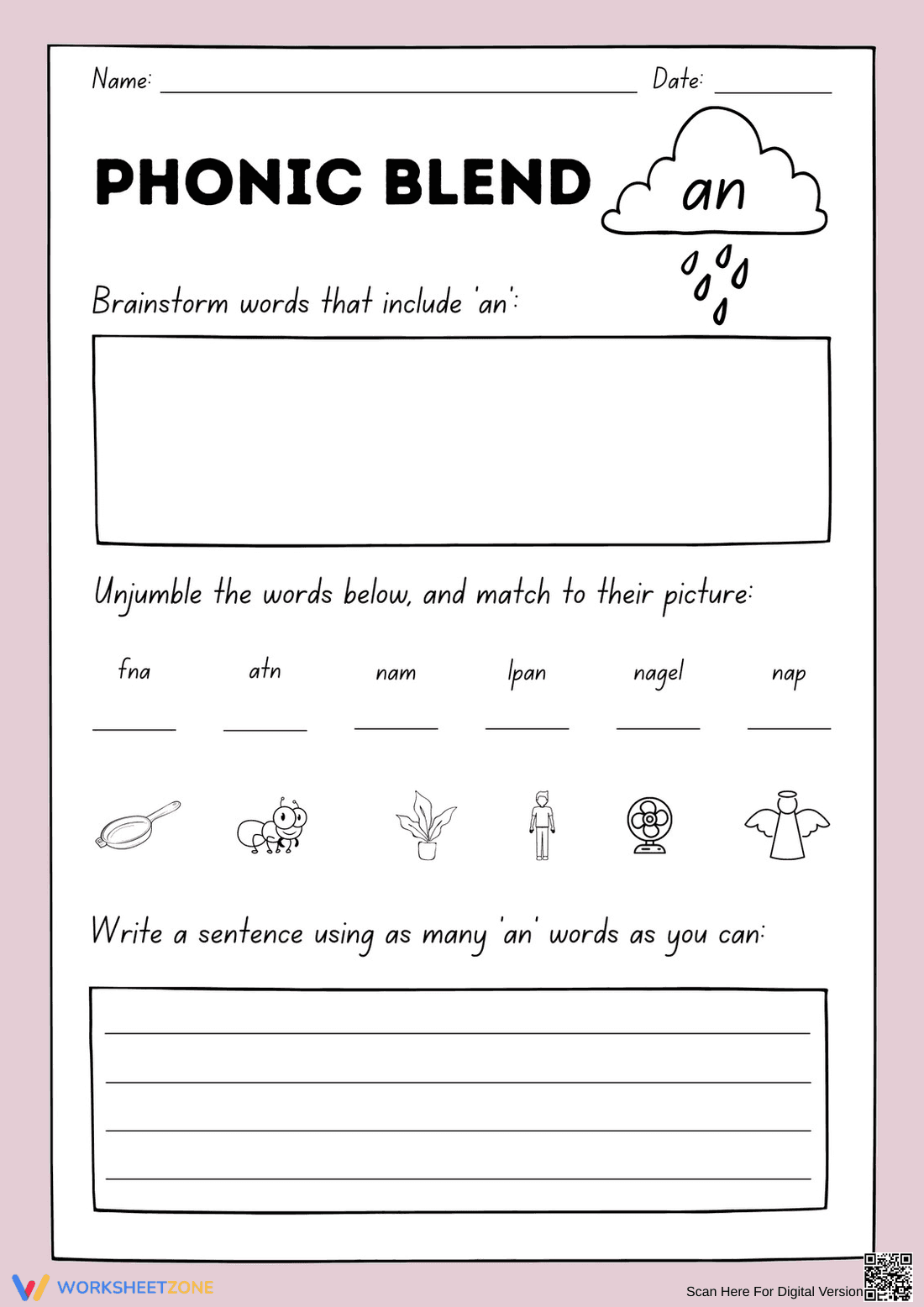

Grade 1 Phonics 'an' Blend — Printable No-Prep Worksheet

Paste this activity's link or code into your existing LMS (Google Classroom, Canvas, Teams, Schoology, Moodle, etc.).
Students can open and work on the activity right away, with no student login required.
You'll still be able to track student progress and results from your teacher account.
This Grade 1 phonics worksheet provides targeted practice with the 'an' word family, helping early readers decode and spell common words. By brainstorming, unscrambling, and writing sentences, students build essential phonemic awareness and vocabulary skills necessary for fluent reading and confident writing.
At a Glance
- Grade: 1 · Subject: ELA
- Standard:
CCSS.ELA-LITERACY.RF.1.3— Apply grade-level phonics to decode words- Skill Focus: 'an' Word Family
- Format: 1 page · 8 problems · Answer key included · PDF
- Best For: Independent practice and morning work
- Time: 10–15 minutes
This single-page resource features three task types to reinforce the 'an' phonics blend. An open-ended brainstorming box encourages students to recall words with the target sound. Next, a six-problem unscramble activity requires learners to decode jumbled letters and connect them to visual cues. Finally, a sentence-writing section provides space for students to apply their vocabulary in context. An answer key is included.
This worksheet requires minimal teacher preparation:
- Print (1 minute): The clean, black-and-white design ensures fast, ink-friendly copying for the entire class.
- Distribute (1 minute): Hand out the single page as students arrive for morning work or transition into literacy centers.
- Review (3 minutes): Use the included answer key to quickly check the unscrambled words and evaluate sentence construction.
With a total prep time of under two minutes, this activity serves as an excellent emergency sub plan or a quick filler activity between guided reading groups.
This activity aligns directly with CCSS.ELA-LITERACY.RF.1.3, which requires students to know and apply grade-level phonics and word analysis skills in decoding words. It also supports CCSS.ELA-LITERACY.L.1.2.D by encouraging conventional spelling for words with common spelling patterns. Both standard codes can be copied directly into lesson plans, IEP goals, or district curriculum mapping tools.
Deploy this worksheet during independent literacy centers after direct instruction on the 'an' word family. Alternatively, assign it as targeted homework. As a formative assessment tip, observe students during the unscramble section; if they struggle to identify initial consonant sounds before the 'an' chunk, they may need support with basic letter-sound correspondence. Expect completion in 10 to 15 minutes.
This resource is primarily designed for first-grade students developing their foundational reading and spelling skills. It also serves as an effective intervention tool for second graders who need a refresher on short vowel word families, or as an enrichment challenge for advanced kindergarteners. For optimal results, pair this worksheet with a decodable reading passage that heavily features 'an' words, allowing students to see the vocabulary in a broader text context.
Mastering word families like the 'an' blend is a critical step in early literacy development. According to Fisher & Frey (2014), providing students with structured, repetitive practice on common spelling patterns significantly improves their decoding speed and reading fluency. When learners can automatically recognize chunks of letters, they free up cognitive resources to focus on reading comprehension rather than laboriously sounding out every individual letter. This worksheet directly supports CCSS.ELA-LITERACY.RF.1.3 by requiring students to apply grade-level phonics to decode words. By combining visual cues with spelling and sentence generation, the activity addresses multiple learning modalities. Consistent exposure to these foundational phonics skills ensures that early readers build the automaticity required for long-term academic success, making this targeted practice an essential component of any comprehensive primary literacy program.


