


























Views
Downloads
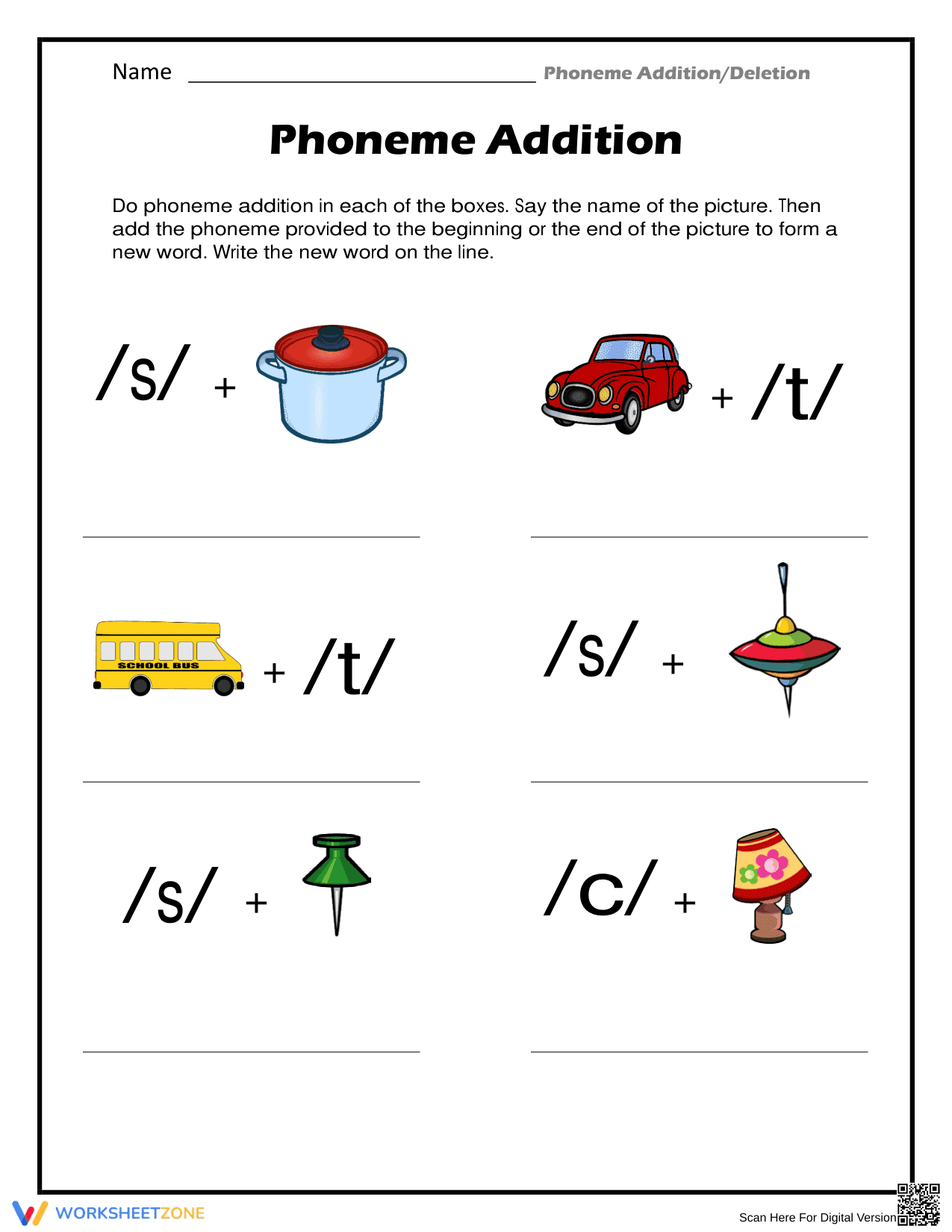

Essential Phoneme Addition Worksheet | Grades 1-3 Phonics
Paste this activity's link or code into your existing LMS (Google Classroom, Canvas, Teams, Schoology, Moodle, etc.).
Students can open and work on the activity right away, with no student login required.
You'll still be able to track student progress and results from your teacher account.
This Essential Phoneme Addition Worksheet provides Grade 1-3 students with targeted practice in manipulating sounds to build new words. By combining visual cues with phonemic cues, learners develop foundational decoding skills for reading fluency and spelling accuracy. Students master the ability to add initial and final phonemes to existing word structures.
At a Glance
- Grade: 1-3 · Subject: ELA - Phonics
- Standard:
CCSS.ELA-LITERACY.RF.1.2— Orally produce and manipulate sounds in words to demonstrate phonemic awareness- Skill Focus: Phoneme Addition (Initial/Final)
- Format: 1 page · 6 problems · Answer key included · PDF
- Best For: Literacy centers and small group phonics intervention
- Time: 10–15 minutes
What's Inside
This printable PDF contains one page featuring six structured phoneme addition tasks. Each task includes a clear illustration representing a base word and a specific phoneme (/s/, /t/, /c/) to be added. Students say the picture name, add the sound to the designated position, and write the resulting word. A full answer key is included for easy grading.
Skill Progression
- Guided Practice: Tasks focus on adding initial sounds (/s/ + pot), allowing teachers to model the blending process.
- Supported Practice: Introduction of final phoneme addition (car + /t/) requires students to identify the correct placement.
- Independent Practice: Final tasks challenge students to independently synthesize the phoneme and image name to produce the new word.
This approach aligns with the "I Do, We Do, You Do" instructional framework for mastery.
Standards Alignment
Aligned with CCSS.ELA-LITERACY.RF.1.2, this activity requires students to manipulate sounds in spoken words. It specifically targets phoneme addition to create new word forms, supporting early literacy development. This resource also supports RF.K.2.E through focused sound manipulation. Both standard codes can be copied directly into lesson plans, IEP goals, or district curriculum mapping tools.
How to Use It
Use this worksheet during phonics blocks as a formative assessment or a small group intervention warm-up. Observe if students can orally blend sounds before writing; this provides insight into their phonological processing speed. Expected completion time is 10 to 15 minutes.
Who It's For
Ideal for Grade 1-3 students, including English Language Learners (ELLs) and those receiving Tier 2 RTI support. It pairs well with short reading passages or anchor charts displaying consonant blends.
According to the RAND AIRS 2024 report on literacy foundations, phonemic awareness is the strongest predictor of later reading success. This phoneme addition worksheet targets this critical sub-skill by requiring students to synthesize sounds into new word units, bridging the gap between oral language and written expression. Research from Fisher & Frey (2014) emphasizes that manipulating sounds helps students recognize internal word structures, which improves both decoding and encoding. By practicing with the CCSS.ELA-LITERACY.RF.1.2 standard through these six visual tasks, students build the cognitive flexibility needed for complex phonological tasks. This resource provides the high-dosage, focused practice identified as essential for accelerating literacy outcomes in early elementary classrooms.


