


























Views
Plays



Persuasive Writing Review | Essential Grade 4 ELA
Paste this activity's link or code into your existing LMS (Google Classroom, Canvas, Teams, Schoology, Moodle, etc.).
Students can open and work on the activity right away, with no student login required.
You'll still be able to track student progress and results from your teacher account.
This comprehensive persuasive writing review worksheet helps students master the core components of argumentative text. By identifying thesis statements, evaluating evidence, and distinguishing between facts and opinions, learners build the foundational knowledge required to draft compelling essays. It provides a clear assessment of student understanding before they begin the drafting phase of the writing process.
At a Glance
- Grade: 4 · Subject: ELA Writing
- Standard:
CCSS.ELA-LITERACY.W.4.1— Write opinion pieces on topics or texts, supporting a point of view with reasons.- Skill Focus: Persuasive structure and transitions
- Format: 3 pages · 25 problems · Answer key included · PDF
- Best For: Unit review or formative assessment
- Time: 20–30 minutes
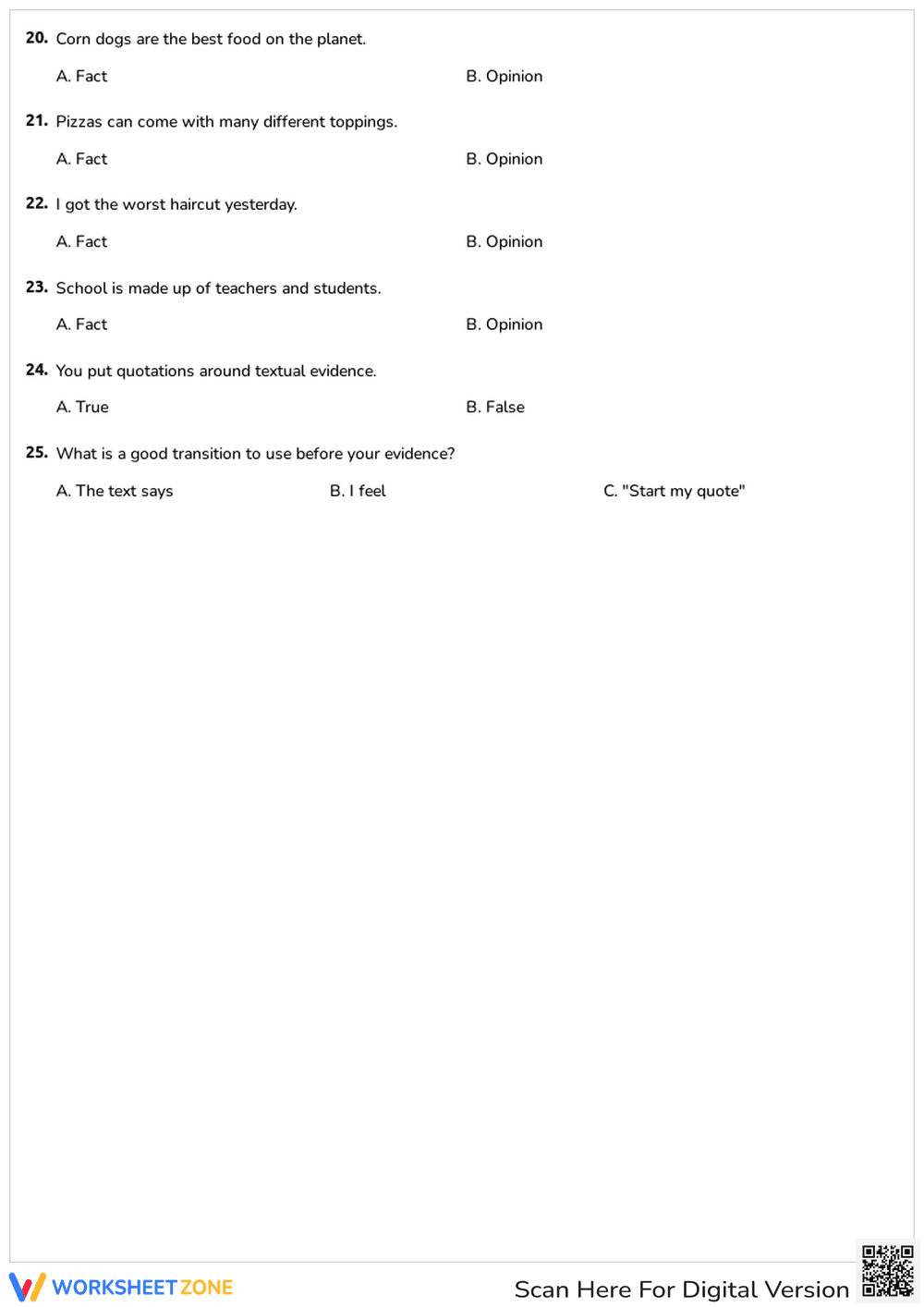
The resource spans three pages and contains 25 multiple-choice questions. It covers essential terminology such as rhetorical questions, transition phrases, and the structural parts of an essay including the introduction and conclusion. A complete answer key is provided to facilitate quick grading or student self-correction during classroom games. The layout is clean and professional, ensuring students stay focused on the content without visual distractions.
The zero-prep workflow is designed for maximum efficiency. First, print the three-page document (30 seconds). Second, distribute the packets to students for independent work or a competitive review game (1 minute). Finally, use the included answer key to review responses as a whole group (10 minutes). Total teacher preparation time is under two minutes, making this an ideal sub plan or emergency lesson for any writing unit.
This resource is aligned to CCSS.ELA-LITERACY.W.4.1, which requires students to write opinion pieces on topics or texts, supporting a point of view with reasons and information. It specifically targets the organizational aspects of the standard, such as using transition words and providing a concluding statement. Both standard codes can be copied directly into lesson plans, IEP goals, or district curriculum mapping tools.
Use this worksheet as a summative assessment at the end of a unit on persuasive techniques. Alternatively, assign it as a pre-assessment to identify which students struggle with differentiating between facts and opinions. During the activity, observe if students can correctly identify the purpose of a thesis statement, as this is a high-leverage indicator of writing readiness. Completion typically takes 20 to 30 minutes depending on the student level.
This review is tailored for Grade 3, 4, and 5 students who are learning the mechanics of opinion writing. It is particularly effective for English Language Learners who need explicit practice with transition phrases like "however" and "in addition." Pair this worksheet with a mentor text or an anchor chart detailing the OREO (Opinion, Reason, Evidence, Opinion) writing strategy for a complete instructional cycle.
The CCSS.ELA-LITERACY.W.4.1 standard emphasizes the importance of logical structure and evidence-based reasoning in student writing. According to Fisher & Frey (2014), the gradual release of responsibility model is most effective when students have a firm grasp of academic vocabulary and structural expectations before attempting independent composition. This worksheet bridges the gap between direct instruction and independent writing by reinforcing the language of the standard. By testing 25 distinct concepts, the resource ensures that students can identify the specific student actions—such as quoting evidence or using rhetorical questions—that lead to high-quality persuasive outcomes. Research from the NAEP suggests that students who can distinguish between fact and opinion are significantly more likely to score in the proficient range on standardized writing assessments. This tool provides the necessary repetition to solidify those critical distinctions in a low-stakes environment.


