




























Views
Downloads
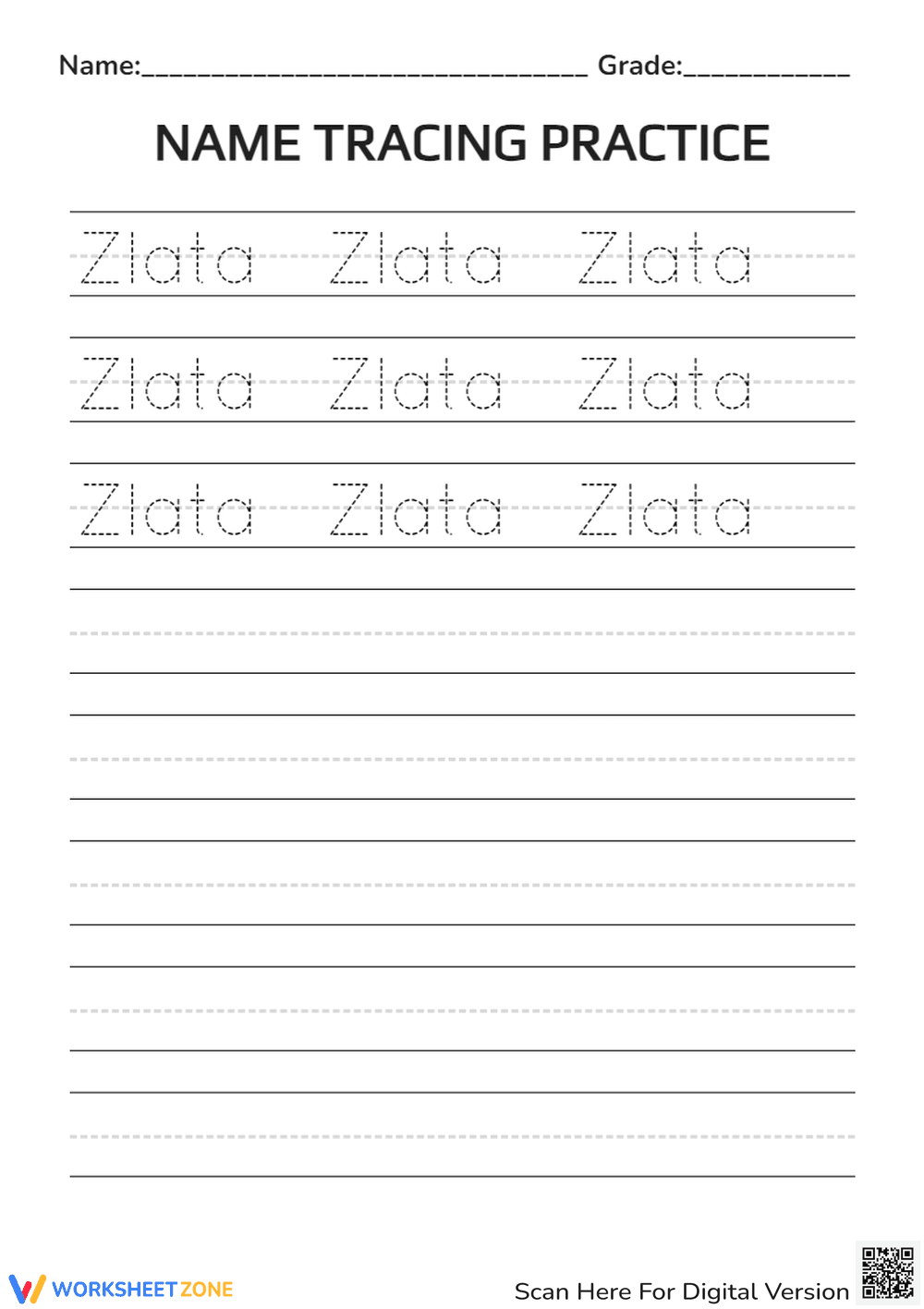

Printable Name Tracing Worksheet: Zlata | Grade K-1

Paste this activity's link or code into your existing LMS (Google Classroom, Canvas, Teams, Schoology, Moodle, etc.).
Students can open and work on the activity right away, with no student login required.
You'll still be able to track student progress and results from your teacher account.
This personalized name tracing worksheet helps early learners master writing the name Zlata while developing essential fine motor skills. By practicing proper letter formation, students build the foundational handwriting abilities needed for fluent writing. The structured layout guides children from tracing to independent writing with ease.
At a Glance
- Grade: K-1 · Subject: Handwriting
- Standard:
CCSS.ELA-LITERACY.L.K.1.A— Print many upper- and lowercase letters- Skill Focus: Name Tracing and Letter Formation
- Format: 1 page · 9 problems · No answer key needed · PDF
- Best For: Morning work or literacy centers
- Time: 10–15 minutes
This single-page printable features a distraction-free design. The top half provides nine dotted tracing models of the name Zlata, set on standard primary writing lines with dashed midlines. The bottom half offers five blank primary lines, encouraging students to transition from guided tracing to independent writing. No answer key is required.
Zero-Prep Workflow
- Print (1 minute): Download the PDF and print the desired copies. The black-and-white design is ink-friendly.
- Distribute (1 minute): Hand out during morning routines or center rotations. Instructions are self-evident.
- Review (0 minutes): Teachers can monitor progress as students work, requiring no formal grading key.
Total teacher prep time is under two minutes, making this excellent for sub plans.
Standards Alignment
This handwriting practice aligns with CCSS.ELA-LITERACY.L.K.1.A, requiring students to print many upper- and lowercase letters. It also supports CCSS.ELA-LITERACY.L.K.2.A by reinforcing proper capitalization of proper nouns. Both standard codes can be copied directly into lesson plans, IEP goals, or district curriculum mapping tools.
How to Use It
First, it serves as an ideal morning work activity; students can immediately begin tracing their name as they settle in, establishing a productive routine. Second, it functions perfectly within a literacy center focused on fine motor development. As a formative assessment tip, observe students' pencil grip and stroke direction while they trace to ensure they are not forming letters backward. Expected completion time is 10 to 15 minutes.
Who It's For
Designed for Kindergarten and first-grade students refining their handwriting skills. It is particularly beneficial for students needing targeted fine motor practice or occupational therapy support. To differentiate, teachers can provide pencil grips or highlight the bottom baseline for students struggling with spatial awareness. This worksheet pairs naturally with tactile letter formation activities, like tracing letters in sand, before moving to pencil and paper.
An EdReports 2024 analysis shows that explicit instruction in letter formation significantly impacts a student's broader writing fluency and reading comprehension. When students practice foundational skills aligned with CCSS.ELA-LITERACY.L.K.1.A, which focuses on the ability to print many upper- and lowercase letters, they effectively reduce the cognitive load required for physical writing. This crucial step allows young learners to dedicate more mental energy to idea generation and phonetic spelling in later grades. Structured tracing activities, like this personalized name practice, provide the necessary scaffolding to build muscle memory and spatial awareness on the page. By transitioning from guided dotted lines to independent practice, students develop the automaticity required for long-term academic success. Consistent, targeted practice in the early grades establishes a robust foundation that supports all future written communication tasks across the curriculum.


