




























Views
Downloads
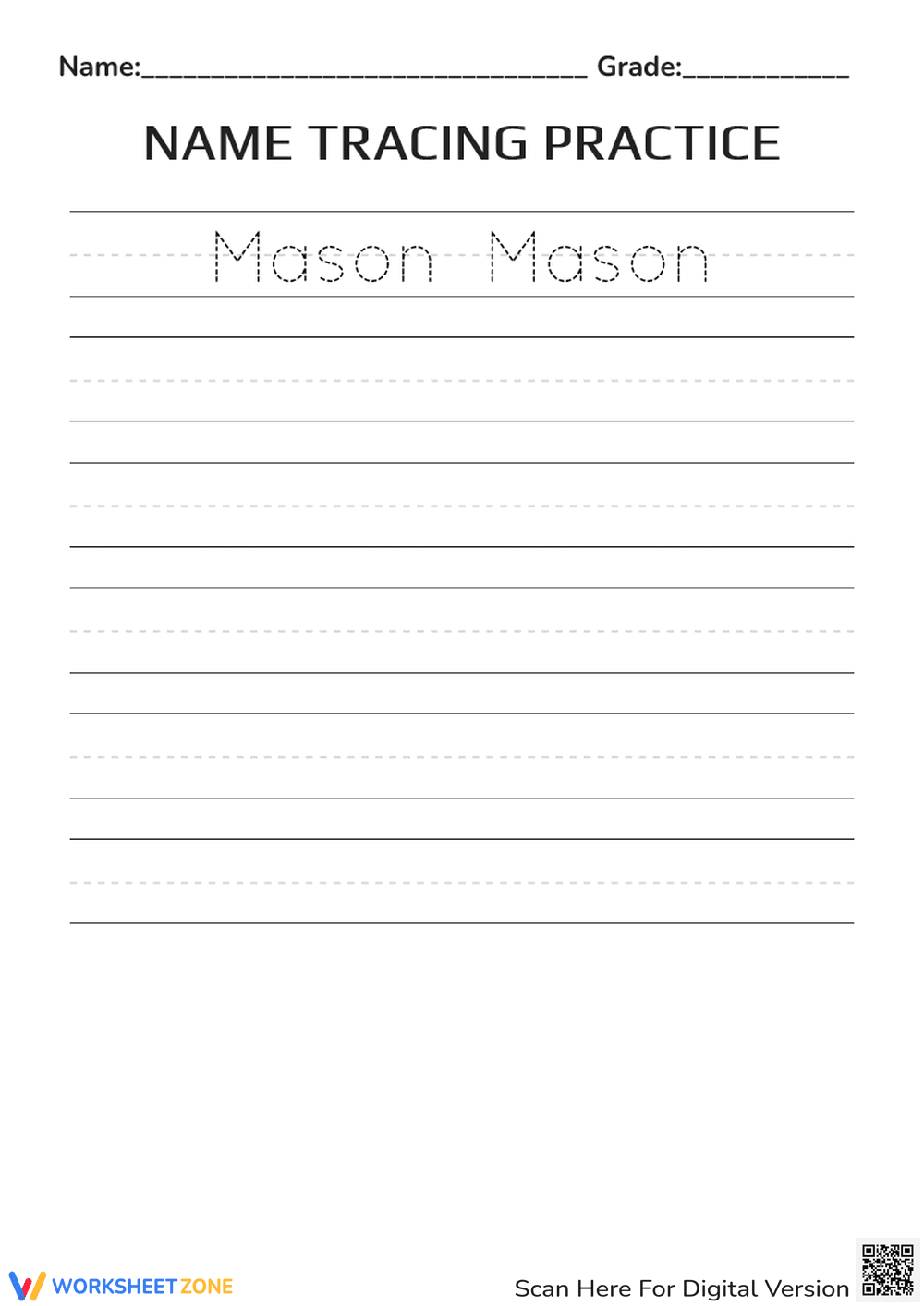

Mason Name Tracing Practice | Essential Grade K-1 Worksheet

Paste this activity's link or code into your existing LMS (Google Classroom, Canvas, Teams, Schoology, Moodle, etc.).
Students can open and work on the activity right away, with no student login required.
You'll still be able to track student progress and results from your teacher account.
This personalized handwriting worksheet helps early learners master the letter formations for the name 'Mason'. By combining guided tracing with independent practice, students develop the muscle memory and fine motor control necessary for legible penmanship. It provides a structured path from visual prompts to autonomous writing success.
At a Glance
- Grade: Kindergarten · Subject: Handwriting
- Standard:
CCSS.ELA-LITERACY.L.K.1.A— Print many upper- and lowercase letters correctly during writing tasks- Skill Focus: Proper letter formation and name recognition
- Format: 1 page · 10 practice lines · No answer key required · PDF
- Best For: Morning work or daily handwriting warm-ups
- Time: 5–10 minutes
The worksheet features a clean, distraction-free layout designed for young students. At the top, the name 'Mason' is presented twice in a large, dotted font to guide initial strokes. Below the guided section, eight additional primary-ruled lines provide ample space for students to transition into freehand writing. The use of standard dashed midlines helps children maintain consistent letter height and spacing throughout the exercise.
Zero-Prep Workflow
This resource is designed for immediate classroom implementation with teacher prep time under 60 seconds. First, print the single-page PDF for each student. Second, distribute the sheets during morning arrival or literacy centers, which takes less than one minute. Finally, review the completed work to check for proper pencil grip and stroke direction, providing instant feedback to the learner. It is an ideal choice for emergency sub plans.
Standards Alignment
This activity aligns with `CCSS.ELA-LITERACY.L.K.1.A`, which requires students to print many upper- and lowercase letters. By focusing on a high-frequency, high-interest word like their own name, students engage more deeply with the mechanics of letter construction. Both standard codes can be copied directly into lesson plans, IEP goals, or district curriculum mapping tools.
How to Use It
Use this worksheet as a consistent morning arrival activity to settle students and focus their attention on fine motor tasks. Alternatively, assign it as a targeted intervention for students struggling with specific letter shapes found in the name 'Mason', such as the arched 'n' or the slanted 'M'. Observe the student's starting point for each letter to ensure they are following top-to-bottom conventions.
Who It's For
This resource is ideal for Kindergarten and first-grade students beginning their formal writing journey. It is effective for English Language Learners building print awareness and students with occupational therapy goals related to grip strength. Pair this worksheet with a tactile sand tray or a large-scale anchor chart demonstrating proper stroke order.
Handwriting remains a foundational literacy skill, as research by Fisher & Frey (2014) emphasizes that the physical act of writing letters by hand supports orthographic mapping and long-term memory retention. This worksheet targets CCSS.ELA-LITERACY.L.K.1.A by providing a structured environment for students to practice printing upper- and lowercase letters within a meaningful context. The transition from dotted-line tracing to independent production follows the gradual release of responsibility model, ensuring students build confidence before working without scaffolds. According to recent NAEP data, early mastery of handwriting is a strong predictor of later writing fluency and academic achievement. By focusing on the name 'Mason', this tool leverages personal relevance to increase student engagement and persistence during repetitive motor tasks. The clear primary ruling ensures that students develop an internal sense of letter proportion and baseline alignment, which are critical components of legible communication in early elementary education.


