




























Views
Downloads
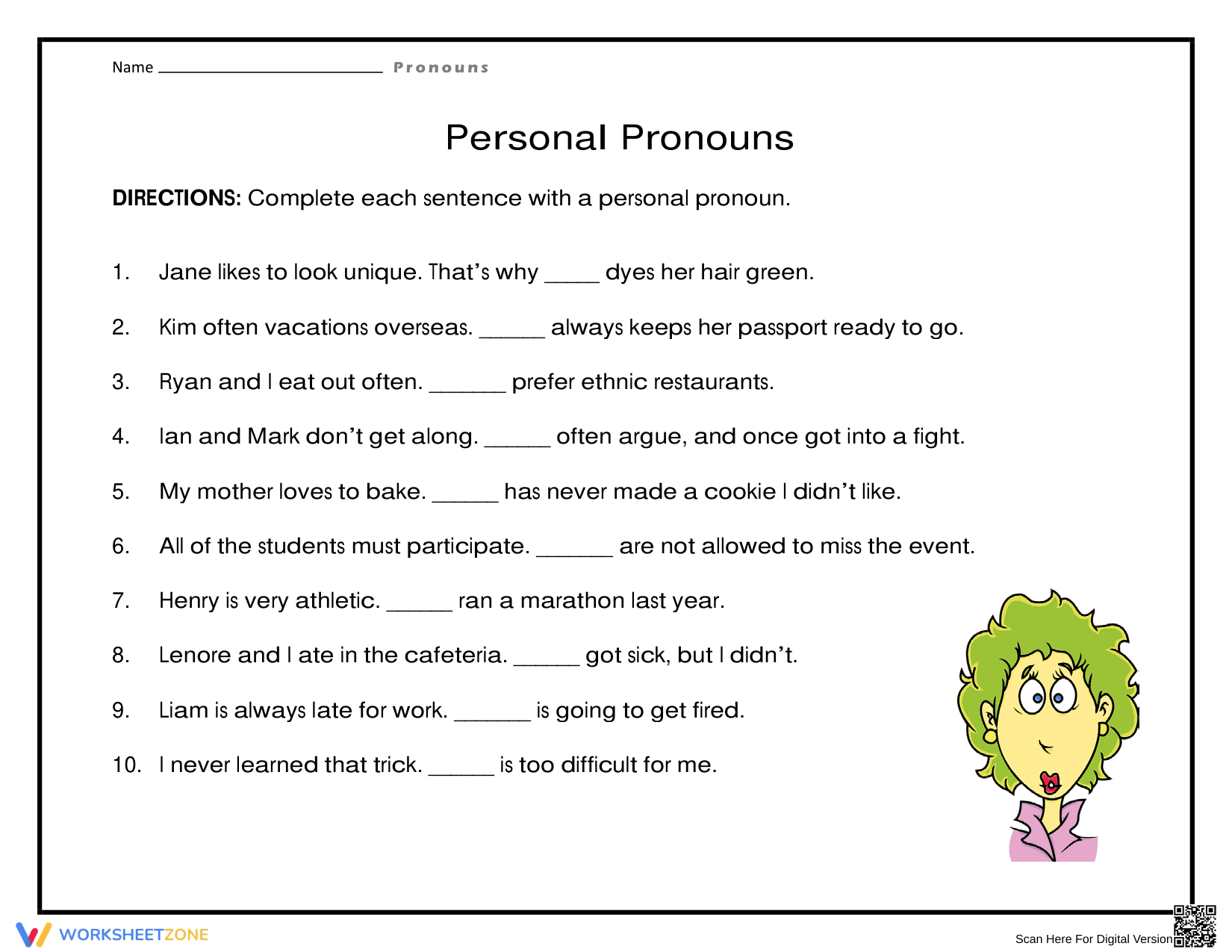

Essential Personal Pronouns Worksheet | Grade 3 English

Paste this activity's link or code into your existing LMS (Google Classroom, Canvas, Teams, Schoology, Moodle, etc.).
Students can open and work on the activity right away, with no student login required.
You'll still be able to track student progress and results from your teacher account.
This essential personal pronouns worksheet helps Grade 3 students master grammar by identifying and using the correct pronoun in context. By replacing nouns with personal pronouns like he, she, they, and we, learners build foundational writing skills and improve sentence variety. This printable resource ensures students can accurately identify antecedents and apply pronoun-verb agreement rules.
At a Glance
- Grade: 3 · Subject: English Language Arts
- Standard:
CCSS.ELA-LITERACY.L.1.1.D— Use personal, possessive, and indefinite pronouns in sentences accurately.- Skill Focus: Personal Pronoun Identification & Usage
- Format: 1 page · 10 problems · Answer key included · PDF
- Best For: Grammar warm-ups and formative assessment
- Time: 15–20 minutes
This single-page PDF features 10 carefully crafted fill-in-the-blank sentences designed to test a student's ability to select the appropriate personal pronoun based on context clues. The worksheet includes a clear title and directions, with a friendly illustration to engage young learners. A complete answer key is provided to facilitate quick grading and immediate student feedback.
The worksheet follows a structured skill progression. Guided practice begins with singular subjects (Jane, Kim) to establish patterns of noun substitution. Supported practice introduces plural subjects (Ryan and I, Ian and Mark), requiring students to differentiate between collective and third-person pronouns. Finally, independent practice challenges students with varied sentence structures. This approach supports the gradual-release model, moving students from basic identification to confident application.
The primary standard addressed is CCSS.ELA-LITERACY.L.1.1.D, which requires students to use personal, possessive, and indefinite pronouns correctly. This activity specifically focuses on the personal aspect of the standard, ensuring students understand how pronouns function as subjects within a sentence. This standard code can be copied directly into lesson plans, IEP goals, or district curriculum mapping tools to track grammar proficiency.
Use this worksheet as a formative assessment during a grammar unit on parts of speech. It is particularly effective as a ticket-out-the-door activity after direct instruction on personal pronouns. Alternatively, assign it for independent practice during literacy rotations. Teachers should observe whether students can identify the gender and number of the antecedent before selecting their answer. Expected completion time is approximately 15 minutes.
This resource is designed for Grade 3 students but is highly adaptable for Grade 1-5 learners who need additional grammar support. It is an excellent tool for English Language Learners (ELL) who are developing an understanding of English pronoun systems. Pair this worksheet with a personal pronouns anchor chart or a short reading passage to reinforce the concept across multiple instructional modalities.
Mastering personal pronouns is a critical milestone in early literacy development, as it directly impacts a student's ability to produce coherent and varied prose. According to the RAND AIRS 2024 reports on foundational writing skills, explicit instruction in grammar mechanics like pronoun usage significantly improves overall writing quality and reading comprehension. This worksheet targets CCSS.ELA-LITERACY.L.1.1.D by providing 10 specific opportunities for students to practice using personal pronouns such as I, you, he, she, it, we, and they in context. By reinforcing the relationship between a noun and its pronoun substitute, students develop the syntactic awareness necessary for complex sentence construction. Research from Fisher & Frey (2014) highlights that structured practice in grammar leads to more effective language use in both oral and written communication. This printable resource offers a focused, data-driven method for teachers to assess and improve student mastery of essential English grammar standards while maintaining a manageable classroom workflow.


