


























Views
Downloads


Personal Pronouns Worksheet | Grade 1-3 Printable
Paste this activity's link or code into your existing LMS (Google Classroom, Canvas, Teams, Schoology, Moodle, etc.).
Students can open and work on the activity right away, with no student login required.
You'll still be able to track student progress and results from your teacher account.
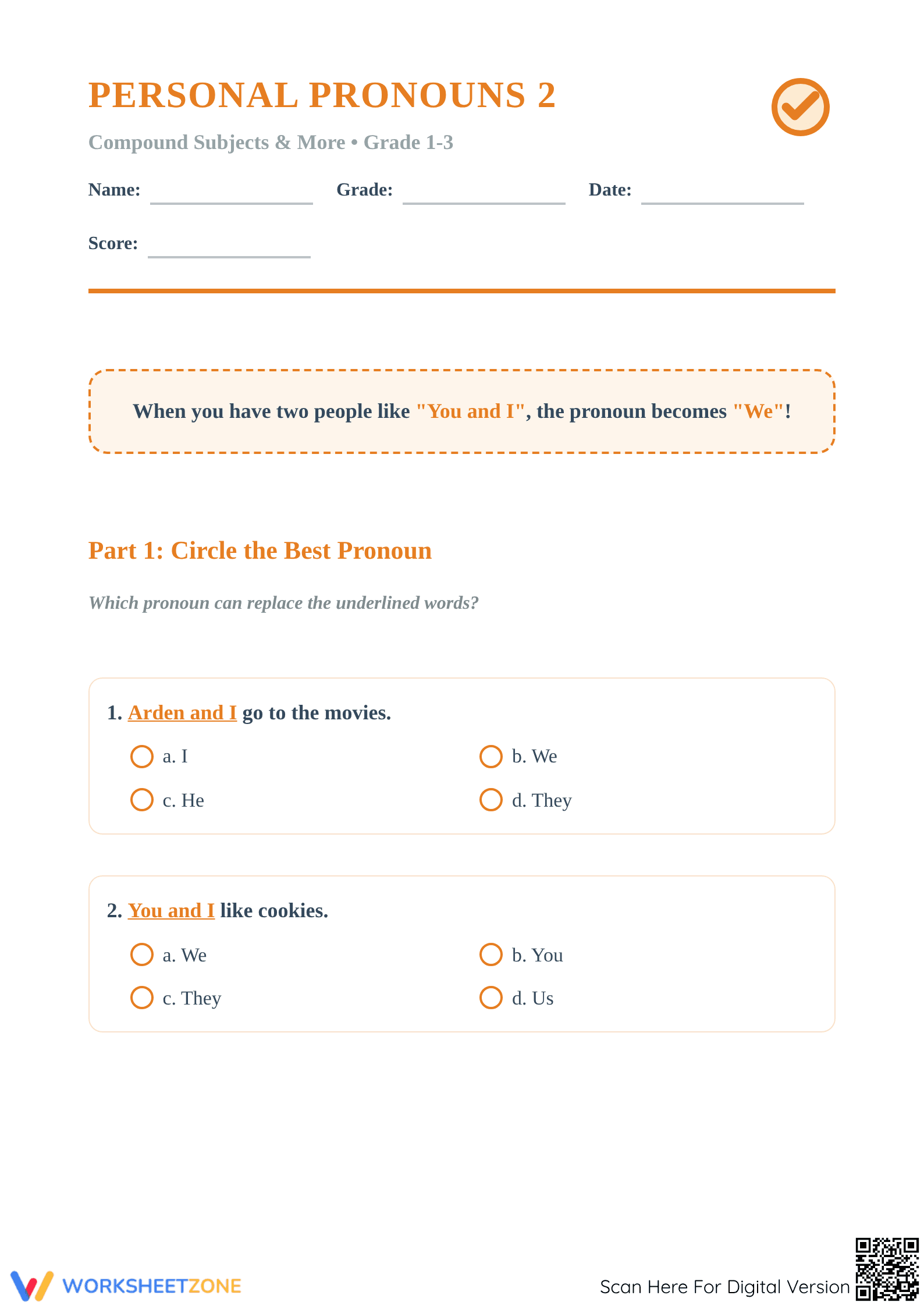
This comprehensive personal pronouns worksheet helps students in Grades 1 through 3 master the art of replacing complex nouns and compound subjects with the correct functional words. By focusing on tricky combinations like "You and I" or "Ben and Jerry," students develop the grammatical precision needed for fluent writing and clear communication. This resource ensures learners can identify and apply pronouns across various sentence structures.
At a Glance
- Grade: 1-3 · Subject: ELA
- Standard:
CCSS.ELA-LITERACY.L.1.1.D— Use personal, possessive, and indefinite pronouns correctly in sentences- Skill Focus: Personal pronouns and compound subjects
- Format: 4 pages · 16 problems · Answer key included · PDF
- Best For: Independent practice or sub plans
- Time: 20–30 minutes
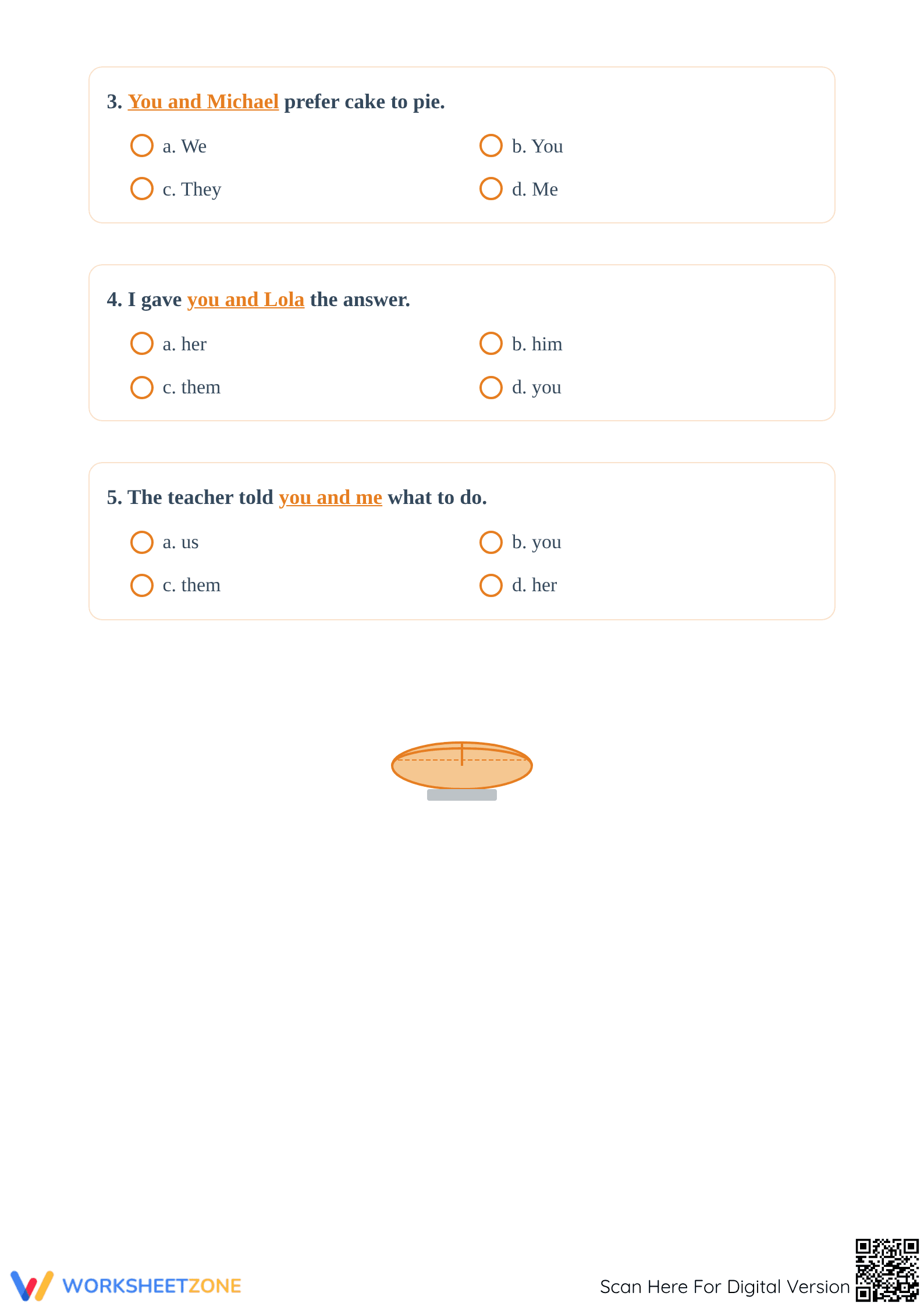
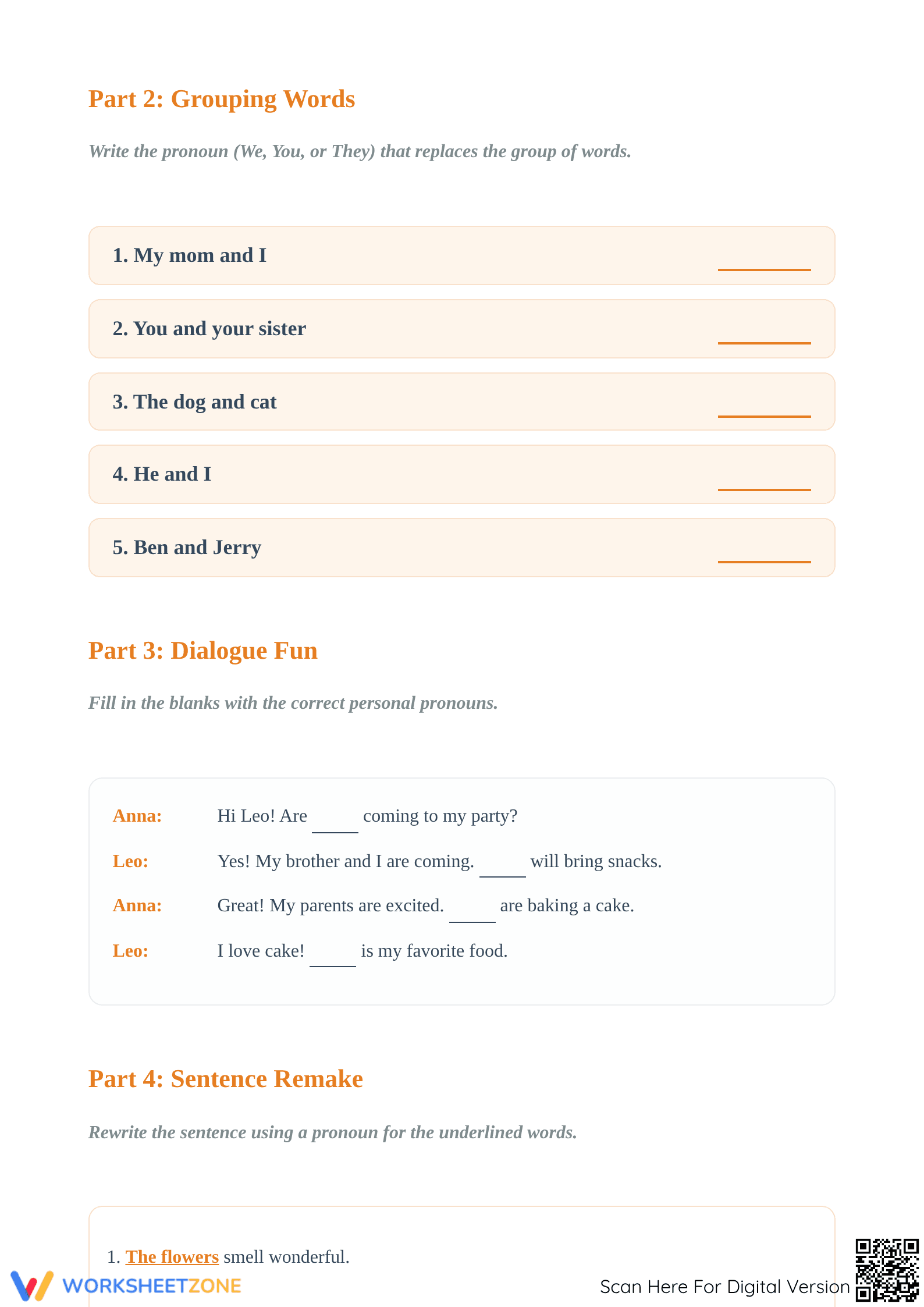
What's Inside: This 4-page PDF contains four distinct sections designed to build confidence. It includes five multiple-choice questions for initial identification, five grouping tasks for compound subjects, a four-part dialogue completion exercise, and two sentence-rewriting challenges. A full answer key is provided, featuring mirrored layouts for rapid grading and immediate student feedback.
Zero-Prep Workflow
- Print (1 minute): Select the specific pages needed for your lesson or print the entire 4-page packet for a comprehensive review session.
- Distribute (30 seconds): Hand out the worksheets as a morning warm-up, a literacy center activity, or a quiet task for early finishers.
- Review (30 seconds): Use the included answer key to check student work or project it on a whiteboard for a whole-class self-correction exercise.
This resource requires zero teacher setup, making it an ideal choice for emergency substitute folders or last-minute grammar reinforcements.
Standards Alignment: The primary focus is `CCSS.ELA-LITERACY.L.1.1.D`, which requires students to use personal, possessive, and indefinite pronouns. The worksheet specifically targets the transition from concrete nouns to functional pronouns. Both standard codes can be copied directly into lesson plans, IEP goals, or district curriculum mapping tools.
How to Use It: Assign this worksheet during the "You Do" phase of a gradual release lesson on word classes. It serves as an excellent formative assessment tool; observe how students handle Part 2 to see if they understand that "You and I" always becomes "We." Expect most students to complete the 16 tasks within a 25-minute instructional block.
Who It's For: This resource is designed for elementary students in Grades 1-3, but it is also highly effective for ESL/ELL learners who struggle with English subject-verb-pronoun agreement. It pairs naturally with a short reading passage or a classroom anchor chart detailing common pronoun replacements.
According to the RAND AIRS 2024 analysis of instructional materials, high-quality ELA resources must provide explicit practice in functional grammar to bridge the gap between isolated skill acquisition and applied writing fluency. This worksheet addresses that need by moving students through a four-stage progression from simple identification to active sentence construction. By targeting the CCSS.ELA-LITERACY.L.1.1.D standard, the material ensures that Grade 1-3 learners develop a foundational understanding of personal pronouns, which is a critical precursor to mastering complex sentence structures in later elementary years. Research indicates that repetitive, structured practice with compound subjects—such as transforming "You and Michael" into "You"—reduces cognitive load during the drafting phase of the writing process. This 4-page document provides the necessary scaffolding to ensure that students can accurately substitute pronouns in both narrative dialogue and informational text contexts, supporting long-term retention of core linguistic functions.


