


























Views
Downloads


Personal Pronouns Practice | Essential Grade 1-3 Worksheet
Paste this activity's link or code into your existing LMS (Google Classroom, Canvas, Teams, Schoology, Moodle, etc.).
Students can open and work on the activity right away, with no student login required.
You'll still be able to track student progress and results from your teacher account.
This Grade 1-3 personal pronouns worksheet helps students master the art of replacing nouns with appropriate subject and object pronouns. By engaging with multiple task types, learners develop a concrete understanding of how pronouns function within sentences to reduce repetition and improve flow. It provides immediate practice for foundational grammar skills.
At a Glance
- Grade: 1-3 · Subject: ELA
- Standard:
CCSS.ELA-LITERACY.L.1.1.D— Use personal, possessive, and indefinite pronouns correctly in sentences.- Skill Focus: Personal Pronoun Identification
- Format: 4 pages · 16 problems · Answer key included · PDF
- Best For: Independent practice or sub plans
- Time: 20–30 minutes
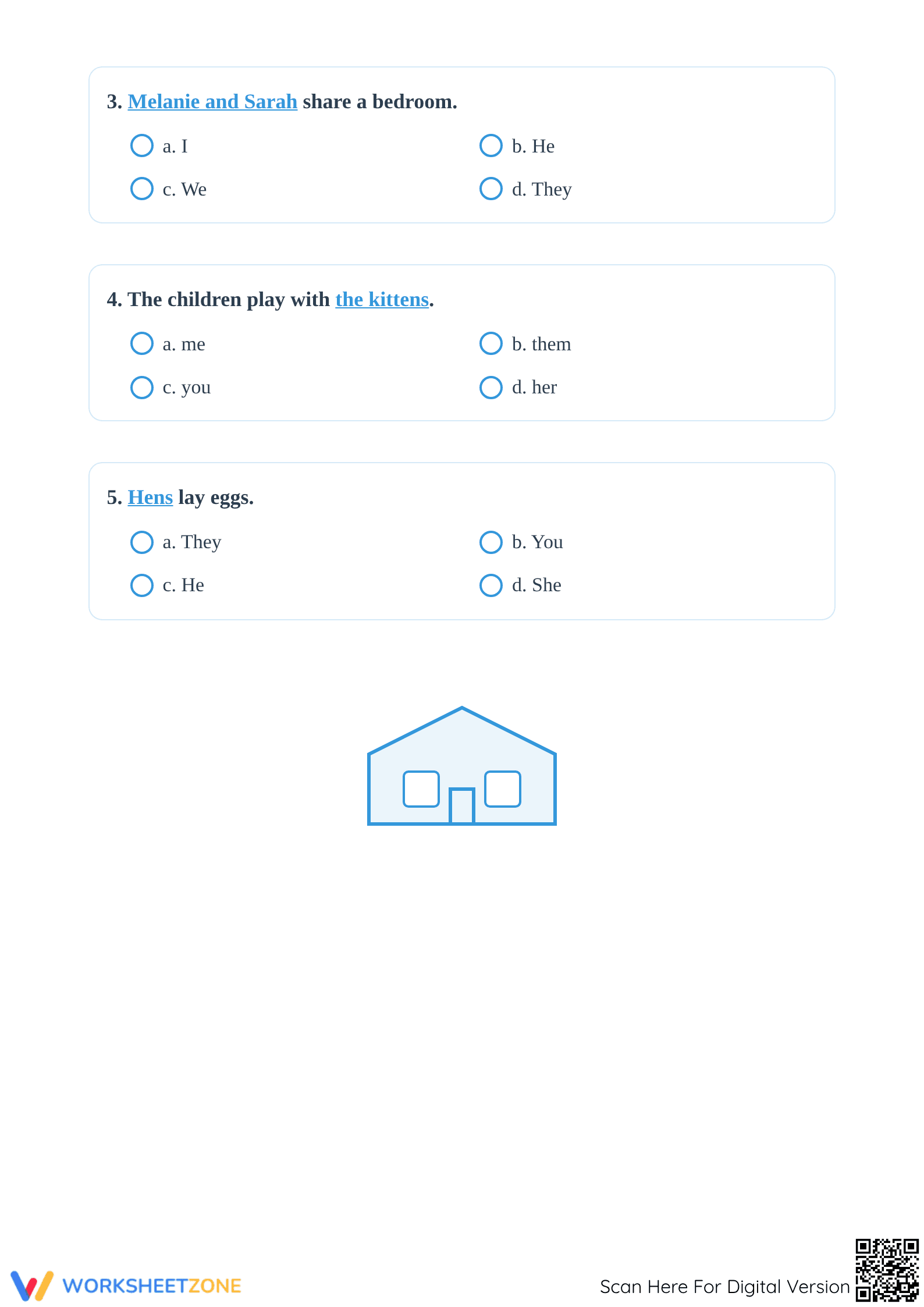
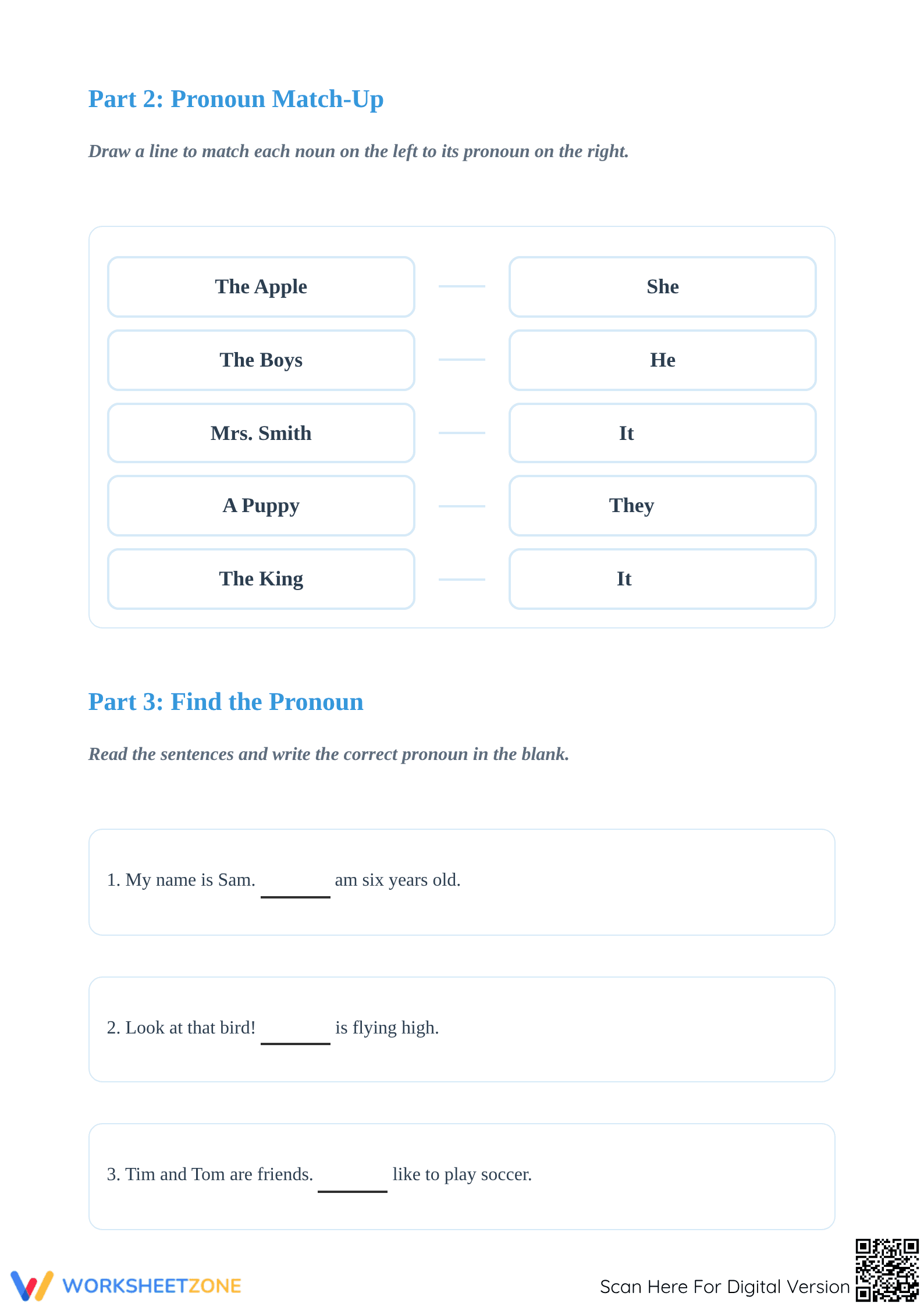
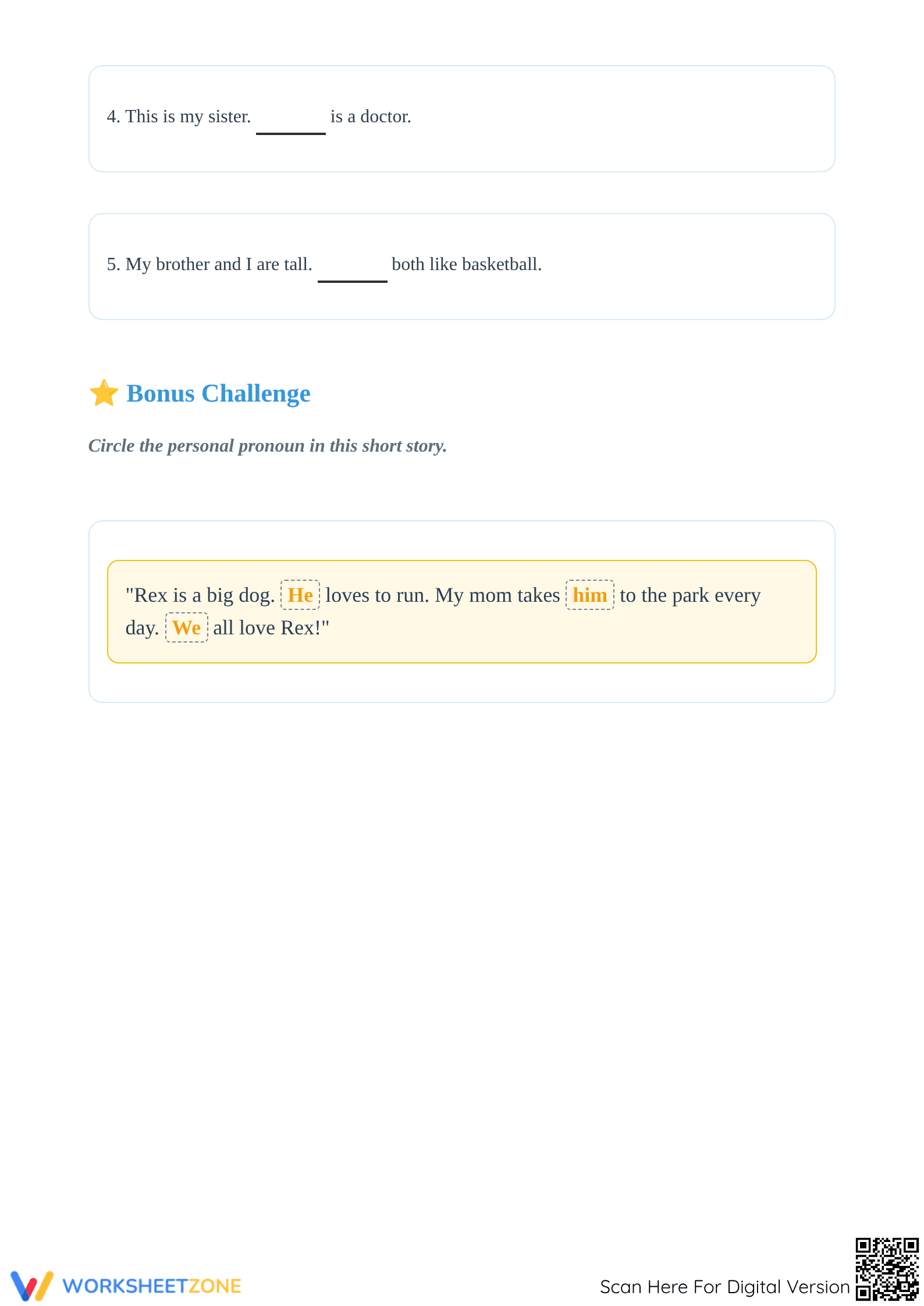
This comprehensive 4-page PDF contains a clear definition of personal pronouns followed by three distinct practice sections. Students encounter multiple-choice questions, a matching activity connecting nouns to pronouns, and fill-in-the-blank sentences. A bonus challenge at the end requires circling pronouns within a short narrative. A full 4-page answer key is provided for quick grading.
Teachers can implement this resource in under two minutes. Simply print the 4-page packet (1 minute), distribute it to students with a brief explanation of the pronoun definition provided at the top (30 seconds), and use the included answer key for rapid review or self-correction (30 seconds). Its self-explanatory nature makes it an ideal emergency sub plan.
This resource aligns with CCSS.ELA-LITERACY.L.1.1.D: "Use personal, possessive, and indefinite pronouns (e.g., I, me, my; they, them, their, anyone, everything)." It specifically targets the identification and substitution of personal pronouns in various sentence contexts. Both standard codes can be copied directly into lesson plans, IEP goals, or district curriculum mapping tools.
Use this worksheet during the independent practice phase of a lesson on word classes. It serves as an excellent formative assessment after a direct instruction session on subject pronouns. Alternatively, assign it as a homework packet to reinforce the concept of noun-pronoun agreement. Expect students to complete the full set in 20 to 30 minutes.
This resource is designed for general education students in Grades 1 through 3, as well as English Language Learners (ELL) who need structured practice with English syntax. It pairs naturally with a classroom anchor chart displaying common pronouns or a short reading passage where students can highlight pronouns before completing the written tasks.
According to the RAND AIRS 2024 report on instructional materials, high-quality supplemental resources that provide varied task formats—such as the matching, multiple-choice, and fill-in-the-blank exercises found here—significantly improve student retention of grammatical rules. This worksheet addresses CCSS.ELA-LITERACY.L.1.1.D by moving students from simple identification to active application within sentences. By providing 16 distinct opportunities for practice across 4 pages, the resource ensures that Grade 1-3 learners can confidently replace nouns with personal pronouns like "he," "she," "it," and "they." Research indicates that explicit instruction in pronoun usage is a critical component of early literacy development, preventing common errors in subject-verb agreement and sentence structure. This printable PDF offers a structured pathway to mastery, supported by a complete answer key for immediate feedback.


