


























Views
Downloads
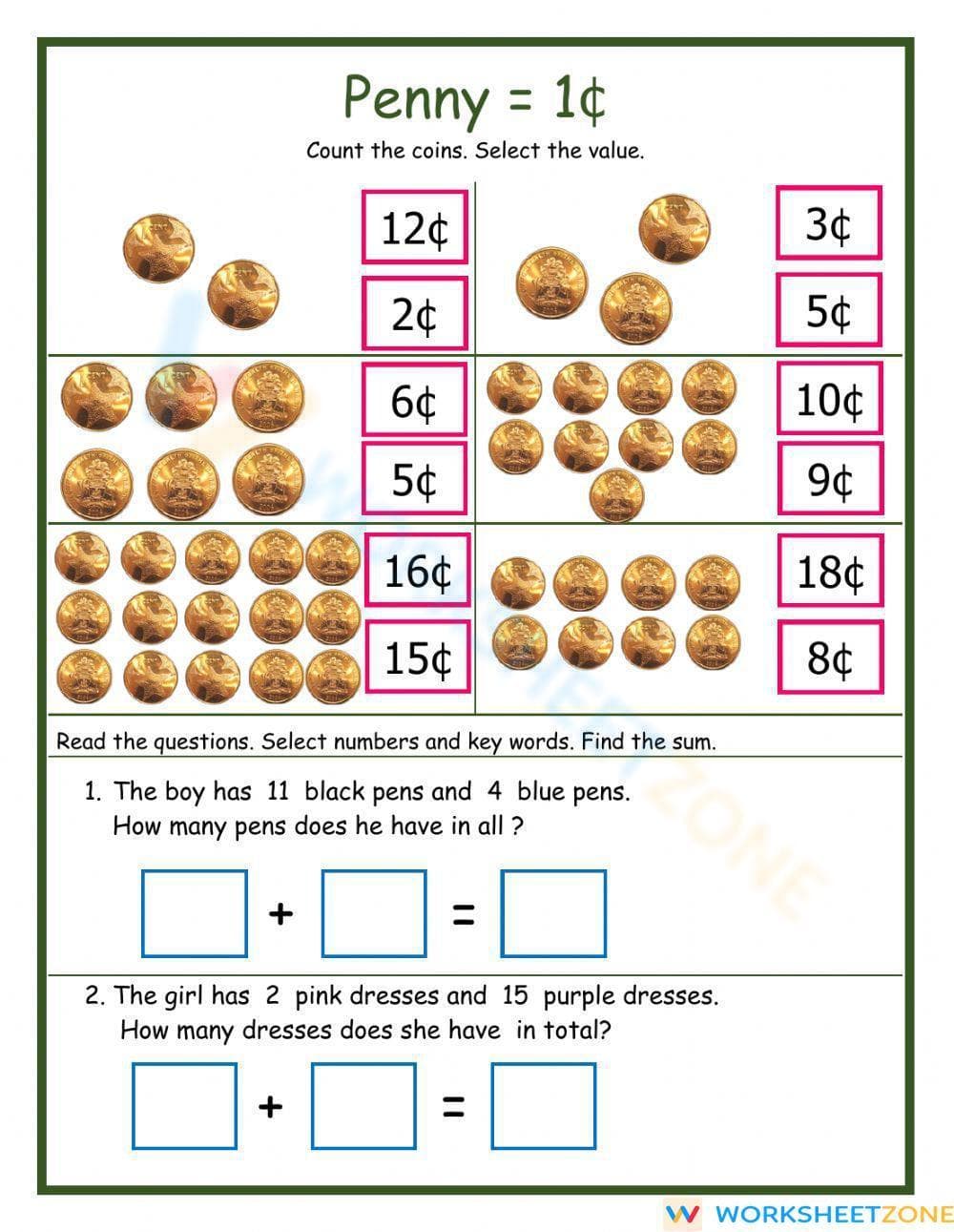

Penny Counting & Addition Printable | Grade 1 Math
Paste this activity's link or code into your existing LMS (Google Classroom, Canvas, Teams, Schoology, Moodle, etc.).
Students can open and work on the activity right away, with no student login required.
You'll still be able to track student progress and results from your teacher account.
This Grade 1 math worksheet provides targeted practice with counting pennies and solving basic addition word problems. Students build foundational currency skills by determining the value of coin groups before applying their knowledge to real-world addition scenarios. This resource strengthens both one-to-one correspondence and early algebraic thinking.
At a Glance
- Grade: 1 · Subject: Math
- Standard:
CCSS.MATH.CONTENT.1.OA.A.1— Solve addition word problems within 20- Skill Focus: Counting pennies and addition
- Format: 1 page · 6 problems · Answer key included · PDF
- Best For: Independent practice and review
- Time: 10–15 minutes
This single-page resource features two distinct sections to build mathematical fluency. The top half includes four visual counting tasks where students determine the total value of penny clusters and select the correct amount. The bottom half presents two addition word problems complete with structured equation boxes, guiding learners to identify key numbers and calculate the final sum. A complete answer key is provided for quick grading.
Zero-Prep Workflow
This worksheet allows for immediate classroom implementation.
- Print (1 minute): Simply download the PDF and print copies for your class. The clear, high-contrast design ensures excellent readability.
- Distribute (1 minute): Hand out the worksheets during math centers or morning work. The instructions are straightforward and student-friendly.
- Review (3 minutes): Use the included answer key to quickly check student responses or project it on the board for whole-class self-correction.
With under two minutes of total teacher prep time, this activity is highly suitable for emergency sub plans or spontaneous skill reinforcement.
Standards Alignment
This resource is aligned to primary standard CCSS.MATH.CONTENT.1.OA.A.1, requiring students to use addition and subtraction within 20 to solve word problems involving situations of adding to, taking from, putting together, taking apart, and comparing. It also supports foundational counting skills. Both standard codes can be copied directly into lesson plans, IEP goals, or district curriculum mapping tools.
How to Use It
Deploy this worksheet during independent math centers after direct instruction. It serves as an excellent formative assessment tool; observe whether students count the pennies one by one or if they can subitize smaller groups. Alternatively, use it as morning work to activate prior knowledge before introducing higher-value coins like nickels and dimes. Expected completion time ranges from 10 to 15 minutes depending on the student's reading level for the word problems.
Who It's For
This resource is primarily designed for first-grade students mastering early addition and basic currency concepts. It is also appropriate for kindergarteners needing an extension activity or second graders requiring foundational review. Teachers can provide physical pennies as manipulatives. Pair this worksheet with a whole-group anchor chart detailing coin names and values to maximize student success.
Mastering early mathematical concepts requires consistent, structured practice that connects abstract numbers to concrete visual representations. This worksheet directly addresses CCSS.MATH.CONTENT.1.OA.A.1 by challenging students to solve addition word problems within 20. According to a recent EdReports 2024 analysis, instructional materials that integrate visual models with numerical equations significantly improve early elementary students' problem-solving capabilities and overall mathematical retention. By combining visual coin counting with structured equation building, this resource bridges the gap between basic counting and early algebraic thinking. The dual-format approach ensures that young learners not only memorize coin values but also apply numerical reasoning to practical, real-world scenarios. Regular engagement with these types of mixed-skill activities fosters greater mathematical fluency, reduces cognitive load during assessments, and builds the necessary confidence for tackling more complex operations in subsequent grade levels.


