




























Views
Downloads

Printable PEMDAS Order of Operations Worksheet | Grade 5-9

Paste this activity's link or code into your existing LMS (Google Classroom, Canvas, Teams, Schoology, Moodle, etc.).
Students can open and work on the activity right away, with no student login required.
You'll still be able to track student progress and results from your teacher account.
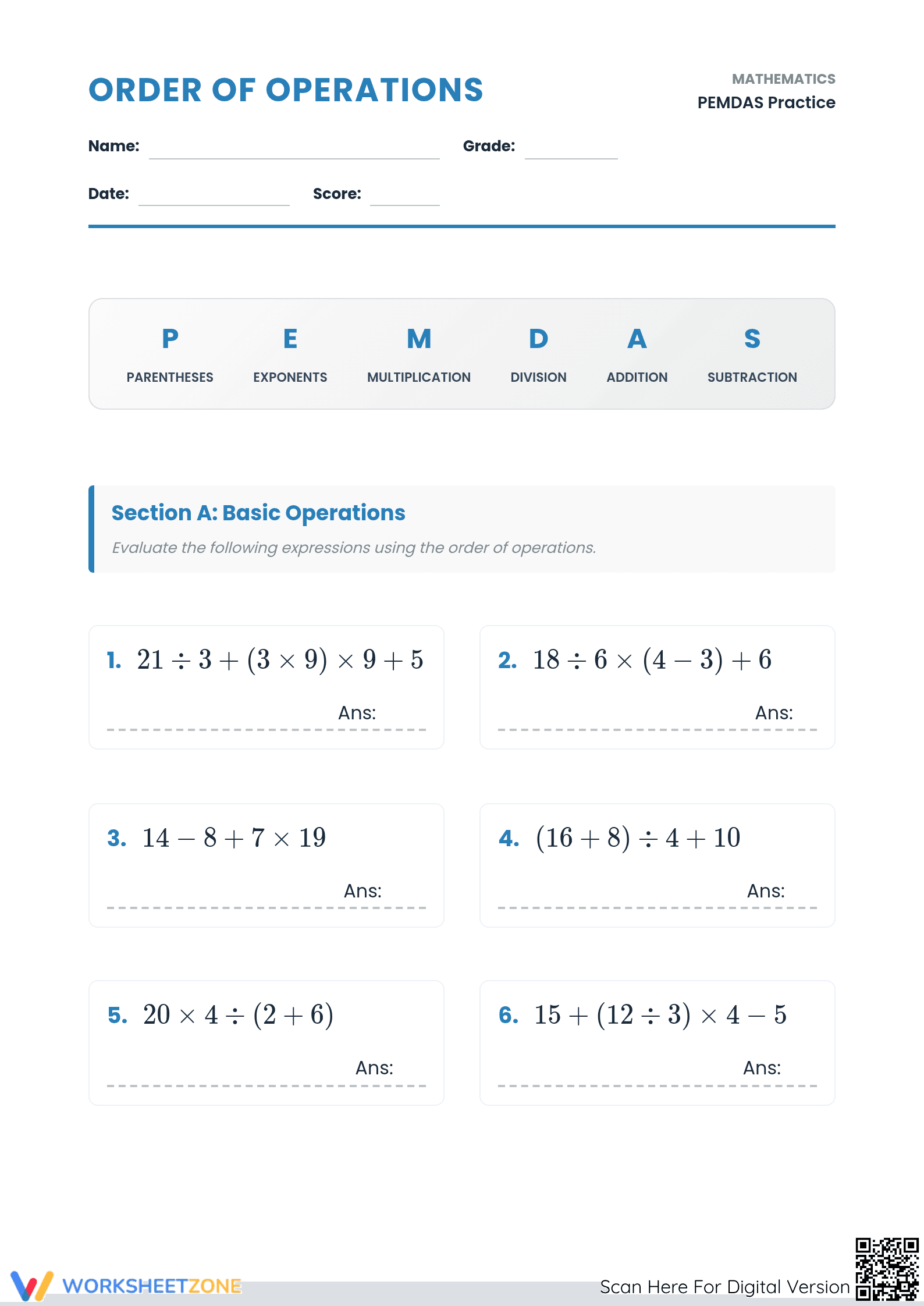
This comprehensive Order of Operations worksheet provides structured practice for students to master the PEMDAS sequence through 24 increasingly complex numerical expressions. Students evaluate problems involving parentheses, exponents, multiplication, division, addition, and subtraction. Learners build the procedural fluency required for success in middle school algebra and beyond.
At a Glance
- Grade: 5–9 · Subject: Math
- Standard:
5.OA.A.1— Use parentheses and brackets in numerical expressions and evaluate those symbols- Skill Focus: Order of Operations (PEMDAS)
- Format: 3 pages · 24 problems · Answer key included · PDF
- Best For: Independent practice and formative assessment
- Time: 25–40 minutes
What's Inside
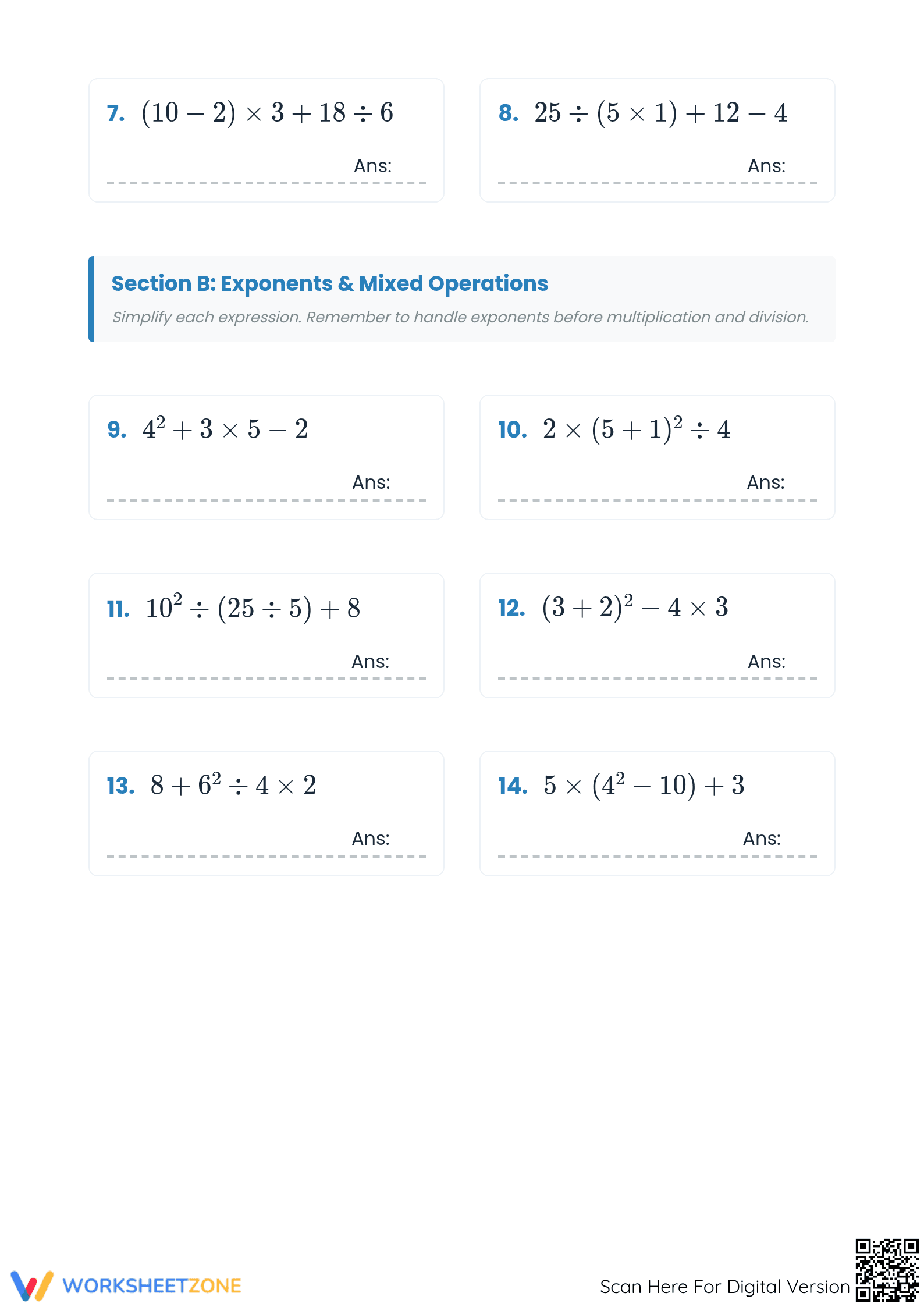
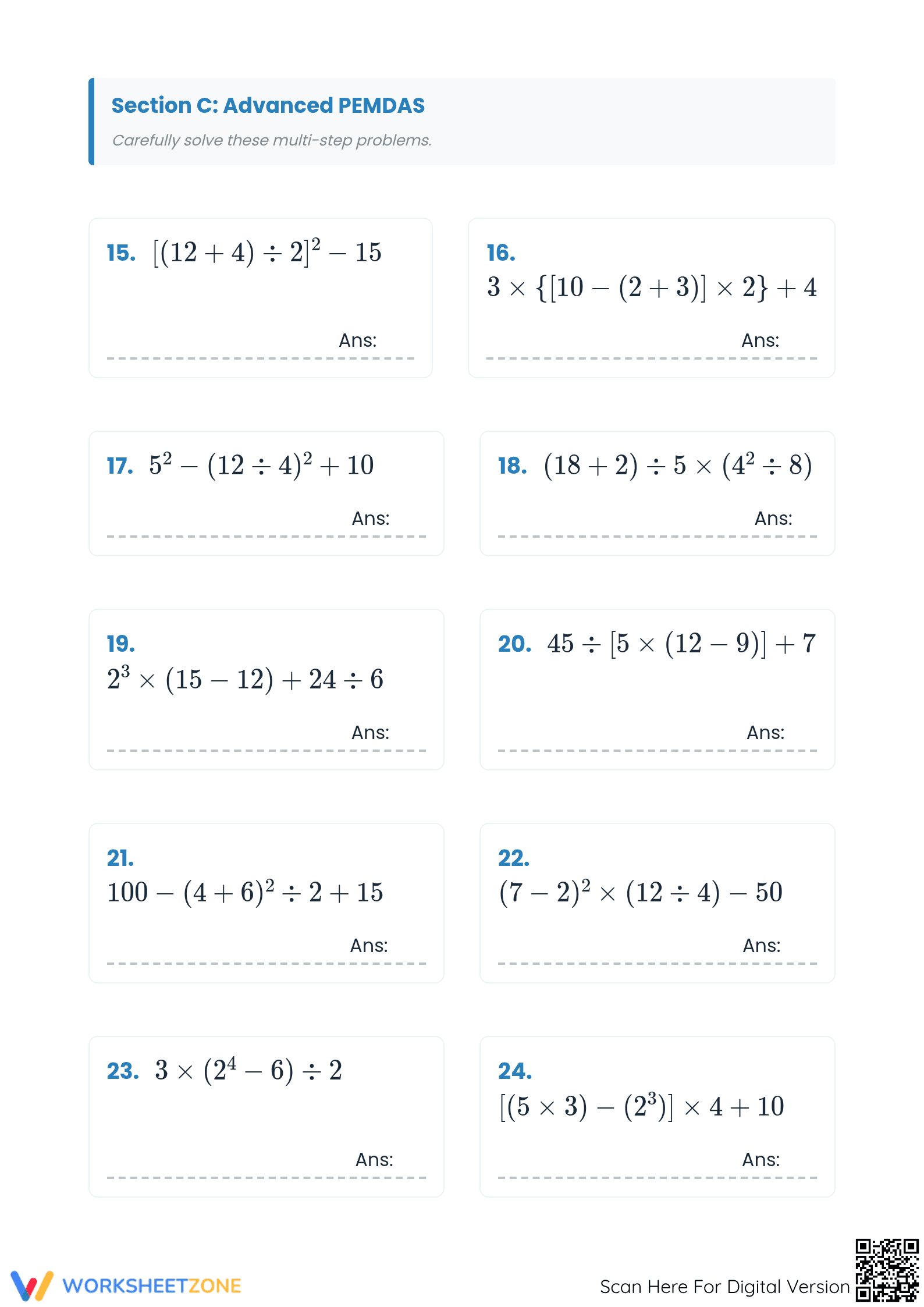
This 3-page PDF features three sections designed to scaffold learning. Section A focuses on basic operations and simple grouping. Section B introduces exponents and mixed operations. Section C challenges students with advanced PEMDAS problems, including nested parentheses and brackets. Each page includes clear headers and whitespace for work, accompanied by a full answer key.
Zero-Prep Workflow
Implementing this activity requires minimal teacher effort, perfect for busy classrooms or substitute plans. Simply print the 3-page packet, distribute copies to students, and use the included answer key for quick review. The total teacher preparation time is under two minutes, allowing you to focus on direct instruction rather than materials assembly.
Standards Alignment
The primary focus of this worksheet is 5.OA.A.1, which requires students to use parentheses, brackets, or braces in numerical expressions and evaluate expressions with these symbols. It also supports 6.EE.A.2.C by incorporating whole-number exponents into the order of operations sequence. Both standard codes can be copied directly into lesson plans, IEP goals, or district curriculum mapping tools to ensure instructional alignment.
How to Use It
Use this worksheet as an independent practice activity following a direct instruction lesson on the hierarchy of mathematical operations. It serves as an excellent mid-unit formative assessment to identify students who struggle with specific PEMDAS steps, such as handling exponents before multiplication. Expected completion time ranges from 25 to 40 minutes depending on the student's familiarity with nested grouping symbols.
Who It's For
This resource is designed for students in grades 5 through 9. It is effective for students requiring extra practice with multi-step calculations. For differentiation, teachers can assign specific sections based on readiness, pairing the worksheet with a PEMDAS anchor chart or tutorial for students who need visual reminders of the operation sequence.
Effective instruction in the order of operations is a foundational pillar for algebraic readiness. According to a RAND AIRS 2024 analysis, students who achieve procedural fluency in evaluating complex numerical expressions early in their mathematical development demonstrate significantly higher success rates in higher-level courses. This worksheet targets the 5.OA.A.1 standard, specifically the ability to evaluate expressions containing multiple grouping symbols like parentheses and brackets. By providing 24 scaffolded problems, the resource ensures that students encounter a wide variety of operation combinations, including the critical integration of exponents. Research from Fisher & Frey (2014) highlights the importance of guided practice and scaffolded difficulty in mathematical tasks to support the gradual release of responsibility. This resource applies these principles through its three-section structure, moving from basic calculations to advanced multi-step problems, ensuring students build the confidence and accuracy needed for district assessments and standardized testing environments.


