




























0
Views
0
Downloads

0.0
0
Save
0 Likes
Share
Pedro's Pool Party- Geometry Performance Task
0 Views
0 Downloads

Paste this activity's link or code into your existing LMS (Google Classroom, Canvas, Teams, Schoology, Moodle, etc.).
Students can open and work on the activity right away, with no student login required.
You'll still be able to track student progress and results from your teacher account.
Information
Description
What It Is:
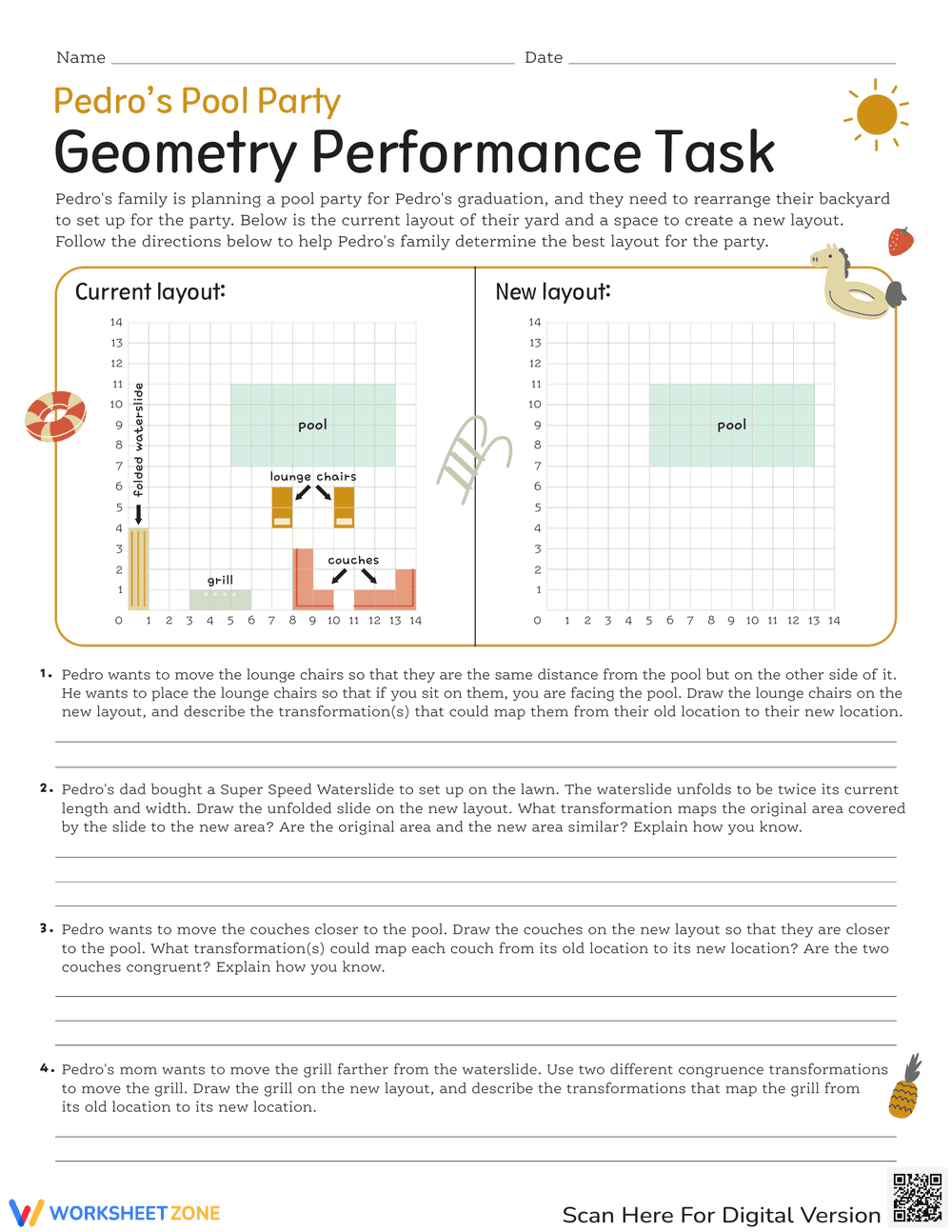
A real-world geometry performance task where students analyze two layouts of a backyard and use geometric transformations to redesign the space. Students must interpret the coordinate grids, identify movement of objects, and apply transformations such as translations, reflections, rotations, and dilations. The task includes four open-ended prompts requiring students to draw new positions for objects, justify transformations, and explain similarity relationships.
Why Use It:
This worksheet strengthens conceptual understanding of geometric transformations in an engaging, authentic context. Students apply academic skills—translation, dilation, reflection, rotation, congruence, and similarity—to solve real layout problems. The open-ended questions encourage reasoning, mathematical communication, and conceptual depth. This performance task helps teachers assess mastery beyond basic computation by evaluating applied understanding in a meaningful scenario.
How to Use It:
• Begin by reviewing the coordinate plane and transformation vocabulary (translation, dilation, rotation, reflection, similarity).
• Have students compare the current and new layouts and redraw objects in their new positions according to the prompts.
• Require students to describe the transformations used, not just draw them—supporting justification and precise language.
• Use this task for assessment, group work, project-based learning, or enrichment during a geometry transformations unit.
• Encourage students to explain whether shapes remain congruent or become similar after the transformation and why.
Grade Suitability:
Best suited for Grades 7–10.
• Perfect for middle school geometry or high school review.
• Strong alignment with standards involving transformations, similarity, and coordinate geometry.
Target Users:
Teachers assessing deeper understanding of geometric transformations, and students practicing real-world application of geometry concepts.
A real-world geometry performance task where students analyze two layouts of a backyard and use geometric transformations to redesign the space. Students must interpret the coordinate grids, identify movement of objects, and apply transformations such as translations, reflections, rotations, and dilations. The task includes four open-ended prompts requiring students to draw new positions for objects, justify transformations, and explain similarity relationships.
Why Use It:
This worksheet strengthens conceptual understanding of geometric transformations in an engaging, authentic context. Students apply academic skills—translation, dilation, reflection, rotation, congruence, and similarity—to solve real layout problems. The open-ended questions encourage reasoning, mathematical communication, and conceptual depth. This performance task helps teachers assess mastery beyond basic computation by evaluating applied understanding in a meaningful scenario.
How to Use It:
• Begin by reviewing the coordinate plane and transformation vocabulary (translation, dilation, rotation, reflection, similarity).
• Have students compare the current and new layouts and redraw objects in their new positions according to the prompts.
• Require students to describe the transformations used, not just draw them—supporting justification and precise language.
• Use this task for assessment, group work, project-based learning, or enrichment during a geometry transformations unit.
• Encourage students to explain whether shapes remain congruent or become similar after the transformation and why.
Grade Suitability:
Best suited for Grades 7–10.
• Perfect for middle school geometry or high school review.
• Strong alignment with standards involving transformations, similarity, and coordinate geometry.
Target Users:
Teachers assessing deeper understanding of geometric transformations, and students practicing real-world application of geometry concepts.


