




























Views
Downloads

Pattern Tracing Practice | Essential Preschool Worksheet

Paste this activity's link or code into your existing LMS (Google Classroom, Canvas, Teams, Schoology, Moodle, etc.).
Students can open and work on the activity right away, with no student login required.
You'll still be able to track student progress and results from your teacher account.
This pattern tracing worksheet develops the foundational fine motor control necessary for successful letter formation and handwriting. By engaging with varied line paths, students strengthen the small muscles in their hands and improve hand-eye coordination. This resource provides a structured yet playful environment for early learners to master the mechanics of pencil control before transitioning to formal alphabet practice.
At a Glance
- Grade: Preschool–Grade 1 · Subject: Handwriting
- Standard:
CCSS.ELA-LITERACY.L.K.1.A— Print many upper- and lowercase letters through foundational motor control- Skill Focus: Fine motor coordination and line tracing
- Format: 1 page · 5 tracing tasks · No-prep · PDF
- Best For: Morning work or early finisher activities
- Time: 10–15 minutes
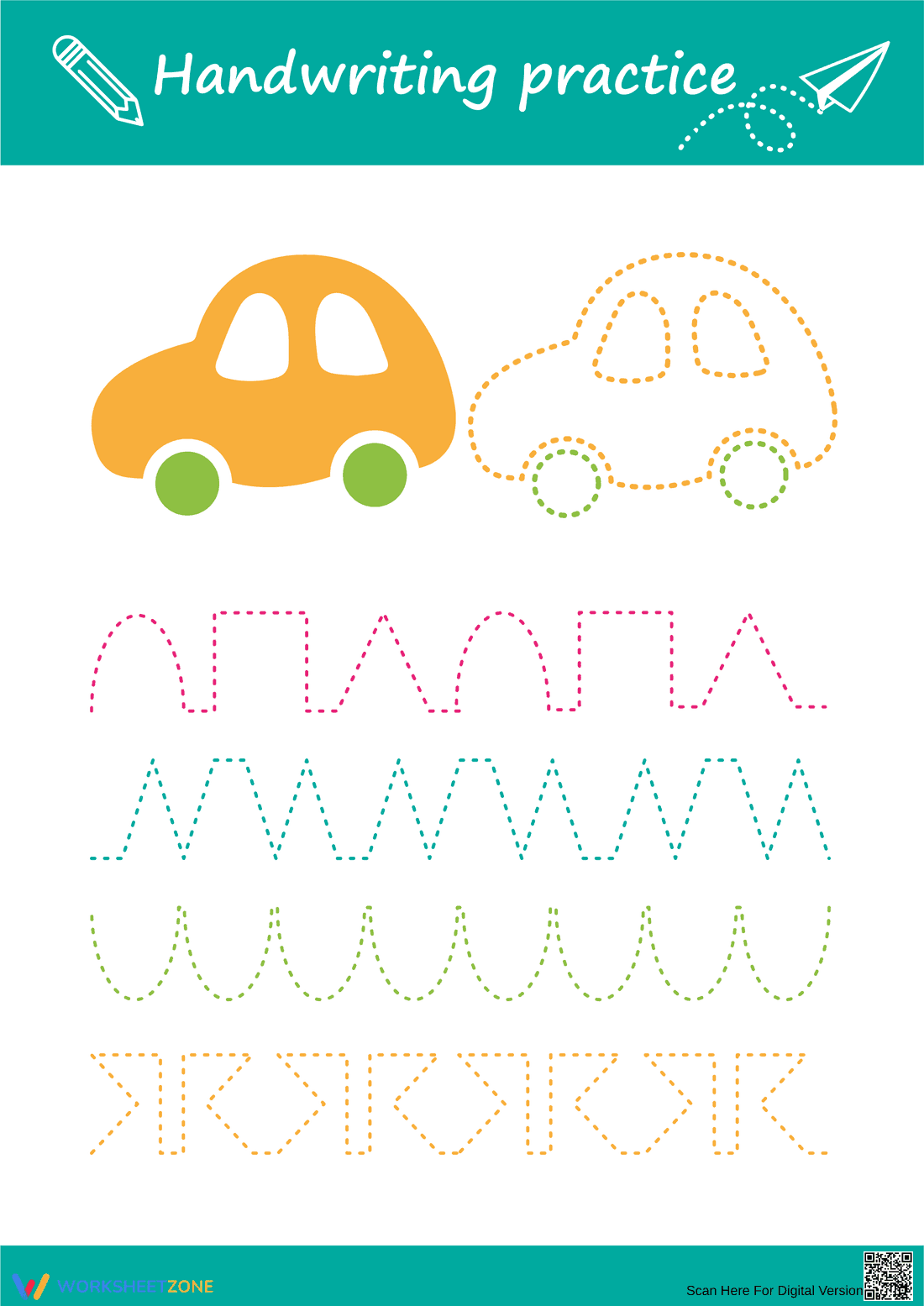
What's Inside: The worksheet features a large, friendly car graphic that serves as an initial engagement point for coloring and tracing. Below the illustration, four distinct rows of patterns challenge students with increasing complexity. These include rounded arches, sharp zig-zags, continuous loops, and a multi-directional geometric sequence. The layout is clean and spacious, ensuring that young children have enough room to maneuver their writing utensils without feeling overwhelmed.
Zero-Prep Workflow
This resource is designed for immediate classroom implementation with a total teacher prep time of under 60 seconds. First, print the single-page PDF for your class. Second, distribute the sheets along with crayons, markers, or primary pencils. Third, review the completed patterns to identify students who may need additional support with grip or pressure. The self-explanatory nature of the tracing lines makes this an ideal choice for emergency sub plans or quiet transition periods.
Standards Alignment
The primary alignment is `CCSS.ELA-LITERACY.L.K.1.A`, which focuses on the physical act of printing. While this worksheet does not feature letters, it builds the prerequisite muscle memory and stroke patterns required for the English alphabet. Additionally, it supports `CCSS.ELA-LITERACY.RF.K.1` by reinforcing left-to-right progression and top-to-bottom orientation. Both standard codes can be copied directly into lesson plans, IEP goals, or district curriculum mapping tools.
How to Use It
Use this worksheet during the "Do Now" portion of a literacy block to settle students into a focused mindset. It is effective when introduced after a brief demonstration of proper pencil grip. As a formative assessment, observe students as they navigate the zig-zag and loop patterns; look for fluid movements versus jerky, disconnected strokes. Most students will complete the tracing and coloring in approximately 12 minutes, making it a perfect bridge between activities.
Who It's For
This resource is tailored for preschool and kindergarten students who are just beginning their writing journey. It also serves as an excellent intervention tool for Grade 1 students who struggle with neatness or hand fatigue. Pair this worksheet with a tactile activity, such as drawing patterns in sand or shaving cream, to provide a multi-sensory learning experience that reinforces the motor pathways established on the page.
Research from the RAND AIRS 2024 report emphasizes that early fine motor development is a significant predictor of later academic success in both reading and mathematics. Developing the ability to control a writing utensil through complex patterns, such as those found in this CCSS.ELA-LITERACY.L.K.1.A aligned resource, allows students to reduce the cognitive load associated with the physical act of writing. When the mechanics of tracing become automatic, learners can redirect their mental energy toward higher-order tasks like spelling and composition. Fisher & Frey (2014) highlight that scaffolded motor practice provides the necessary transition for young learners. By providing clear visual guides and varied line types, this worksheet ensures that students build the stamina and precision required for neat handwriting in later elementary grades, effectively bridging the gap between play and formal literacy instruction.


