


























Views
Downloads



Pathos Writing Worksheet | Essential Grade 5 Persuasion
Paste this activity's link or code into your existing LMS (Google Classroom, Canvas, Teams, Schoology, Moodle, etc.).
Students can open and work on the activity right away, with no student login required.
You'll still be able to track student progress and results from your teacher account.
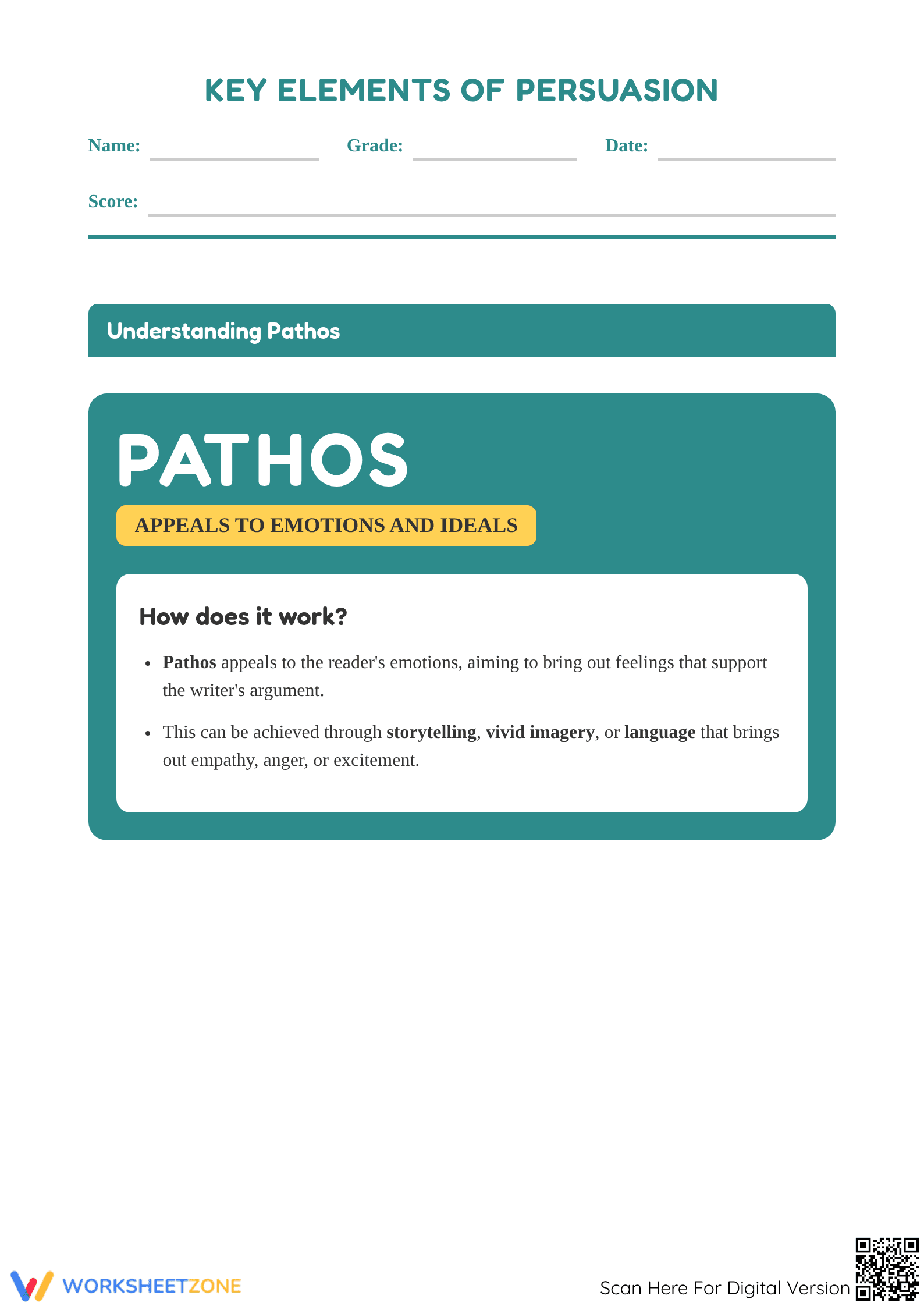
This Grade 5 persuasive writing resource helps students master the art of pathos by identifying and creating emotional appeals. Students learn to move beyond dry facts to evoke empathy, excitement, or urgency in their readers. By the end of these activities, learners will understand how specific word choices and vivid imagery transform standard arguments into compelling narratives.
At a Glance
- Grade: 5 · Subject: English
- Standard:
CCSS.ELA-LITERACY.W.5.1— Write opinion pieces supporting a point of view with reasons and information- Skill Focus: Pathos and Emotional Appeals
- Format: 4 pages · 10 problems · Answer key included · PDF
- Best For: Persuasive writing units and rhetoric introduction
- Time: 30–45 minutes
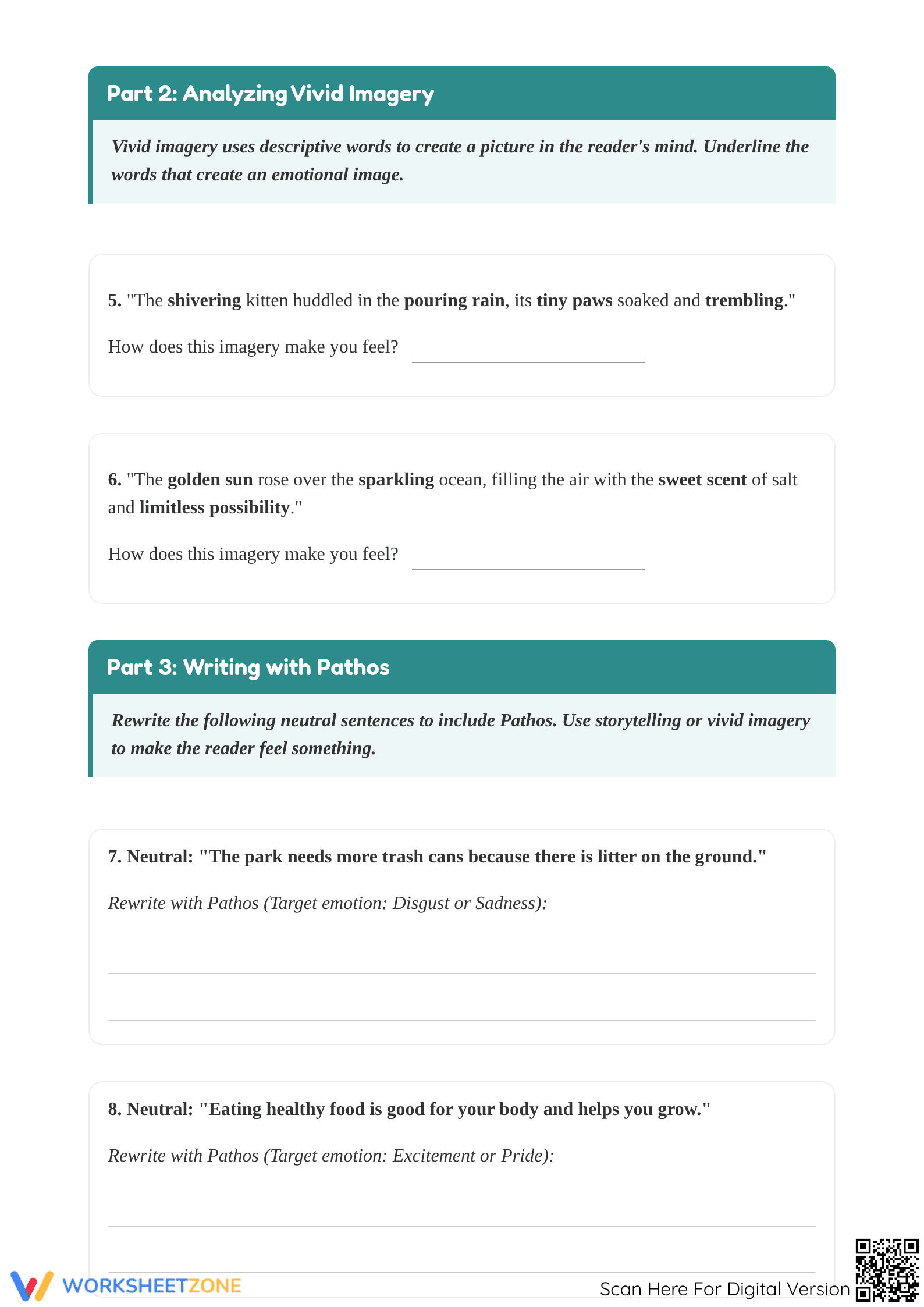
This comprehensive 4-page PDF contains a structured introduction to rhetorical devices. It includes a clear definition of pathos, four identification exercises based on persuasive sentences, two analysis tasks focused on vivid imagery, and three creative rewriting prompts. A final reflection question ensures students can articulate the purpose of emotional appeals. A full answer key is provided for easy grading and immediate feedback.
Skill Progression
- Guided Practice: Students begin by reading four distinct persuasive sentences and identifying the specific emotion targeted, such as sadness, fear, or pride, using provided examples as a scaffold.
- Supported Practice: Learners analyze sensory details and vivid imagery in two text samples, explaining how specific descriptions like "shivering kitten" or "sparkling ocean" influence their feelings.
- Independent Practice: The final stage requires students to rewrite three neutral, fact-based sentences into persuasive statements using pathos, followed by a metacognitive reflection on why emotional appeals are effective.
This sequence follows a gradual-release model, moving from recognition to application and finally to synthesis of rhetorical concepts.
Standards Alignment
This worksheet aligns with `CCSS.ELA-LITERACY.W.5.1`, which requires students to write opinion pieces that support a point of view with clear reasons. By focusing on pathos, students learn to use language that strengthens their arguments and connects with an audience. Both standard codes can be copied directly into lesson plans, IEP goals, or district curriculum mapping tools.
How to Use It
Use this worksheet during the "elaborate" phase of a persuasive writing unit, after students have already drafted basic arguments. It serves as an excellent formative assessment to see if students can distinguish between logos and pathos. Expect students to take approximately 35 minutes to complete the full packet, including the creative rewriting section. Teachers can use the imagery section to lead a whole-class discussion on word choice.
Who It's For
This resource is designed for fifth-grade general education classrooms, but it is also highly effective for middle school students needing a refresher on rhetorical devices. It pairs naturally with a mentor text analysis or an anchor chart detailing the three modes of persuasion (ethos, pathos, and logos) to provide a complete instructional cycle.
According to the RAND AIRS 2024 report on literacy instruction, the ability to recognize and employ rhetorical strategies like pathos is a critical component of advanced writing proficiency. This worksheet addresses CCSS.ELA-LITERACY.W.5.1 by providing 10 targeted tasks that bridge the gap between simple opinion stating and sophisticated persuasive writing. By engaging with emotional appeals, students develop the linguistic flexibility required for middle school ELA success. Research from Fisher & Frey (2014) emphasizes that scaffolded practice in identifying authorial intent—such as the emotional triggers found in these exercises—significantly improves a student's own ability to craft nuanced arguments. This 4-page resource provides the necessary structure for students to move from passive readers to active, persuasive communicators. The inclusion of vivid imagery analysis ensures that students understand the mechanics of how pathos is constructed through specific vocabulary and sensory details.


