


























Views
Downloads
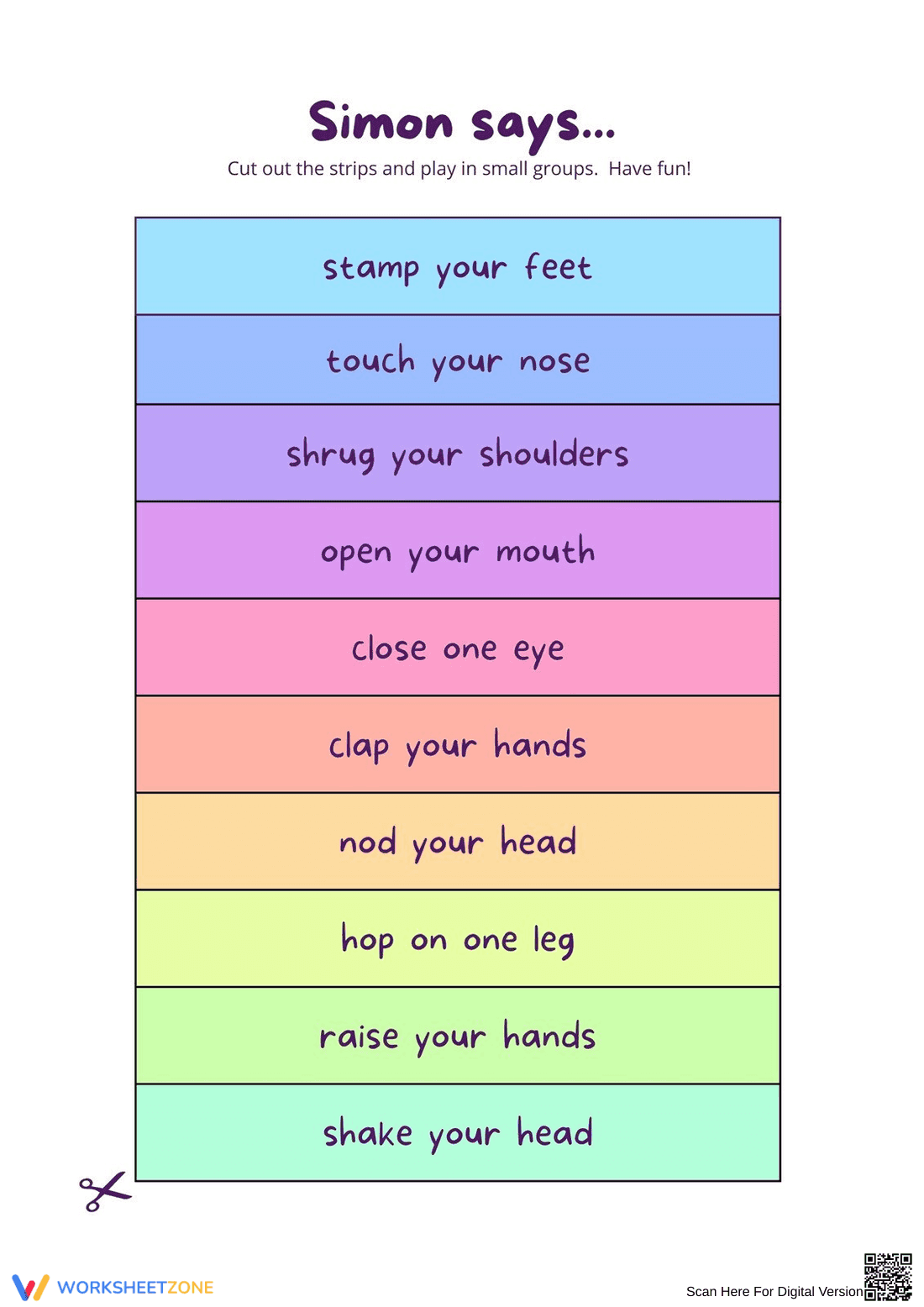

Simon Says Verbs Brain Break | Grade K Printable
Paste this activity's link or code into your existing LMS (Google Classroom, Canvas, Teams, Schoology, Moodle, etc.).
Students can open and work on the activity right away, with no student login required.
You'll still be able to track student progress and results from your teacher account.
This Grade K action verb worksheet transforms vocabulary practice into an active movement session. By using the classic Simon Says format, students connect physical actions to specific verbs and body parts, reinforcing language acquisition through kinesthetic learning. It is an effective tool for improving listening comprehension and following multi-step directions in early childhood settings.
At a Glance
- Grade: K · Subject: ELA
- Standard:
CCSS.ELA-LITERACY.L.K.5.C— Identify real-life connections between words and their use through physical actions- Skill Focus: Action Verbs & Body Parts
- Format: 1 page · 10 activities · Activity Guide · PDF
- Best For: Morning meetings and brain breaks
- Time: 5–10 minutes
The resource features 10 distinct, color-coded strips designed for easy cutting. Each strip contains a simple imperative sentence pairing a high-frequency action verb (like "stamp," "shrug," or "hop") with a specific body part. The pastel rainbow design provides visual cues for students, while the clear font ensures readability for emerging readers or English Language Learners.
The zero-prep workflow is designed for immediate classroom implementation. First, print the single-page PDF (30 seconds). Second, cut the 10 strips along the provided guides or keep the sheet whole for a call-and-response format (1 minute). Third, distribute the strips to student leaders or begin the game immediately to reset student focus. Total teacher preparation time is under 2 minutes, making it an ideal sub-plan addition.
This activity aligns with `CCSS.ELA-LITERACY.L.K.5.C`, which requires students to identify real-life connections between words and their use. By physically performing the verbs, students demonstrate a concrete understanding of the vocabulary. It also supports `CCSS.ELA-LITERACY.SL.K.1.A` regarding following rules for collaborative activities. Both standard codes can be copied directly into lesson plans, IEP goals, or district curriculum mapping tools.
Use this as a transition tool between high-intensity subjects like Math and quiet reading time. Formatively observe students to ensure they are correctly identifying body parts and performing the specific verb requested, rather than just mimicking peers. The activity typically takes 5 to 10 minutes depending on the number of rounds played and the speed of the commands.
This resource is perfect for Kindergarten students, English Language Learners (ELLs), and students requiring sensory breaks. It pairs naturally with a direct instruction lesson on "Action Words" or a science unit on the human body. The visual strips can also be used as flashcards for one-on-one vocabulary intervention or speech therapy sessions.
Research from Fisher & Frey (2014) emphasizes the importance of the gradual release of responsibility, but also highlights how kinesthetic engagement anchors new vocabulary in long-term memory. This Simon Says activity utilizes Total Physical Response (TPR), a proven method for language acquisition where students respond to oral commands with physical movement. According to the RAND AIRS 2024 report on classroom climate, brief "brain breaks" that incorporate academic content significantly reduce off-task behavior and improve executive function in early elementary learners. By integrating CCSS.ELA-LITERACY.L.K.5.C into a movement-based game, educators provide a low-stakes environment for students to practice listening skills and verb identification. This worksheet serves as a bridge between abstract language concepts and concrete physical reality, ensuring that foundational ELA skills are reinforced through active participation rather than passive observation, leading to higher retention rates across diverse learner populations.


