


























Views
Downloads

Grade 2 Nouns Practice — Printable No-Prep Worksheet
Paste this activity's link or code into your existing LMS (Google Classroom, Canvas, Teams, Schoology, Moodle, etc.).
Students can open and work on the activity right away, with no student login required.
You'll still be able to track student progress and results from your teacher account.
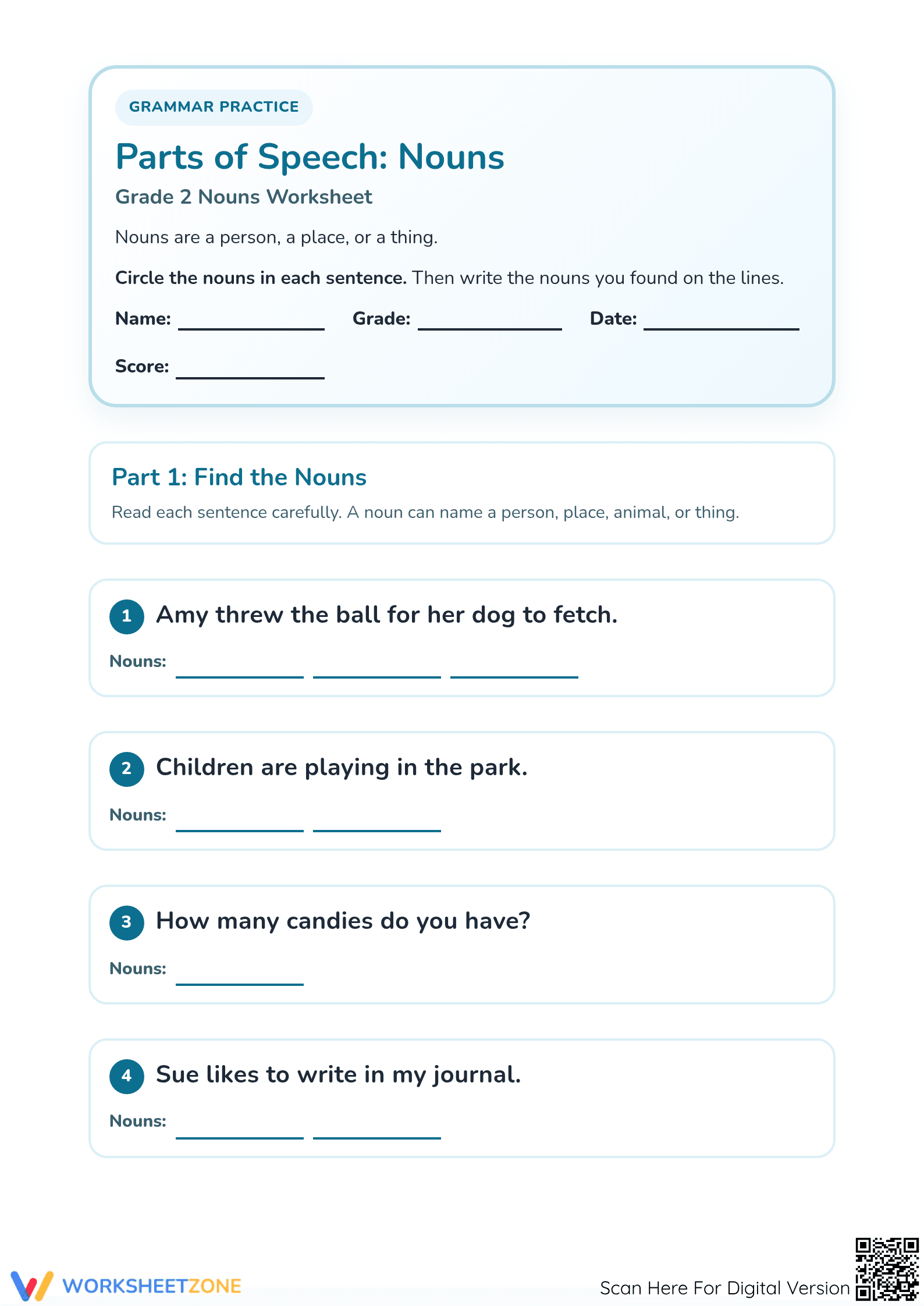
This Grade 2 grammar resource provides a straightforward and effective way for students to master the identification of naming words. By focusing on the core definition of a noun as a person, place, animal, or thing, students build the linguistic foundation necessary for complex sentence construction and reading comprehension. This worksheet ensures students can isolate parts of speech within varied sentence contexts.
At a Glance
- Grade: 2 · Subject: English Language Arts
- Standard:
CCSS.ELA-LITERACY.L.2.1— Demonstrate command of the conventions of standard English grammar and usage- Skill Focus: Noun Identification
- Format: 2 pages · 10 problems · Answer key included · PDF
- Best For: Independent grammar practice or sub plans
- Time: 15–20 minutes
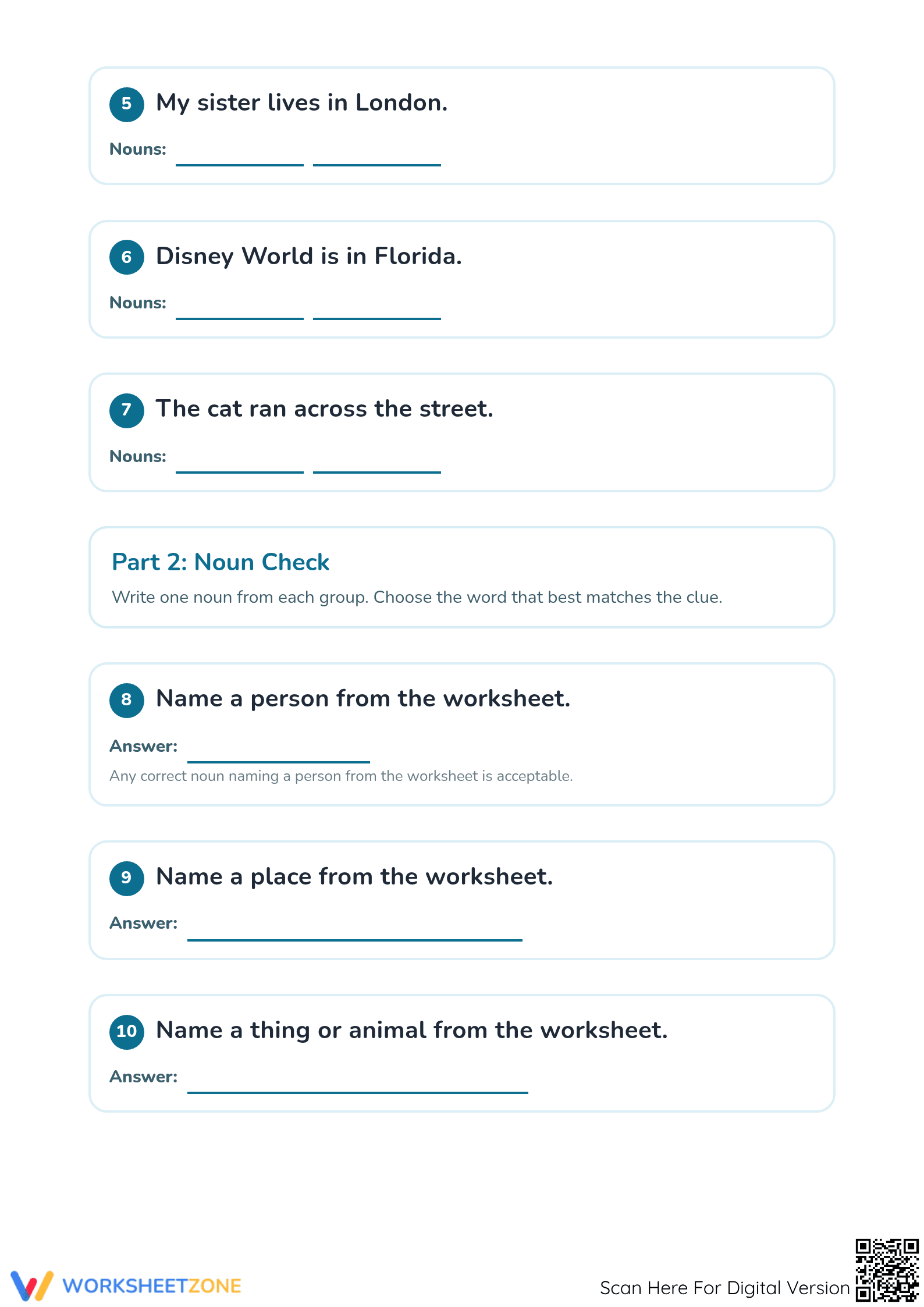
What's Inside: This 2-page PDF features 10 distinct tasks designed to reinforce lexical word classes. The first section contains 7 sentences where students must circle and then write the nouns found in each. The second section provides a categorization check, asking students to retrieve specific types of nouns from the previous exercises. A full answer key is included for rapid grading.
Zero-Prep Workflow: This resource is designed for immediate classroom implementation with three simple steps. First, print the 2-page document (30 seconds). Second, distribute the sheets to your students during your grammar block or as a bell-ringer activity (1 minute). Finally, use the included answer key to review student work or facilitate a peer-grading session (5 minutes). Total teacher preparation time is under 2 minutes.
Standards Alignment: This worksheet is aligned to `CCSS.ELA-LITERACY.L.2.1`, which requires students to demonstrate command of the conventions of standard English grammar and usage when writing or speaking. Specifically, it addresses the identification of common nouns and their roles within sentences. This standard code can be copied directly into lesson plans, IEP goals, or district curriculum mapping tools.
How to Use It: This worksheet is ideal for the "independent practice" phase of a lesson on parts of speech. Assign it after a direct instruction session where you define nouns using an anchor chart. It also serves as an excellent formative assessment tool; by observing which students struggle to identify nouns like "journal" or "park," you can quickly group students for targeted small-group intervention. Expect completion in 15 to 20 minutes.
Who It's For: While designed for Grade 2, this resource is highly effective for Grade 1 students ready for a challenge or Grade 3 students requiring a quick review of grammar fundamentals. It is also a valuable tool for English Language Learners (ELLs) who are building their basic English vocabulary. Pair this with a short reading passage to have students hunt for additional nouns in a different text format.
This Grade 2 grammar resource focuses on the foundational skill of noun identification, specifically targeting the ability of students to distinguish between people, places, animals, and things within a sentence structure. By requiring students to both circle the target word and transcribe it onto a line, the worksheet reinforces orthographic mapping and syntactic awareness. According to Fisher & Frey (2014), the gradual release of responsibility is supported when students move from identifying parts of speech in isolation to applying that knowledge in context. This resource aligns with CCSS.ELA-LITERACY.L.2.1, ensuring that learners demonstrate a command of standard English grammar conventions. The inclusion of a secondary categorization task encourages higher-order thinking by asking students to retrieve and classify information they previously identified. This dual-layered approach ensures that the 10 tasks provided offer sufficient evidence of student mastery for formative assessment purposes in any primary classroom.


