


























0
Views
0
Downloads

0.0
0
Save
0 Likes
Share
Parts of a Seed Labeling and Fill-in-the-Blank Worksheet
0 Views
0 Downloads
Paste this activity's link or code into your existing LMS (Google Classroom, Canvas, Teams, Schoology, Moodle, etc.).
Students can open and work on the activity right away, with no student login required.
You'll still be able to track student progress and results from your teacher account.
Information
Description
What It Is:
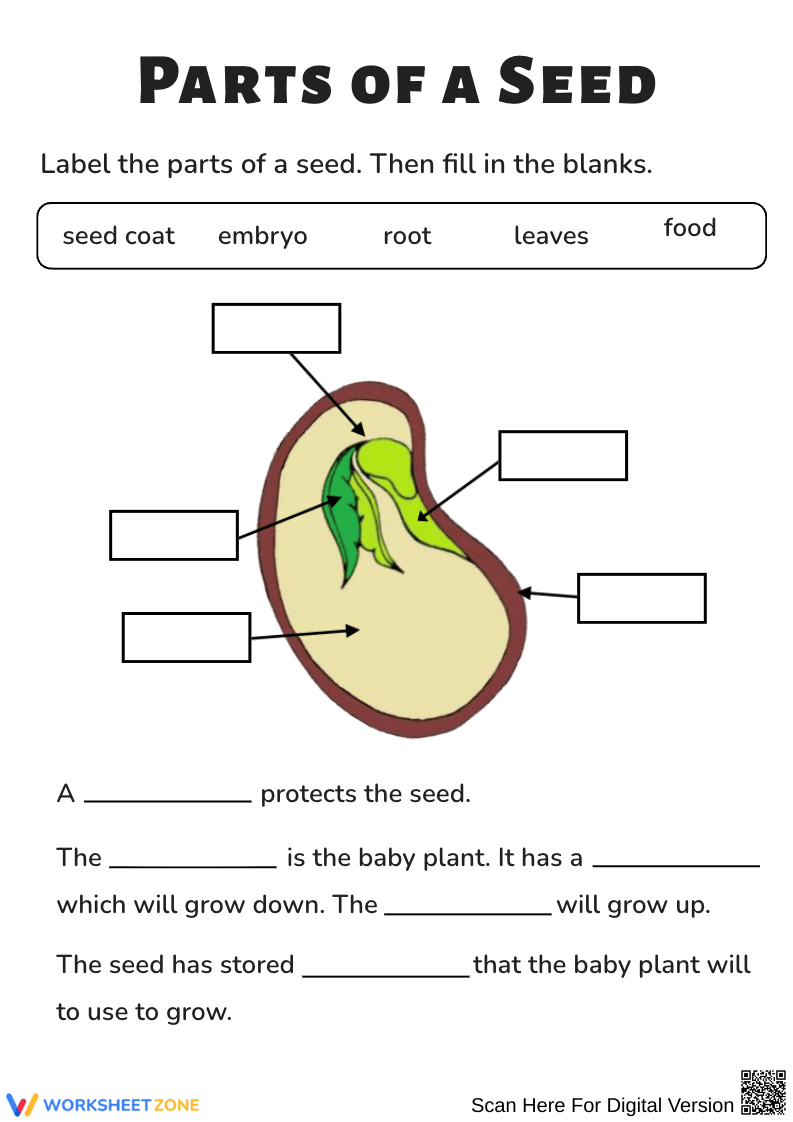
This parts of a seed worksheet combines labeling and fill-in-the-blank activities. Students identify seed coat, embryo, root, leaves, and food, then complete short sentences about their functions.
Why Use It:
The worksheet strengthens both science knowledge and reading comprehension. By labeling diagrams and filling in missing words, students reinforce plant biology vocabulary, seed anatomy, and critical thinking.
How to Use It:
• Students label the seed diagram using the provided word bank.
• Complete the fill-in-the-blank sentences to explain each part’s role.
• Discuss as a group how seeds grow into plants.
• Use as classwork, homework, or a science assessment.
Grade Level Suitability:
Ideal for elementary science lessons.
• Grades 2–3: Guided completion with teacher support.
• Grades 4–5: Independent practice and vocabulary reinforcement.
Target Users:
Perfect for teachers, homeschooling parents, and students learning about seed anatomy, plant growth, and germination.
This parts of a seed worksheet combines labeling and fill-in-the-blank activities. Students identify seed coat, embryo, root, leaves, and food, then complete short sentences about their functions.
Why Use It:
The worksheet strengthens both science knowledge and reading comprehension. By labeling diagrams and filling in missing words, students reinforce plant biology vocabulary, seed anatomy, and critical thinking.
How to Use It:
• Students label the seed diagram using the provided word bank.
• Complete the fill-in-the-blank sentences to explain each part’s role.
• Discuss as a group how seeds grow into plants.
• Use as classwork, homework, or a science assessment.
Grade Level Suitability:
Ideal for elementary science lessons.
• Grades 2–3: Guided completion with teacher support.
• Grades 4–5: Independent practice and vocabulary reinforcement.
Target Users:
Perfect for teachers, homeschooling parents, and students learning about seed anatomy, plant growth, and germination.


