


























Views
Downloads

Grade 1 Plant Parts — Printable No-Prep Worksheet
Paste this activity's link or code into your existing LMS (Google Classroom, Canvas, Teams, Schoology, Moodle, etc.).
Students can open and work on the activity right away, with no student login required.
You'll still be able to track student progress and results from your teacher account.
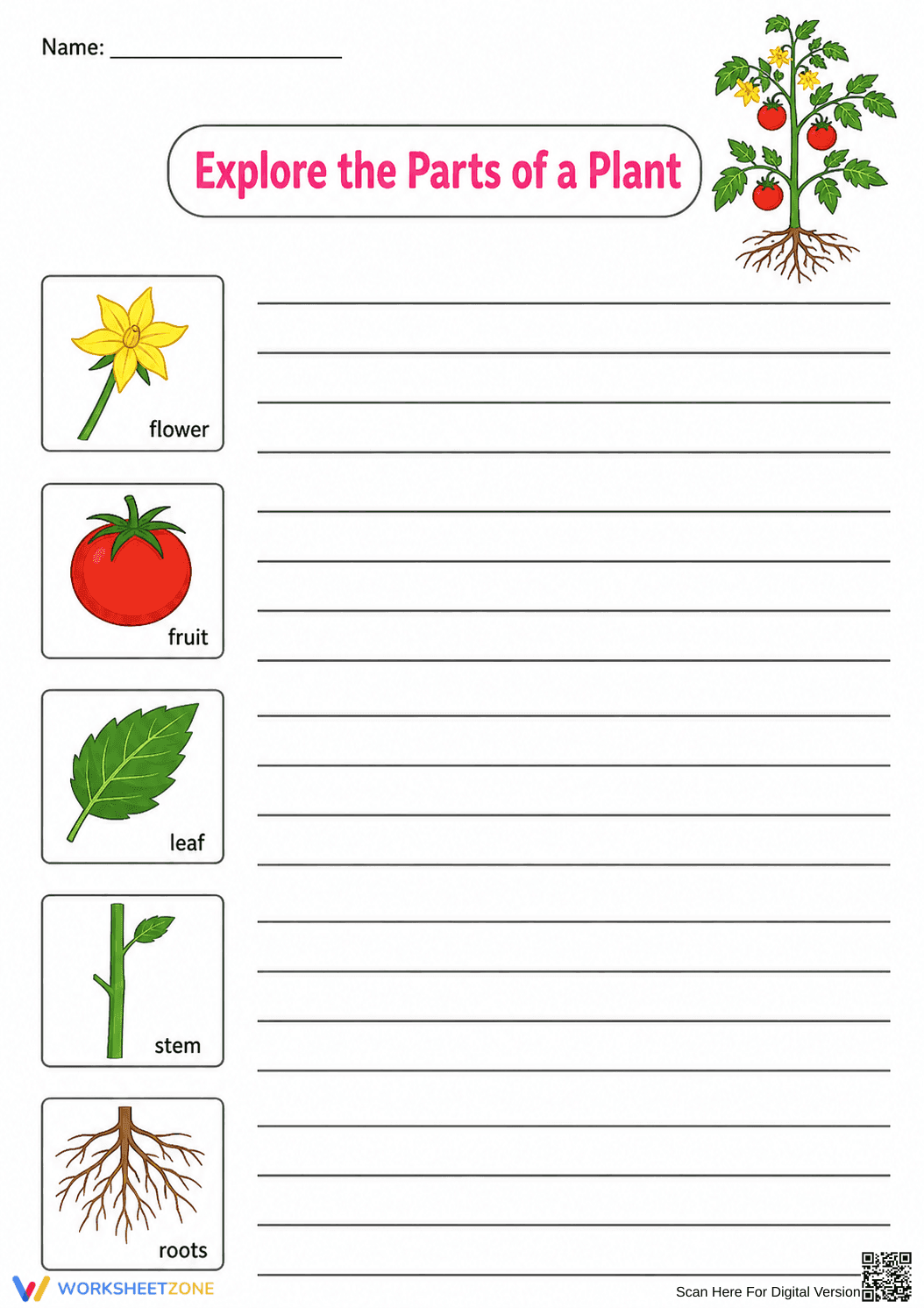
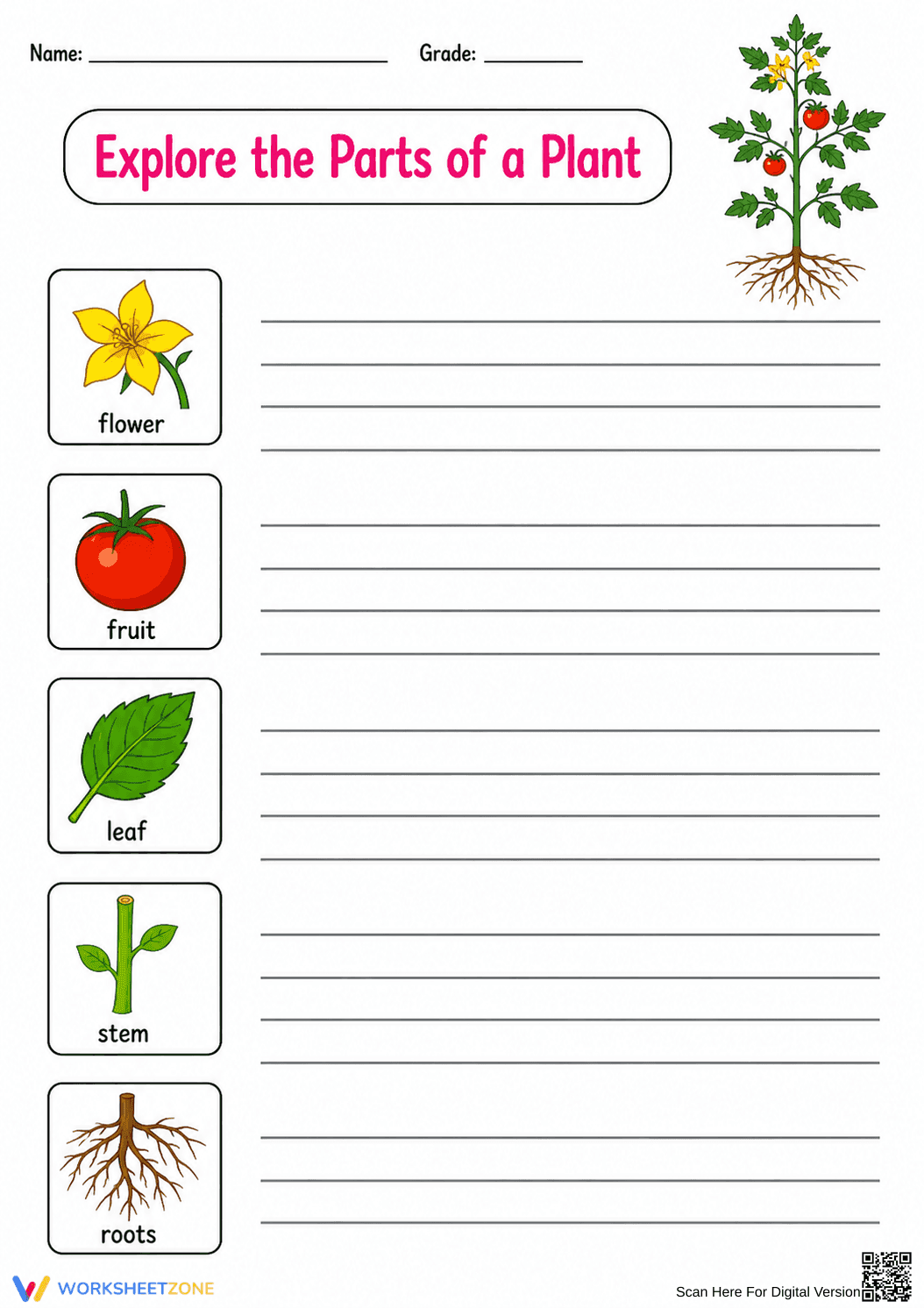
This Grade 1 science worksheet helps students identify and describe the functions of basic plant parts. By examining illustrations of a flower, fruit, leaf, stem, and roots, learners write short facts about how each structure helps the plant survive.
At a Glance
- Grade: 1 · Subject: Science
- Standard:
1-LS1-1— Describe how plant parts help them survive and grow- Skill Focus: Identifying plant structures and functions
- Format: 2 pages · 5 problems · PDF
- Best For: Independent practice or science centers
- Time: 15–20 minutes
Inside this printable PDF, educators will find a straightforward layout featuring five writing tasks. Students are presented with labeled images of a tomato plant's key structures: flower, fruit, leaf, stem, and roots. Next to each illustration, blank lines provide space for students to record the specific function of that plant part. A complete diagram at the top serves as a helpful visual reference.
Zero-Prep Workflow
- Print: Download the PDF and print copies. The clean design works perfectly in black-and-white.
- Distribute: Hand out during your science block. The intuitive layout means students understand the task immediately.
- Review: Quickly review the functions of each plant part as a class to reinforce concepts.
With teacher preparation time under two minutes, this resource is excellent for emergency sub plans.
Standards Alignment
This resource aligns to the Next Generation Science Standards, focusing on 1-LS1-1: Use materials to design a solution to a human problem by mimicking how plants and/or animals use their external parts to help them survive, grow, and meet their needs. It provides the foundational knowledge—identifying external parts and functions—needed for broader survival concepts. Both standard codes can be copied directly into lesson plans, IEP goals, or district curriculum mapping tools.
How to Use It
Use this as independent practice following a lesson on plant life cycles, or place it in a science center where students reference books to find facts. As a formative assessment tip, observe whether students articulate that roots absorb water rather than just describing appearances. Expected completion time is 15 to 20 minutes.
Who It's For
Designed for first-grade students, this worksheet also serves as a review for second graders. To differentiate, provide a word bank featuring vocabulary like "water" and "sunlight." It pairs naturally with hands-on activities, such as observing a growing bean sprout, connecting illustrations to real-world science.
Understanding the external structures of living organisms is a foundational element of early elementary science education. According to a recent ScienceDirect TpT Analysis, instructional materials that combine clear visual diagrams with immediate writing tasks significantly improve vocabulary retention and conceptual understanding in young learners. By explicitly targeting 1-LS1-1, this resource ensures students can accurately describe how plant parts help them survive and grow in their environments. When students connect the visual representation of a stem, leaf, or root to its specific biological function, they build the critical thinking skills necessary for later, more complex life science concepts. This targeted practice helps bridge the gap between simple observation and scientific explanation, providing a structured format that supports both literacy and scientific inquiry simultaneously. Integrating this focused practice into weekly routines builds a stronger STEM foundation.


