


























Views
Downloads
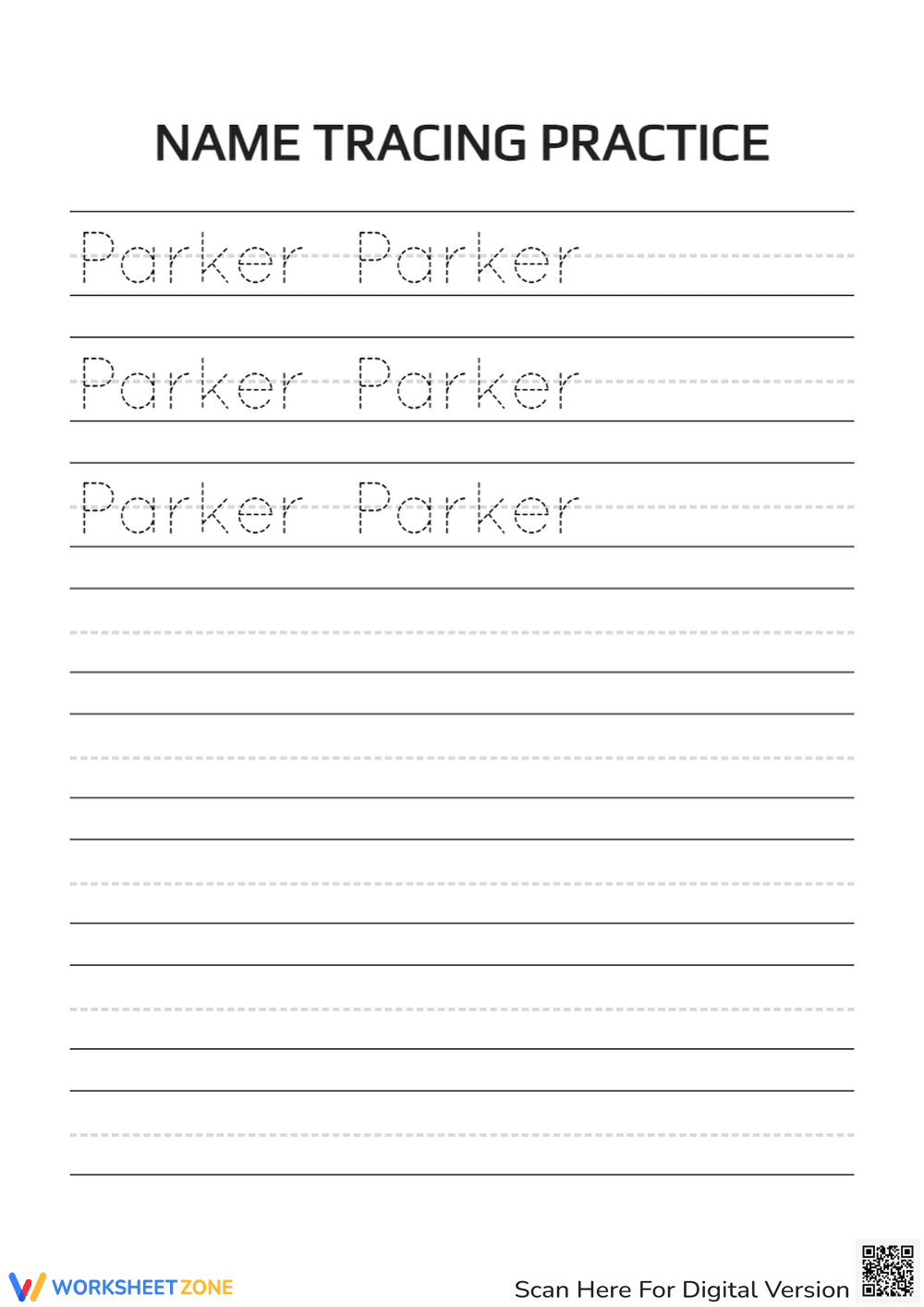

Parker Name Tracing Sheet | Essential Grade K-1 Ready
Paste this activity's link or code into your existing LMS (Google Classroom, Canvas, Teams, Schoology, Moodle, etc.).
Students can open and work on the activity right away, with no student login required.
You'll still be able to track student progress and results from your teacher account.
This Parker name tracing worksheet helps early learners master letter formation and fine motor control through repetitive practice. Students transition from guided tracing to independent writing on primary lines. This resource ensures that children named Parker develop the muscle memory needed for legible handwriting and confident name recognition in the classroom.
At a Glance
At a Glance
- Grade: Kindergarten · Subject: Handwriting
- Standard:
CCSS.ELA-LITERACY.L.K.1.A— Print many upper- and lowercase letters accurately- Skill Focus: Name tracing and letter formation
- Format: 1 page · 12 tasks · No answer key needed · PDF
- Best For: Morning work or name recognition practice
- Time: 5–10 minutes
What's Inside
Inside this single-page PDF, you will find 6 guided tracing opportunities for the name "Parker" using dotted fonts. Below the guided section, 6 additional blank primary lines with a dashed midline are provided for independent practice. The layout is clean and distraction-free to help young students focus on their pencil grip and stroke order.
Zero-Prep Workflow
The zero-prep workflow is designed for busy educators and parents. First, print the single-page PDF (30 seconds). Next, distribute the sheet to the student with a sharpened pencil or crayon (30 seconds). Finally, review the student's letter height and spacing as they complete the 12 lines of practice (1 minute). Total teacher prep time is under 2 minutes.
Standards Alignment
This worksheet aligns with `CCSS.ELA-LITERACY.L.K.1.A`, which requires students to print many upper- and lowercase letters. By focusing on a specific name, students apply this standard to a high-frequency, personally meaningful word. This standard code can be copied directly into lesson plans, IEP goals, or district curriculum mapping tools.
How to Use It
Use this worksheet during the first week of school as a "settle-down" activity or as part of a literacy center rotation. It is also an excellent formative assessment tool; observe the student's grip and stroke directionality to identify who needs additional intervention. Completion typically takes between 5 and 10 minutes depending on the student's fine motor development.
Who It's For
This resource is ideal for preschoolers, kindergarteners, and first graders who are learning to write their names. It is particularly helpful for students requiring occupational therapy support or extra fine motor practice. Pair this with a name-tag activity or a letter-sound anchor chart for a comprehensive literacy lesson.
According to the RAND AIRS 2024 report on early literacy, repetitive tracing of high-frequency personal words like a student's name significantly accelerates the development of orthographic mapping and fine motor coordination. This Parker name tracing worksheet provides the structured repetition necessary for students to move from cognitive effort to automaticity in letter formation. By utilizing the CCSS.ELA-LITERACY.L.K.1.A standard, the resource ensures that students are meeting foundational benchmarks for print concepts. Research from Fisher & Frey (2014) emphasizes that gradual release models—moving from the heavy scaffolding of dotted lines to the independence of blank primary lines—are essential for building student confidence. This 1-page tool serves as a practical application of these pedagogical principles, offering 12 distinct opportunities for practice. Educators can rely on this evidence-based approach to support early writing milestones and ensure that students develop the legible handwriting required for later academic success.


