


























Views
Downloads

Essential Paragraph Structure Worksheet | Grades 3-4
Paste this activity's link or code into your existing LMS (Google Classroom, Canvas, Teams, Schoology, Moodle, etc.).
Students can open and work on the activity right away, with no student login required.
You'll still be able to track student progress and results from your teacher account.
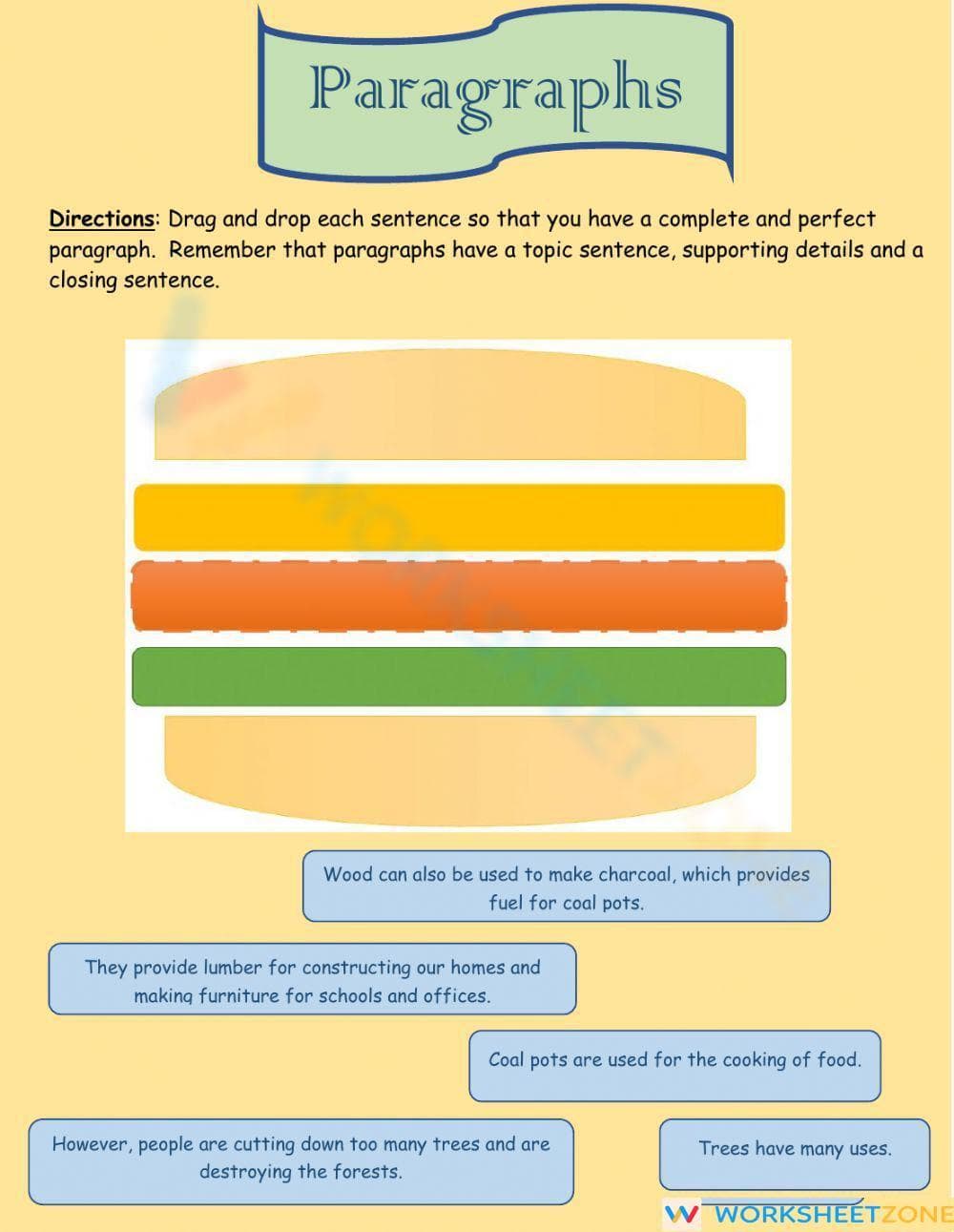
This Grade 3 and 4 paragraph structure worksheet helps students master the art of organizing ideas into a cohesive whole. By using a familiar "hamburger" graphic organizer, students learn to identify and sequence topic sentences, supporting details, and closing sentences. This activity ensures students understand the logical flow of information required for effective academic writing.
At a Glance
- Grade: 3–4 · Subject: ELA
- Standard:
CCSS.ELA-LITERACY.W.3.2.A— Group related information together to introduce a topic clearly- Skill Focus: Paragraph organization and sentence sequencing
- Format: 1 page · 1 task · Answer key included · PDF
- Best For: Writing centers, independent practice, or sub plans
- Time: 10–15 minutes
This single-page resource features a "Hamburger Paragraph" graphic that visually represents the structural components of a well-written paragraph. Students are provided with five jumbled sentences regarding the uses and conservation of trees. The task requires them to evaluate each sentence and drag or write it into the correct position—from the introductory bun to the concluding base. An answer key is included for quick correction.
Zero-Prep Workflow
- Print (30 seconds): Download the PDF and print copies for your class.
- Distribute (30 seconds): Introduce the hamburger metaphor for paragraph parts.
- Review (1 minute): Use the answer key for quick student feedback.
Teacher preparation time is under two minutes, making this ideal for sub plans.
Standards Alignment
This worksheet is primarily aligned to CCSS.ELA-LITERACY.W.3.2.A, which requires students to introduce a topic and group related information together in a logical sequence. It also supports CCSS.ELA-LITERACY.W.4.2.A by emphasizing the importance of internal paragraph coherence. Both standard codes can be copied directly into lesson plans, IEP goals, or district curriculum mapping tools.
How to Use It
For best results, use this activity during the "We Do" phase of a writing lesson to model how isolated sentences become a unified message. Alternatively, assign it as a formative assessment after teaching the hamburger paragraph method to check for student understanding of sentence function. Observe if students can distinguish the broad topic sentence from the specific supporting details during completion.
Who It's For
This resource is tailored for third and fourth-grade students developing foundational writing skills. It is particularly effective for English Language Learners (ELLs) and students requiring visual scaffolds to understand abstract organizational concepts. It pairs naturally with a mentor text about nature or an anchor chart detailing the parts of a paragraph to reinforce the lesson.
Academic writing proficiency begins with the foundational ability to organize thoughts at the sentence level before transitioning to complex multi-paragraph essays. This resource directly targets the CCSS.ELA-LITERACY.W.3.2.A standard, focusing on the critical skill of grouping related information to ensure clarity for the reader. Research from Fisher & Frey (2014) highlights that visual organizers, such as the hamburger paragraph model used here, significantly improve student ability to retain structural writing concepts by providing a concrete mental framework for abstract ideas. By engaging with this 5-sentence sequencing task, students practice evaluating sentence logic and hierarchy, which are essential precursors to advanced informational writing. The structured nature of the activity allows for immediate feedback, reinforcing the connection between logical order and reading comprehension. This worksheet serves as a high-signal tool for both direct instruction and formative assessment in the elementary ELA classroom.


