


























Views
Downloads

Essential Presentation Vocab Worksheet | Grade 9 ELA
Paste this activity's link or code into your existing LMS (Google Classroom, Canvas, Teams, Schoology, Moodle, etc.).
Students can open and work on the activity right away, with no student login required.
You'll still be able to track student progress and results from your teacher account.
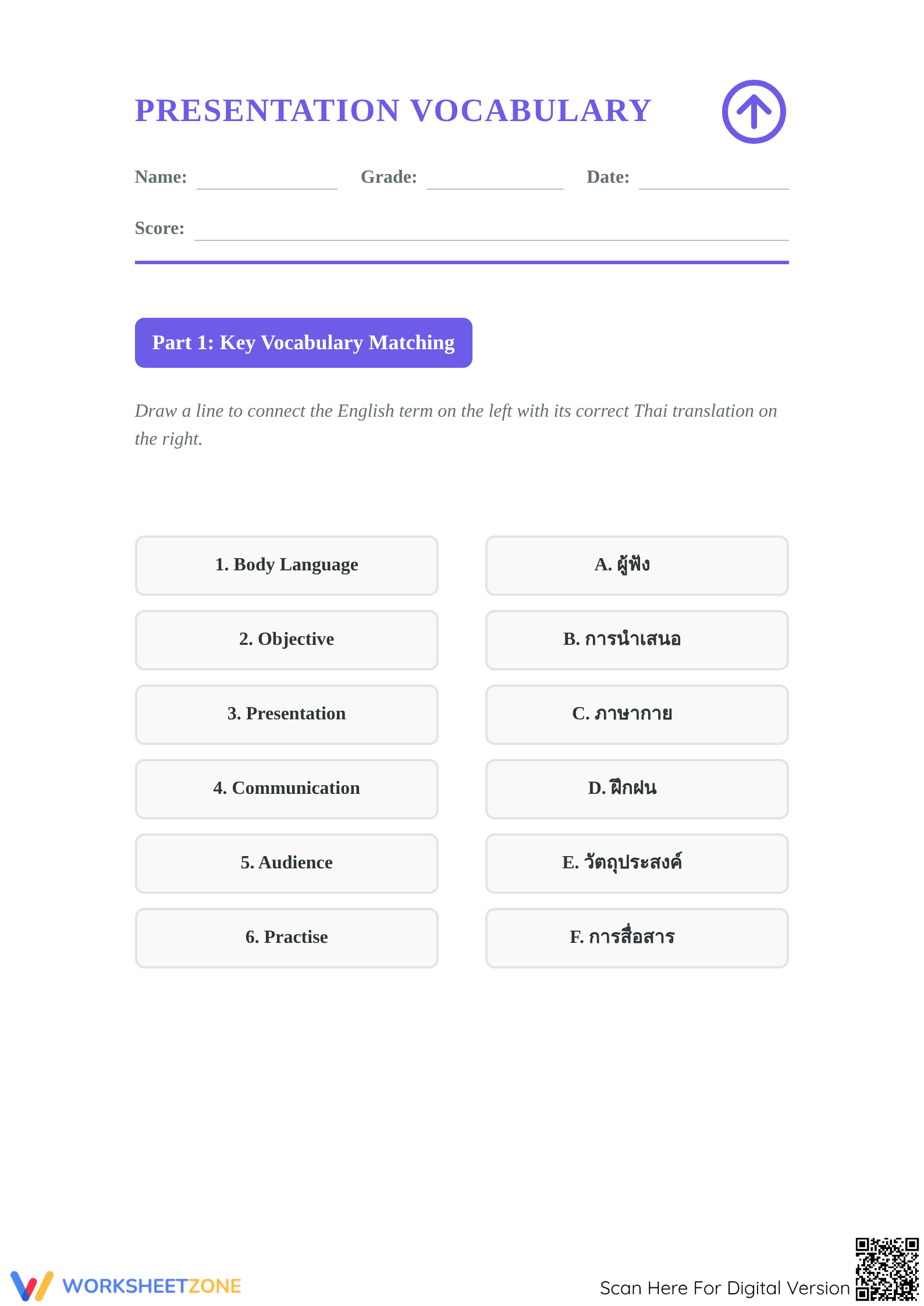
This Grade 9 ELA worksheet empowers students to master the specific terminology and structural components required for effective public speaking. By engaging with domain-specific vocabulary, learners bridge the gap between casual conversation and formal academic presentations, ensuring they can communicate complex ideas with clarity and professional poise in any classroom setting.
At a Glance
- Grade: 9 · Subject: ELA
- Standard:
CCSS.ELA-LITERACY.L.9-10.6— Acquire and use accurately general academic and domain-specific words and phrases- Skill Focus: Presentation Vocabulary and Structure
- Format: 3 pages · 19 problems · Answer key included · PDF
- Best For: Speech prep and academic vocabulary building
- Time: 25–35 minutes
What's Inside
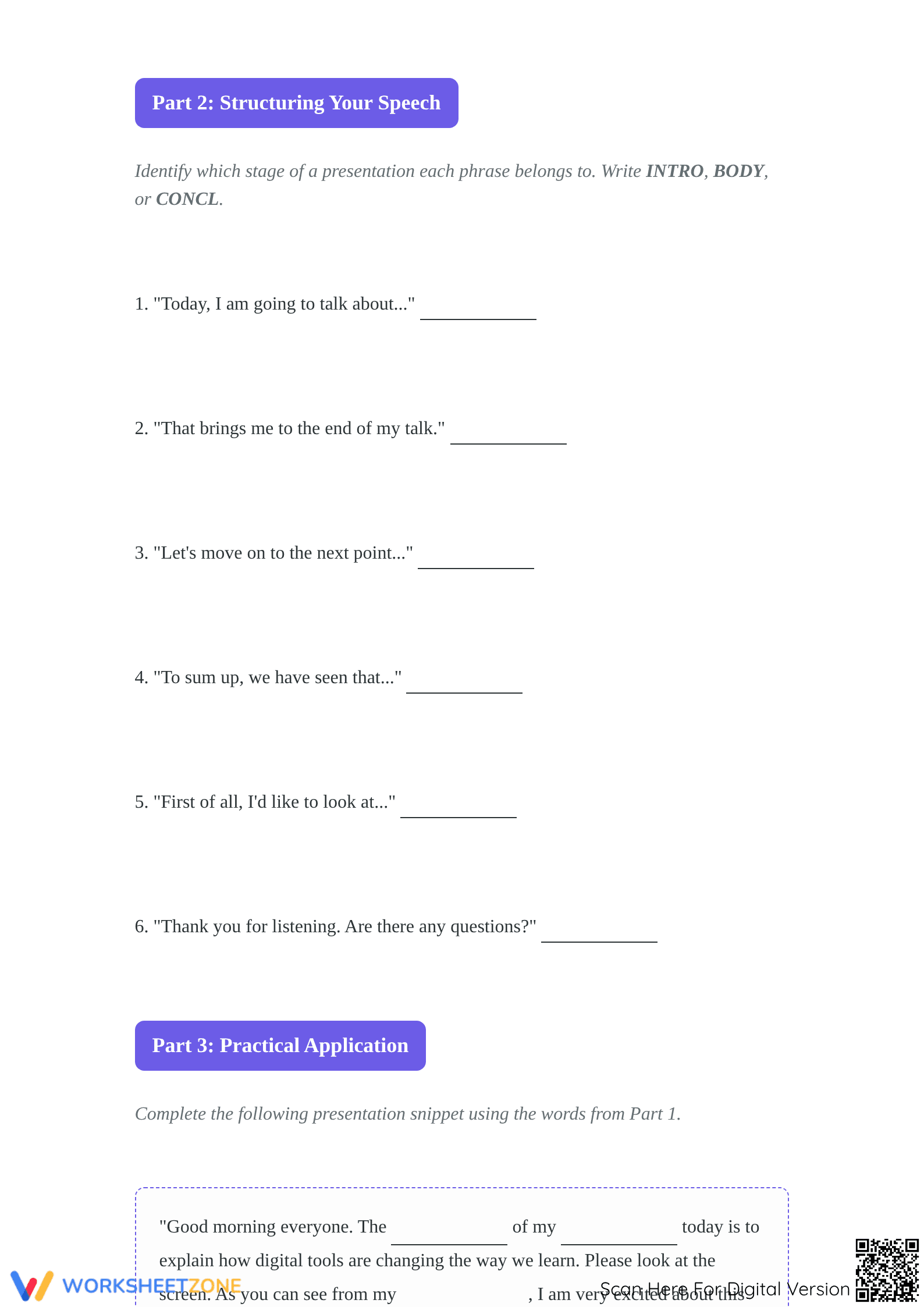
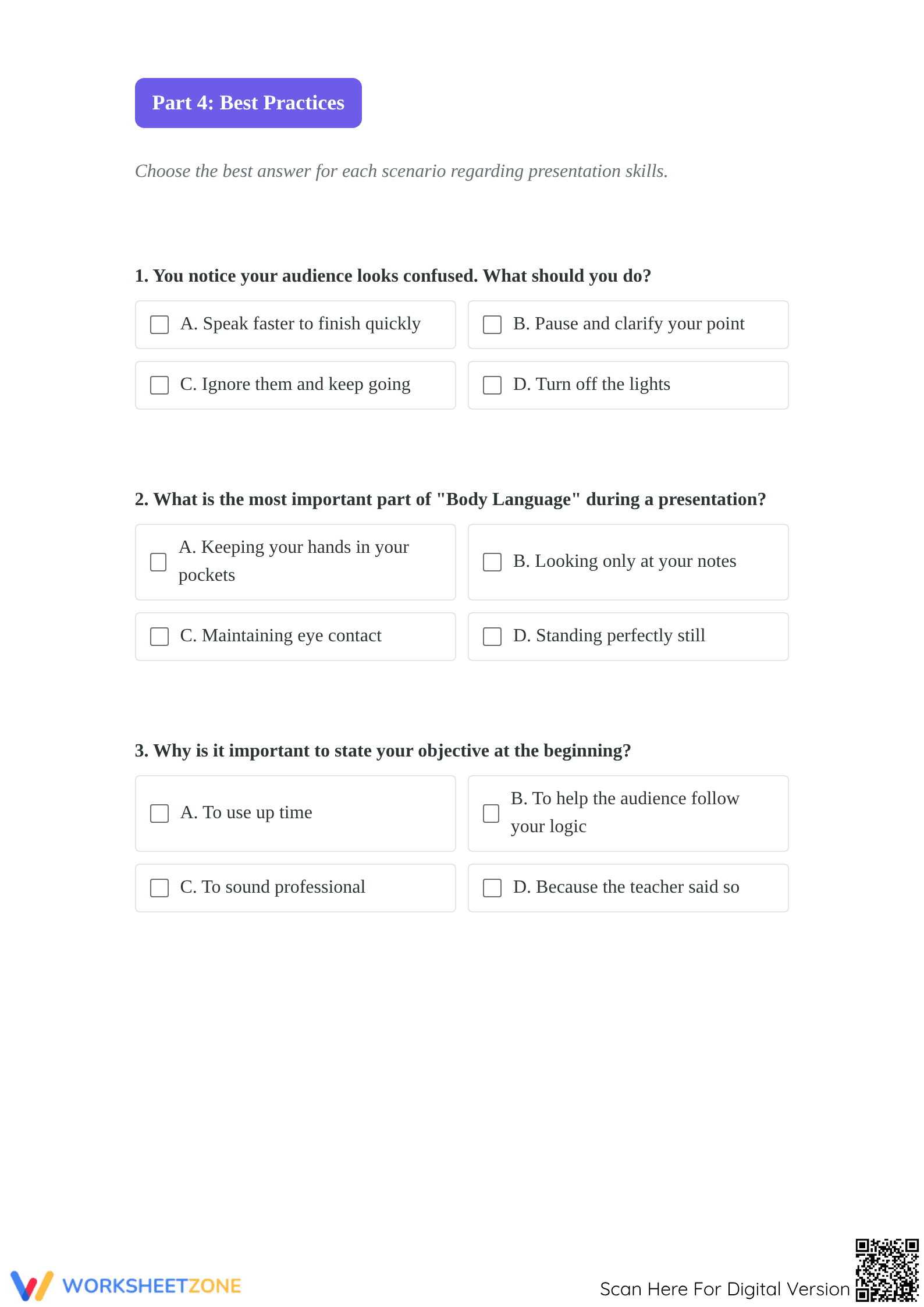
This three-page PDF resource includes four distinct sections designed to build confidence in public speaking. Students engage in vocabulary matching, structural analysis, and practical application through a cloze-style presentation snippet. The final page features multiple-choice scenarios regarding best practices. A complete answer key is provided for efficient grading and immediate feedback.
Skill Progression
- Guided Practice: Students match six core presentation terms to meanings, establishing a foundational lexicon for academic discourse.
- Supported Practice: Learners categorize six transition phrases into speech segments to understand logical organization and flow.
- Independent Practice: Students apply knowledge to a scenario-based script and evaluate audience engagement strategies through multiple-choice questions.
This sequence follows the gradual-release model, moving from simple identification to the critical evaluation of communication strategies.
Standards Alignment
This resource is primarily aligned with CCSS.ELA-LITERACY.L.9-10.6, focusing on acquiring domain-specific words. It also supports CCSS.ELA-LITERACY.SL.9-10.4 regarding the organization of formal presentations. Both standard codes can be copied directly into lesson plans, IEP goals, or district curriculum mapping tools.
How to Use It
This worksheet is ideal as a formative assessment or a pre-teaching tool before students draft a major presentation. Teachers can use the multiple-choice section to spark discussions on non-verbal communication. Expect students to complete the 19 tasks within 25 to 35 minutes depending on their prior exposure to the terms.
Who It's For
This material is designed for Grade 9 ELA students and is particularly effective for English Language Learners due to the translation supports. It serves as an excellent companion to a formal speech rubric or digital project. Use it alongside direct instruction on rhetorical devices for a complete instructional cycle.
The acquisition of domain-specific vocabulary, such as the terms found in this CCSS.ELA-LITERACY.L.9-10.6 aligned resource, is a critical component of secondary literacy development. Research by Fisher & Frey (2014) emphasizes the importance of a gradual release of responsibility when teaching complex academic language, moving from direct word-to-meaning association to contextual application. This worksheet facilitates that transition by providing 19 distinct tasks that require students to not only define presentation terms but also categorize them within the structural framework of a speech. By mastering concepts like "body language" and "objective" through structured practice, Grade 9 students develop the linguistic precision necessary for high-stakes academic environments. This resource serves as a foundational tool for building the communicative competence required by modern standards, ensuring students can articulate their findings with the professional vocabulary expected in both collegiate and professional spheres.


