


























Views
Plays

Pacific South America Quiz | Printable Grade 6 Geography
Paste this activity's link or code into your existing LMS (Google Classroom, Canvas, Teams, Schoology, Moodle, etc.).
Students can open and work on the activity right away, with no student login required.
You'll still be able to track student progress and results from your teacher account.
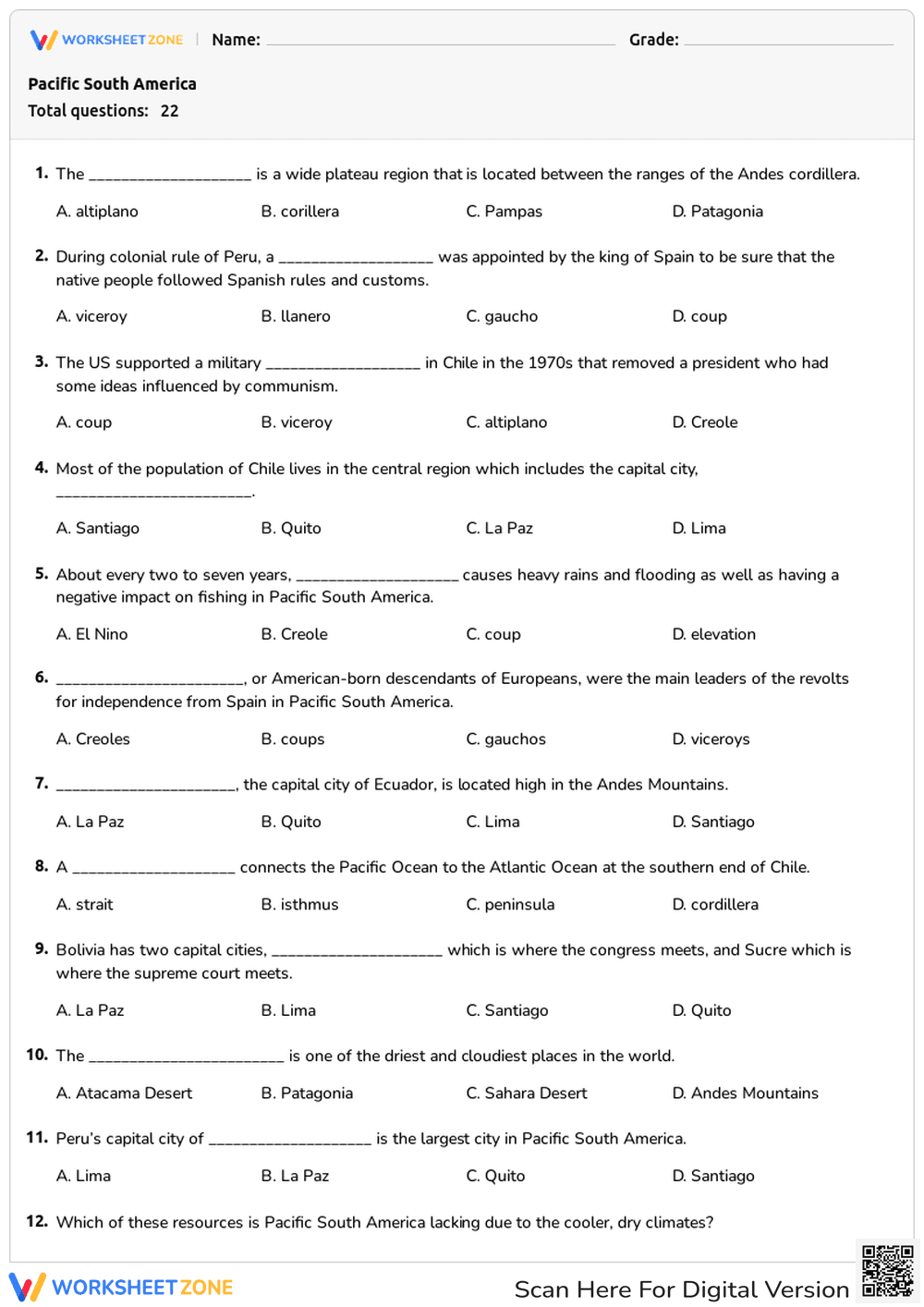
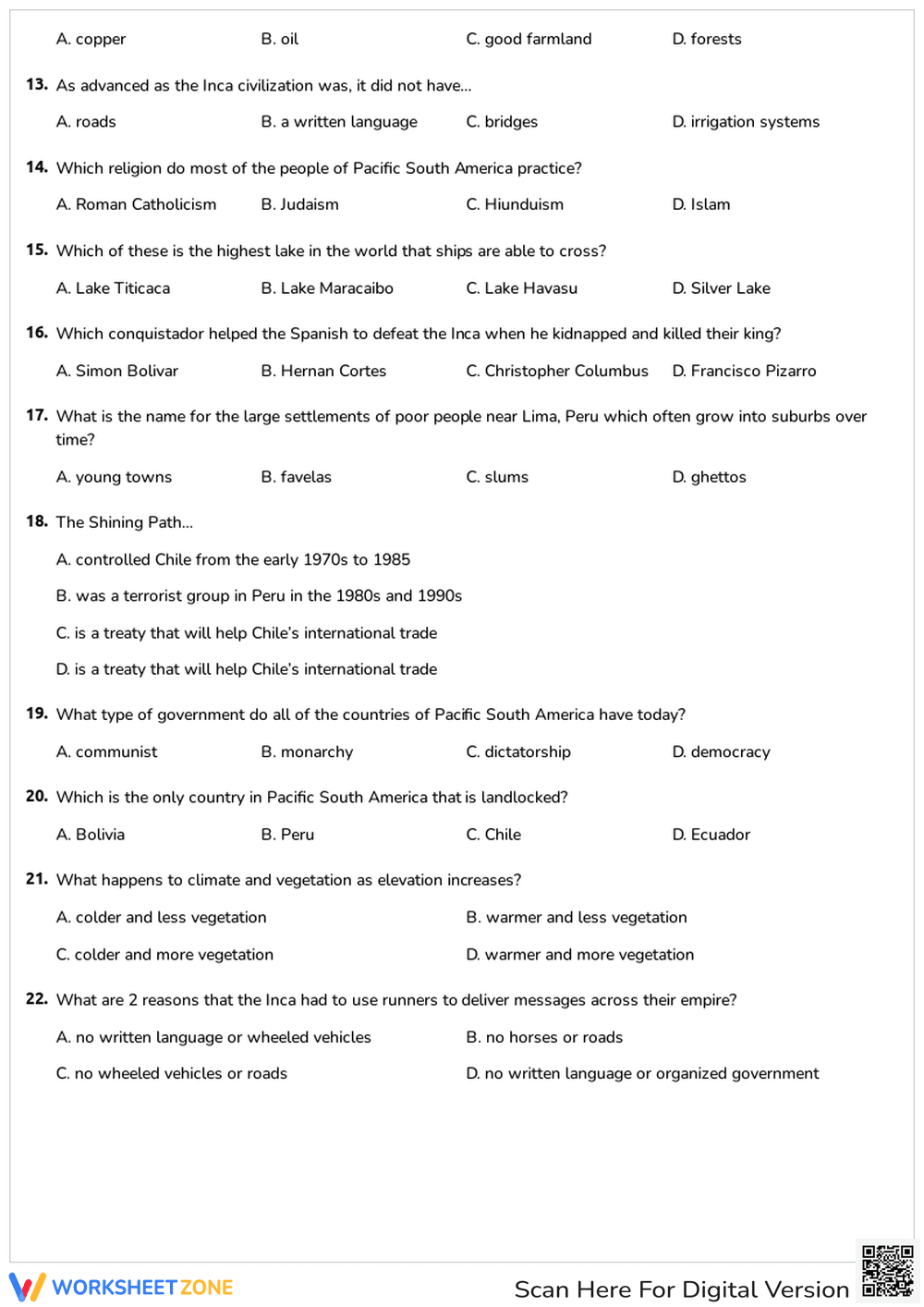
This comprehensive Pacific South America worksheet evaluates student knowledge of the geography, history, and culture of Chile, Peru, Ecuador, and Bolivia. Students will demonstrate their understanding of key regional vocabulary, historical events like the Inca civilization, and physical features such as the Andes Mountains and Atacama Desert.
At a Glance
- Grade: 6 · Subject: Social Studies
- Standard:
CCSS.ELA-LITERACY.RH.6-8.4— Determine the meaning of domain-specific social studies vocabulary- Skill Focus: Pacific South America Geography and History
- Format: 2 pages · 22 problems · Answer key included · PDF
- Best For: End-of-unit assessment or review
- Time: 25–35 minutes
This resource features a robust 22-question multiple-choice assessment spanning two pages. The questions cover a wide range of topics, from physical geography and climate to historical figures and modern governments. An included answer key ensures quick and accurate grading for educators, making it an ideal tool for evaluating student comprehension of the Pacific South America region.
Designed for immediate classroom implementation, this assessment requires minimal teacher preparation.
- Print (1 minute): Simply download the PDF and print the two-page assessment for each student.
- Distribute (1 minute): Hand out the quiz after completing your unit on South America.
- Review (5 minutes): Use the provided answer key to quickly grade the 22 multiple-choice questions or review them together as a class.
With under two minutes of total teacher prep time, this worksheet is highly suitable for emergency sub plans or busy grading periods.
This assessment is aligned to CCSS.ELA-LITERACY.RH.6-8.4, requiring students to determine the meaning of words and phrases as they are used in a text, including vocabulary specific to domains related to history/social studies. Students must understand terms like "viceroy," "altiplano," and "coup" in their proper geographical and historical contexts. Both standard codes can be copied directly into lesson plans, IEP goals, or district curriculum mapping tools.
This worksheet is highly versatile and can be used as a formal summative assessment after direct instruction on the Pacific South America region. Alternatively, it serves as an excellent independent review activity or study guide before a larger unit test. As a formative assessment observation tip, teachers can analyze which specific question clusters (e.g., history vs. physical geography) students struggle with to guide future review sessions. Expected completion time ranges from 25 to 35 minutes.
This resource is primarily designed for middle school students in grades 5 through 7 studying world geography or Latin American history. The straightforward multiple-choice format provides built-in scaffolding for students who benefit from having answer options rather than open-ended recall. It pairs perfectly with a regional map activity or a direct instruction lesson on the Inca Empire and the Andes Mountains.
Assessing domain-specific vocabulary and regional knowledge is a critical component of middle school social studies instruction. Aligned with CCSS.ELA-LITERACY.RH.6-8.4, this resource requires students to determine the meaning of domain-specific social studies vocabulary in context. According to a recent EdReports 2024 analysis, students who regularly engage with structured, vocabulary-rich assessments in social studies demonstrate significantly higher retention of historical and geographical facts over time. By evaluating their understanding of terms like "altiplano" and historical events involving the Inca civilization, educators can accurately measure content mastery and identify areas needing review. This 22-question assessment provides a highly reliable metric for student comprehension while simultaneously minimizing teacher preparation time. Regular use of targeted quizzes helps solidify foundational knowledge, ensuring students are well-prepared for more complex analytical tasks in future history and geography units.


