


























Views
Downloads

Essential Grade 4 Division Adventures Worksheet | Ready
Paste this activity's link or code into your existing LMS (Google Classroom, Canvas, Teams, Schoology, Moodle, etc.).
Students can open and work on the activity right away, with no student login required.
You'll still be able to track student progress and results from your teacher account.
This comprehensive Grade 4 division worksheet transforms procedural practice into a structured adventure, helping students master the art of sharing through four progressive stages. By moving from mental math fluency to complex long division and real-world word problems, learners build the conceptual confidence needed for upper elementary mathematics success.
At a Glance
- Grade: 4 · Subject: Math
- Standard:
4.NBT.B.6— Find whole-number quotients with up to four-digit dividends and one-digit divisors.- Skill Focus: Multi-step division mastery
- Format: 3 pages · 24 problems · Answer key included · PDF
- Best For: Independent practice or sub plans
- Time: 30–45 minutes
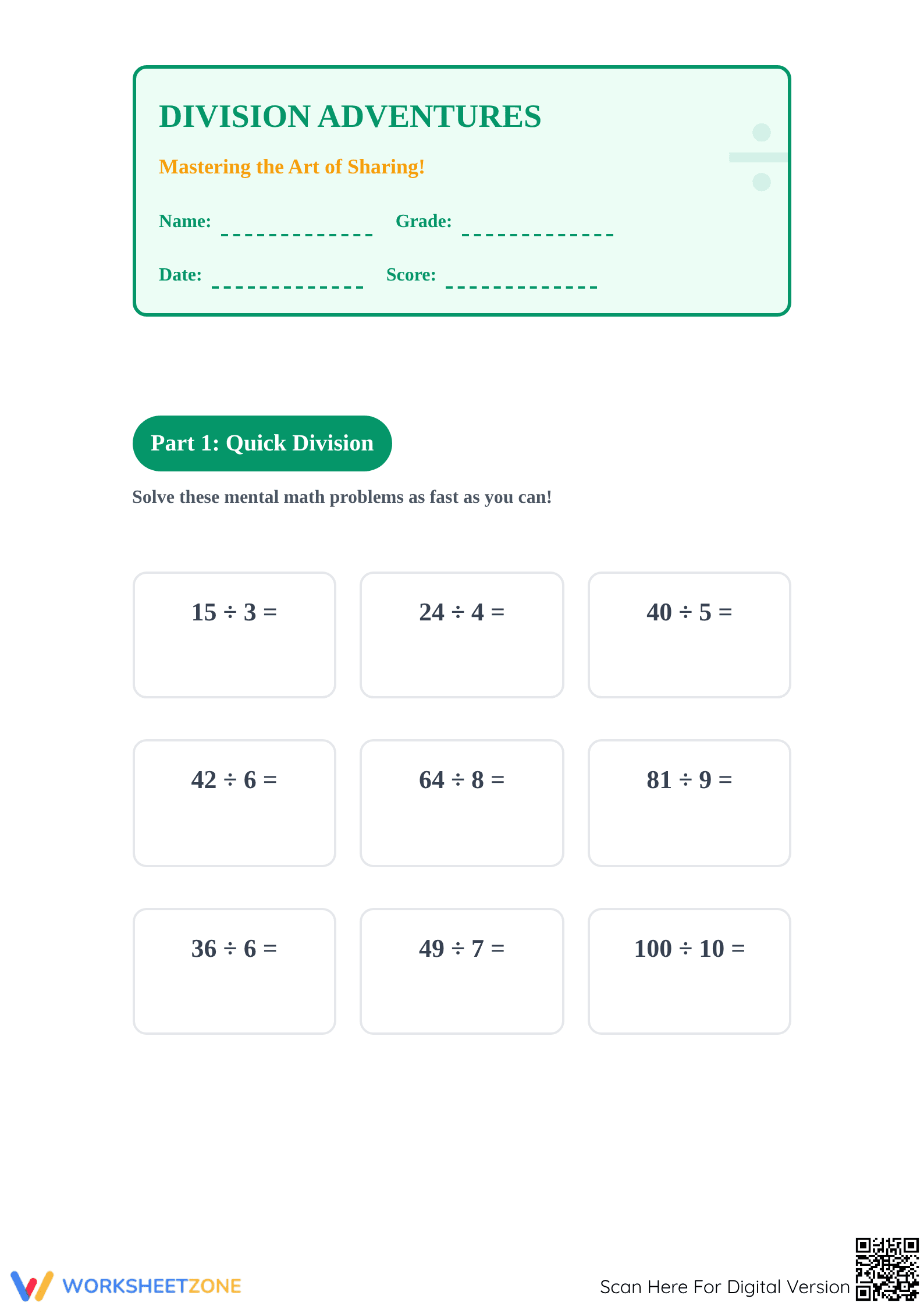
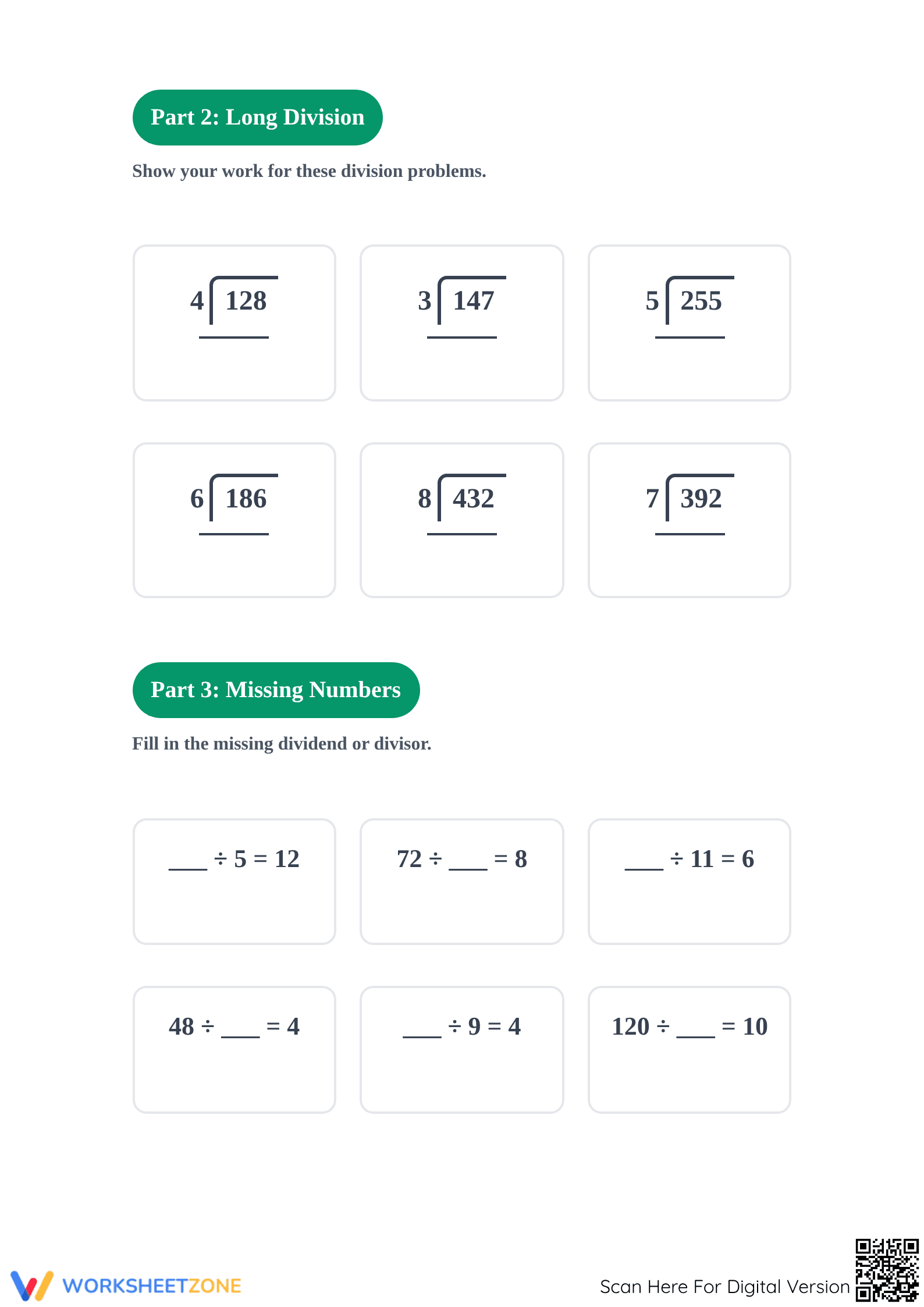
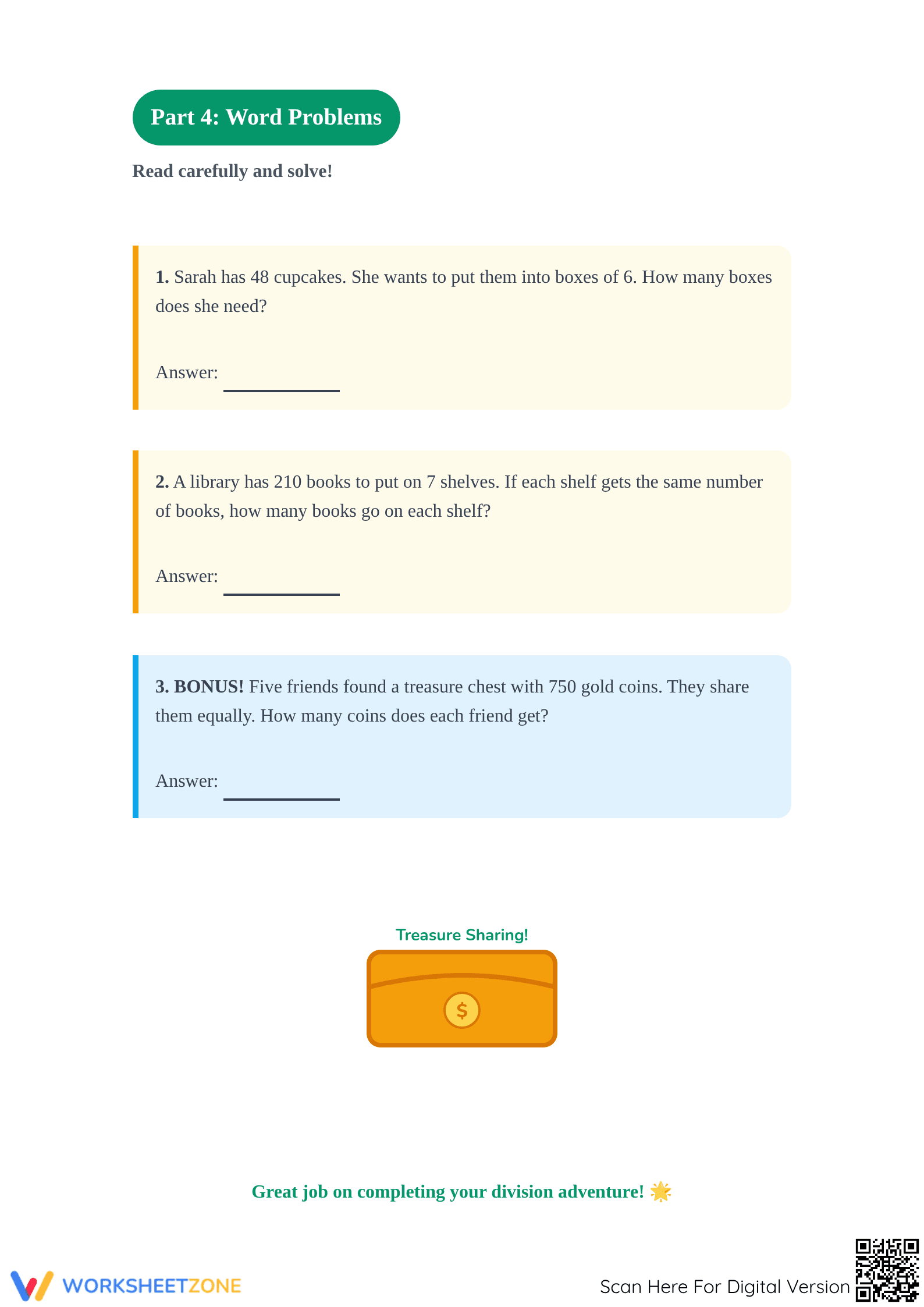
What's Inside: This three-page PDF features a logical instructional flow starting with 9 quick division mental math challenges. It advances to 6 long division problems with space for showing work, followed by 6 missing number equations to build algebraic thinking. The adventure concludes with 3 application-based word problems, including a high-interest bonus challenge involving sharing treasure coins.
Zero-Prep Workflow
- Print: Generate the 3-page packet in under 30 seconds using the standard PDF format.
- Distribute: Hand out to students as a complete unit or individual pages for targeted skill checks.
- Review: Use the included answer key for 1-minute grading or student self-correction sessions.
Total teacher preparation time is less than two minutes, making this an ideal resource for morning work, homework, or emergency substitute folders where clear, self-explanatory instructions are a necessity.
Standards Alignment
This resource is specifically aligned to `4.NBT.B.6`: Find whole-number quotients and remainders with up to four-digit dividends and one-digit divisors, using strategies based on place value and properties of operations. The inclusion of word problems also supports `4.OA.A.3` by asking students to solve multi-step problems using the four operations. Both standard codes can be copied directly into lesson plans, IEP goals, or district curriculum mapping tools.
How to Use It
Deploy this worksheet during the independent practice phase of your division unit. Start with the 'Quick Division' section as a warm-up to gauge mental math readiness before moving to the 'Long Division' workspace. For a formative assessment observation, watch how students handle the 'Missing Numbers' section; students who struggle here often need more support with the inverse relationship between multiplication and division. Expect a completion time of 40 minutes for the full packet.
Who It's For
This resource is designed for Grade 4 students but serves as an excellent challenge for Grade 3 learners or a necessary intervention for Grade 5 students needing algorithm reinforcement. It pairs naturally with a division anchor chart or a short-form instructional video on the long division steps (Divide, Multiply, Subtract, Bring Down).
The CCSS.MATH.CONTENT.4.NBT.B.6 standard requires students to find whole-number quotients and remainders with up to four-digit dividends and one-digit divisors, using strategies based on place value, the properties of operations, and the relationship between multiplication and division. This worksheet supports this cognitive development by moving students through four distinct phases of division mastery. According to Fisher & Frey (2014), the gradual release of responsibility model—moving from mental math 'Quick Division' to complex 'Long Division' and eventually application-based 'Word Problems'—is essential for mathematical fluency. By practicing missing dividend and divisor identification, students build a deeper algebraic understanding of the division operation. This resource ensures that learners do not just memorize procedures but develop a conceptual framework for sharing and grouping. Using this structured practice helps teachers identify specific misconceptions in the division algorithm before moving to multi-digit divisors, ensuring a solid foundation for fifth-grade math standards.


