


























Views
Downloads
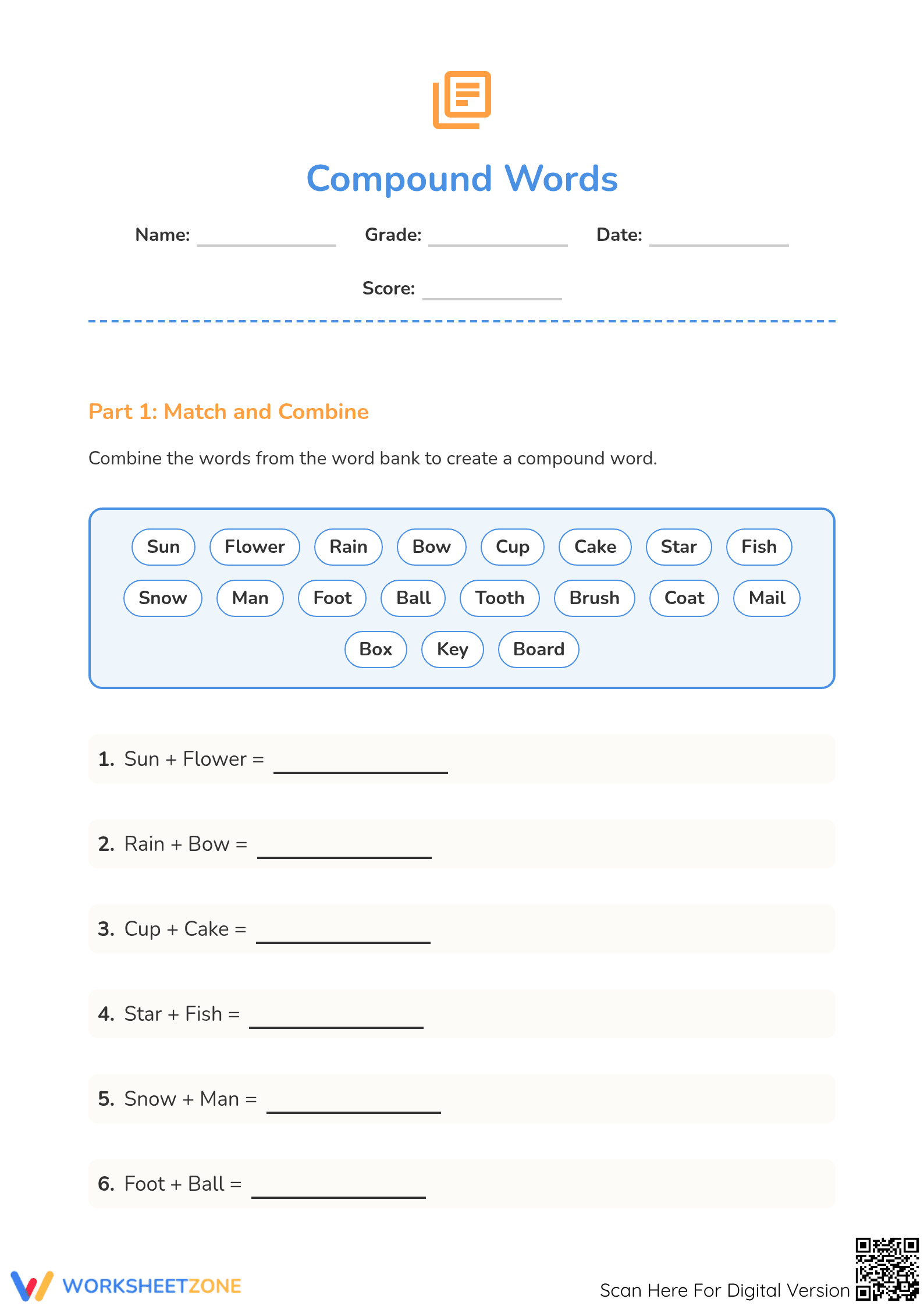



Compound Words Worksheet | Grade 2 Essential Ready
Paste this activity's link or code into your existing LMS (Google Classroom, Canvas, Teams, Schoology, Moodle, etc.).
Students can open and work on the activity right away, with no student login required.
You'll still be able to track student progress and results from your teacher account.
Mastering compound words is a pivotal step in developing literacy and expanding vocabulary. This 3-page worksheet helps students understand how two independent words merge to create a single new term with a distinct meaning. By practicing this "word addition," students build the decoding skills necessary for reading success and more precise written expression.
At a Glance
- Grade: 2 · Subject: ELA
- Standard:
CCSS.ELA-LITERACY.L.2.4.D— Use knowledge of individual word meanings to predict the meaning of compound words- Skill Focus: Compound Words
- Format: 3 pages · 24 problems · Answer key included · PDF
- Best For: Independent literacy centers and homework practice
- Time: 20–30 minutes
What's Inside
This comprehensive resource features 24 targeted tasks spread across three pages. Part 1 includes a 16-word bank where students match and combine terms like "sun" and "flower" to form 10 common compound words. Parts 2 and 3 move into "Create Your Own," requiring students to synthesize additional word pairs such as "note" + "book" and "fire" + "fly" into coherent terms. A full answer key ensures rapid feedback.
Zero-Prep Workflow
The instructional design prioritizes teacher efficiency through a 2-minute workflow. First, print the three-page PDF; the clear headings and word bank ensure no additional explanation is needed. Second, distribute the sheets for a silent literacy block or as a homework assignment. Finally, use the included answer key for instant grading or student self-correction, making this an ideal sub-plan or morning-work activity.
Standards Alignment
Aligned to CCSS.ELA-LITERACY.L.2.4.D, this worksheet requires students to "Use knowledge of the meaning of individual words to predict the meaning of compound words." By identifying the semantic contribution of each word part, learners improve their ability to tackle complex vocabulary. Both standard codes can be copied directly into lesson plans, IEP goals, or district curriculum mapping tools to demonstrate rigorous adherence to state frameworks.
How to Use It
Implement this resource as a bridge between direct instruction and independent mastery. During the "We Do" phase of a lesson, work through the first three problems of Part 1 together to model the combining process. For formative assessment, circle the room to observe if students can identify the root words without referring to the word bank. The 25-minute completion time makes it perfect for a standard literacy rotation.
Who It's For
This practice set is optimized for Grade 2 students but serves as an excellent enrichment tool for Grade 1 or a remediation resource for Grade 3. The inclusion of a word bank supports English Language Learners by providing visual and textual cues for word formation. It pairs effectively with a classroom "Compound Word Wall" or a weekly spelling list focused on multisyllabic terms.
Research from Fisher & Frey (2014) highlights that structural analysis is a foundational strategy for vocabulary acquisition in early childhood education. By explicitly teaching students to break down compound words into recognizable morphemes, educators provide them with the tools to decode unfamiliar texts with greater confidence. This worksheet operationalizes this research by providing 24 opportunities for students to apply word-level logic to new combinations. Aligned with CCSS.ELA-LITERACY.L.2.4.D, the tasks encourage students to move beyond rote memorization toward a conceptual understanding of word formation. Evidence from NAEP studies suggests that students who master these morphological strategies early exhibit significantly higher reading comprehension scores in later grades. This resource provides a structured, high-repetition environment that facilitates this mastery without requiring extensive teacher preparation. It offers a reliable, evidence-based solution for building the morphological awareness necessary for long-term literacy growth and academic success across all subject areas.


