


























Views
Downloads
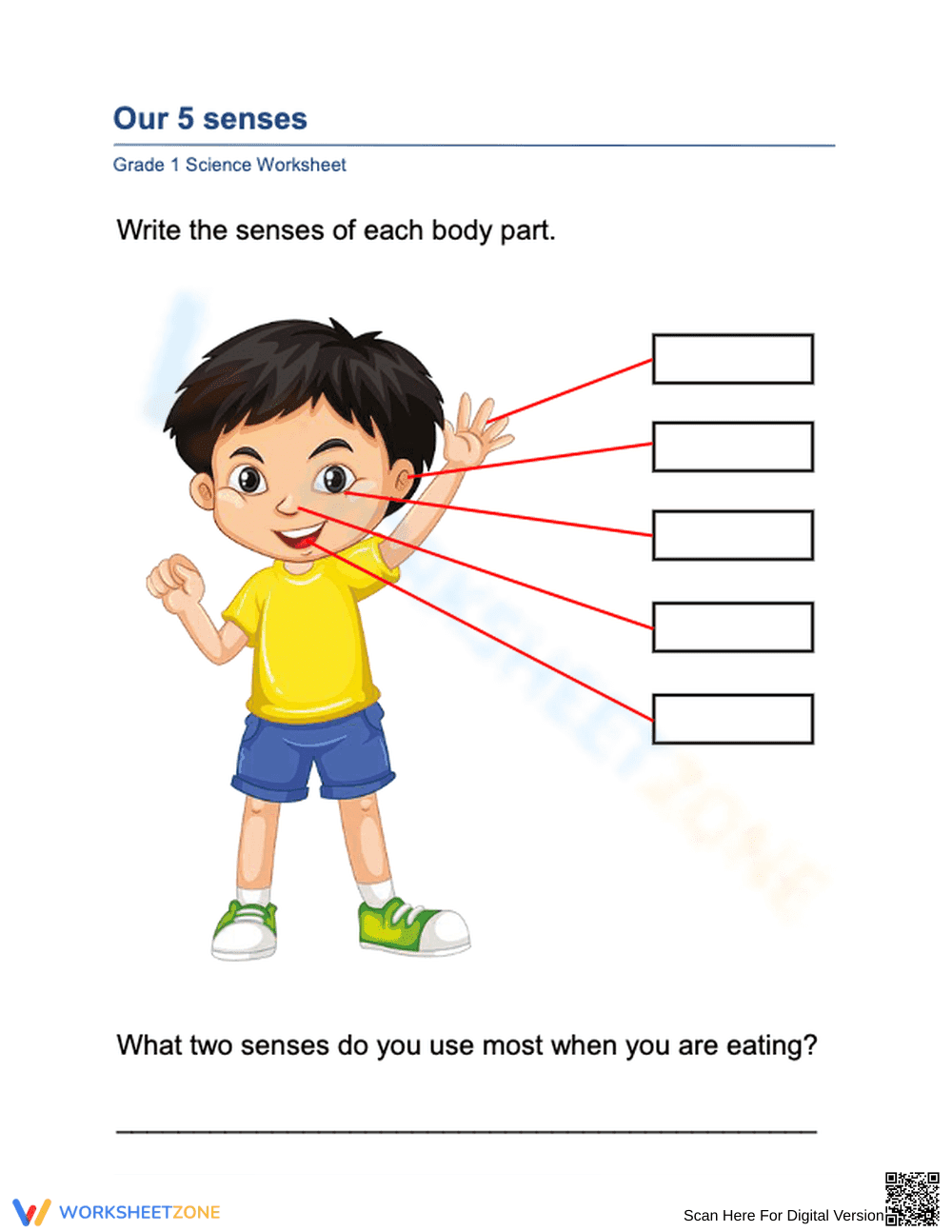

5 Senses Worksheet | Grade 1 Science Printable
Paste this activity's link or code into your existing LMS (Google Classroom, Canvas, Teams, Schoology, Moodle, etc.).
Students can open and work on the activity right away, with no student login required.
You'll still be able to track student progress and results from your teacher account.
This Grade 1 science worksheet helps students master the five senses by connecting physical body parts to their sensory functions. Students identify how eyes, ears, noses, tongues, and hands interact with the world. By completing these visual labeling tasks, learners build a foundational understanding of human biology and observational science through clear, age-appropriate diagrams.
At a Glance
- Grade: 1 · Subject: Science
- Standard:
1-LS1-1— Identify how external body parts help humans sense and interact with their environment- Skill Focus: Five Senses Identification
- Format: 1 page · 6 problems · Answer key included · PDF
- Best For: Introduction to human body systems
- Time: 10–15 minutes
What's Inside: This single-page PDF features a clear, student-friendly illustration of a child with guided pointers to specific sensory organs. It includes 5 labeling boxes for the primary senses and 1 critical thinking question regarding sensory integration during daily activities like eating. A comprehensive answer key is provided on the second page for immediate feedback and easy grading.
The workflow for this resource is designed for maximum efficiency. First, print the single-page worksheet in under 30 seconds. Next, distribute to students for independent or guided practice during your science block for approximately 10 minutes. Finally, use the included answer key to review responses as a whole group or for quick grading in about 1 minute. This makes it an ideal choice for emergency sub plans or morning work.
Standards Alignment: This resource aligns with `1-LS1-1`, focusing on how humans use their external parts to meet their needs and process information. By identifying the specific functions of eyes, ears, and other organs, students demonstrate an understanding of biological structures. Both standard codes can be copied directly into lesson plans, IEP goals, or district curriculum mapping tools.
How to Use It: Use this worksheet as a formative assessment after a hands-on "mystery bag" sensory activity to check for individual understanding. Teachers should observe if students can distinguish between the organ (eye) and the sense (sight). The expected completion time is 10 to 15 minutes, making it perfect for a quick science exit ticket or a quiet transition activity.
Who It's For: This worksheet is designed for first-grade students beginning their study of life science. It is also suitable for Kindergarten enrichment or Grade 2 review for students needing a refresher on body systems. It pairs naturally with a classroom anchor chart showing the five senses or a read-aloud book about the human body.
According to the RAND AIRS 2024 report, high-quality visual aids in early science education significantly improve the retention of anatomical vocabulary among primary learners. This worksheet addresses the 1-LS1-1 standard by requiring students to map sensory functions to specific external body parts, a fundamental step in developing scientific literacy. By engaging with 6 distinct tasks, students move beyond simple memorization toward an understanding of how biological systems facilitate environmental interaction. Research from Fisher & Frey (2014) emphasizes that clear labeling exercises serve as essential scaffolds for young students as they transition from oral language to technical scientific writing. This resource provides that necessary structure, ensuring that Grade 1 students can accurately communicate their observations. The inclusion of a synthesis question about eating further encourages students to consider how multiple senses work in tandem, supporting higher-order thinking skills within a basic science framework.


