


























Views
Downloads


Essential Open and Closed Shapes Worksheet | Grades 1-4
Paste this activity's link or code into your existing LMS (Google Classroom, Canvas, Teams, Schoology, Moodle, etc.).
Students can open and work on the activity right away, with no student login required.
You'll still be able to track student progress and results from your teacher account.
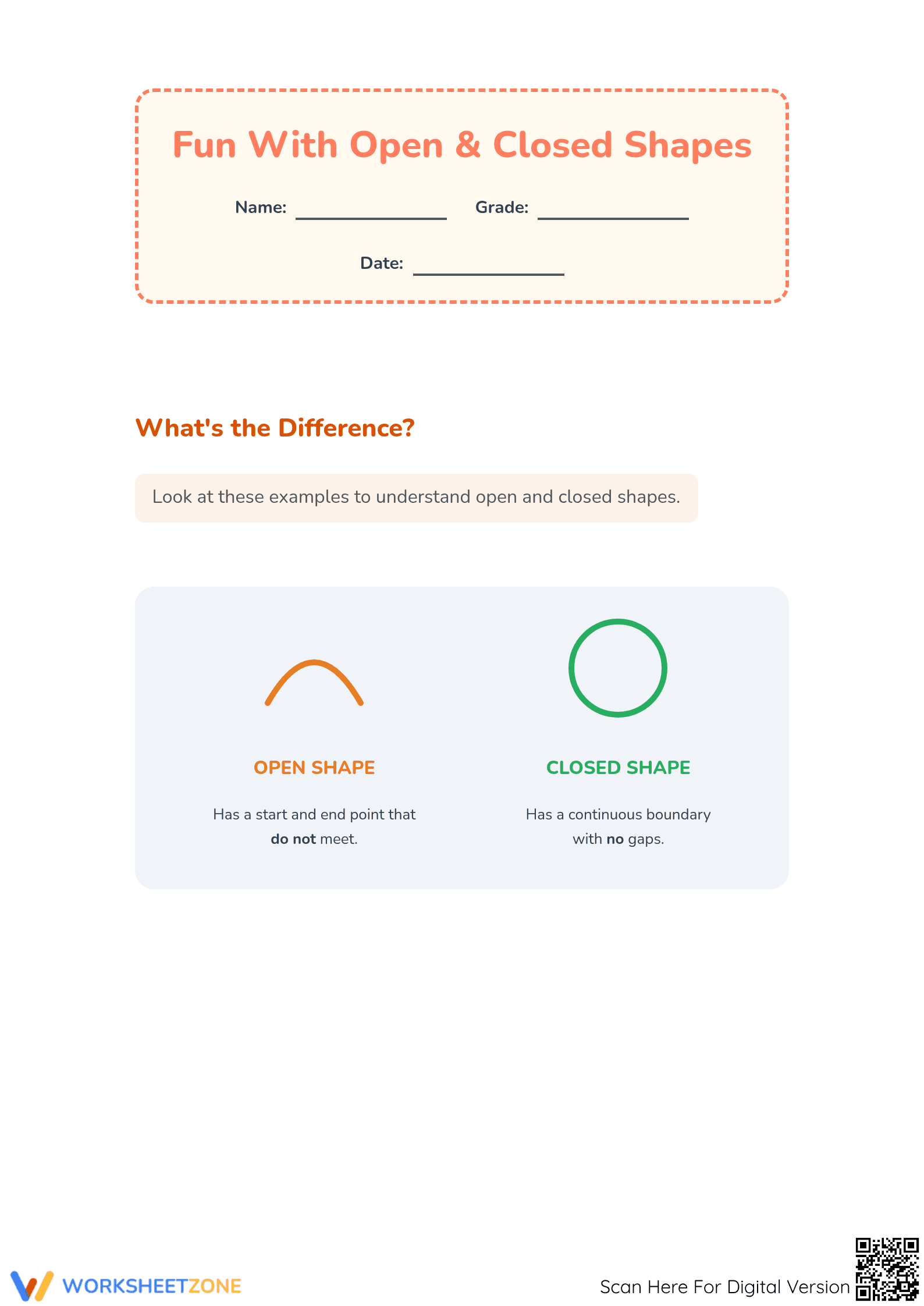
This comprehensive worksheet helps students distinguish between open and closed figures through sorting, drawing, and coloring activities. By mastering this fundamental geometric concept, learners build a strong foundation for understanding polygons and spatial relationships. Students move from simple identification to creative application across four pages of focused geometry practice designed for classroom efficiency.
At a Glance
- Grade: 1–4 · Subject: Math
- Standard:
CCSS.MATH.CONTENT.1.G.A.1— Distinguish defining attributes like closed sides to build and draw shapes- Skill Focus: Geometric attribute identification
- Format: 4 pages · 34 problems · Answer key included · PDF
- Best For: Introduction to geometry and independent practice
- Time: 20–30 minutes
Inside this packet, teachers will find a variety of engagement levels. The first page focuses on visual sorting, while the second encourages creative synthesis through drawing. The third and fourth pages reinforce mastery with coloring and matching tasks. Each page is clearly formatted with plenty of space for young learners to work, and the included answer key ensures that grading or self-correction is immediate and accurate.
Zero-Prep Workflow
- Print: Select the pages you need and print enough copies for your group in under 60 seconds.
- Distribute: Hand out the materials as a warm-up or a standalone lesson; the clear instructions require minimal verbal explanation.
- Review: Use the included answer key to check for understanding in less than one minute per student, or display it for a whole-class check.
This workflow is designed to fit into busy instructional blocks or serve as a high-quality sub plan that keeps students productive with zero teacher setup required.
Standards Alignment
This resource is aligned to `CCSS.MATH.CONTENT.1.G.A.1`: "Distinguish between defining attributes versus non-defining attributes; build and draw shapes to possess defining attributes." By focusing on the "closed" nature of polygons, students learn why a shape like a circle or square is distinct from an open line segment. This standard code can be copied directly into lesson plans, IEP goals, or district curriculum mapping tools.
How to Use It
Use this worksheet as a formative assessment during your geometry unit. It works best after a brief direct instruction session where the terms "open" and "closed" are introduced. During independent work, observe if students can identify the gap in an open shape; this is a key indicator of their spatial reasoning progress. The expected completion time is 25 minutes, making it an ideal choice for centers or morning work.
Who It's For
While primarily designed for first and second graders, the four-page structure provides enough variety to support Grade 3 and 4 students who need a refresher on geometric properties. It pairs perfectly with physical manipulatives like geoboards or pattern blocks, allowing students to translate what they build in 3D onto the 2D plane of the worksheet.
Research from ScienceDirect TpT Analysis (2024) indicates that tactile and visual sorting tasks, such as distinguishing between open and closed shapes, significantly enhance geometric reasoning in early elementary students. By engaging in the dual process of identification and physical drawing, learners internalize the defining attributes of shapes more effectively than through passive observation alone. This worksheet is structured to support these findings by offering multiple modalities of engagement—sorting, coloring, and sketching—which cater to diverse learning styles and promote long-term retention of spatial concepts. The alignment with CCSS.MATH.CONTENT.1.G.A.1 ensures that students are not merely memorizing names but are analyzing the structural properties that define geometric figures. These foundational skills are critical for later mastery of area, perimeter, and polygon classification, providing the scaffolding necessary for advanced mathematical success in subsequent grade levels.


